

Mathematical Methods for Physics - Advanced PDE Techniques
Mathematical Methods for Physics - Advanced PDE Techniques
Price subject to change. Tap below for current.
Couldn't load pickup availability
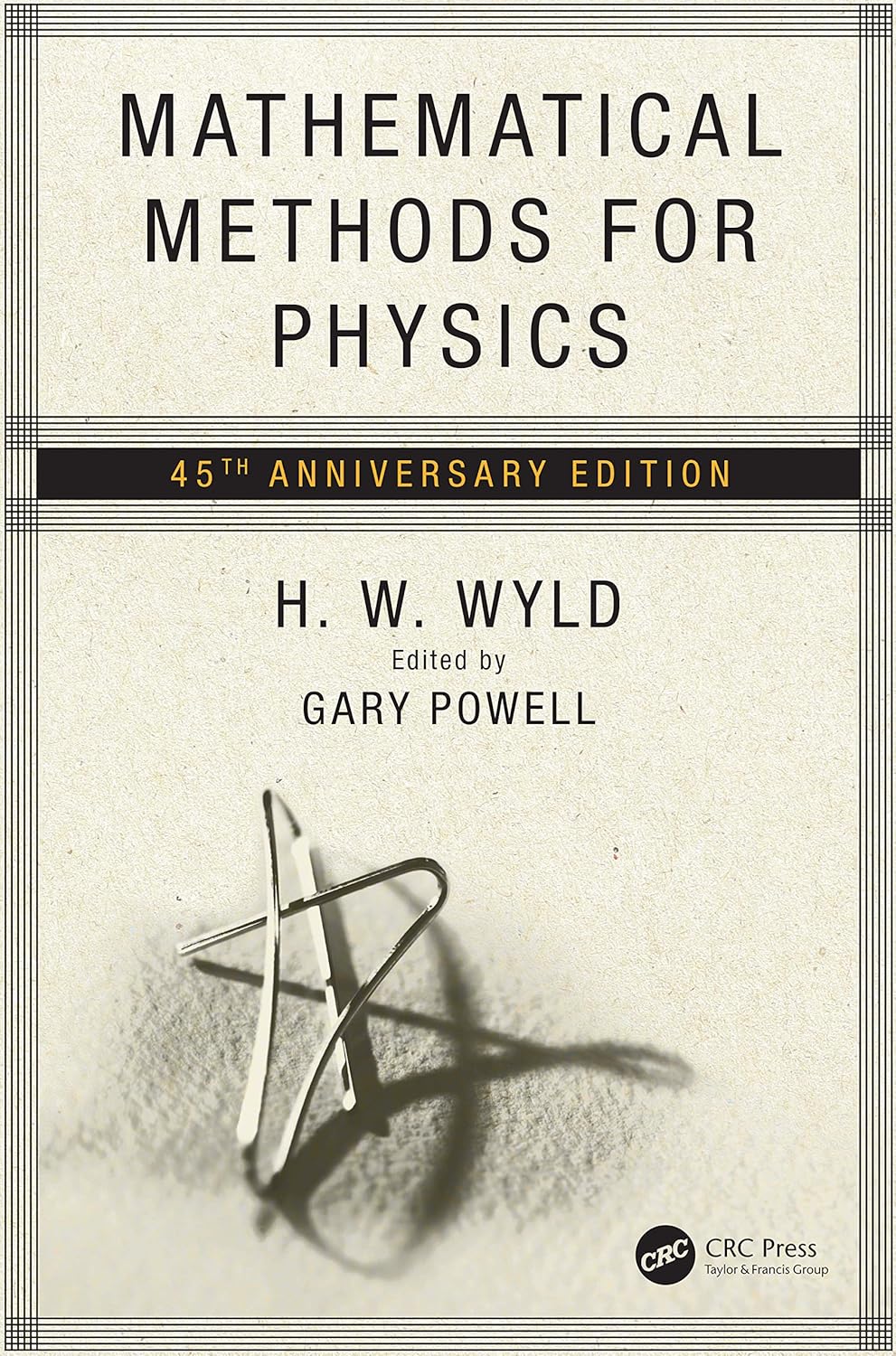
In this review of Mathematical Methods for Physics the bottom line is straightforward: this is a rigorous, example-rich reference for advanced undergraduates and graduate students who need practical methods for solving partial differential equations common in physics. The 45th anniversary edition emphasizes how many physical problems reduce to similar inhomogeneous PDEs and shows the mathematical tools to solve them, making it particularly valuable for readers seeking a deeper, methodical understanding rather than a superficial survey.
Key Features
- Systematic PDE focus: The book demonstrates how many physics problems resolve into similar inhomogeneous partial differential equations, helping readers connect disparate topics to common solution strategies.
- Coordinate-system coverage: Detailed development of solutions in rectilinear, cylindrical, and spherical coordinates gives practical recipes for boundary-value problems encountered in mechanics and electrodynamics.
- Series solution techniques: Clear exposition of series methods and Sturm-Liouville theory helps with constructing complete solution spaces for differential operators.
- Indicial relations and orthogonality: The treatment of indicial relations and orthogonal expansions supports the reader in forming convergent series solutions and justified expansions.
- Classic text with updated edition: The 45th anniversary edition preserves the original advanced approach while reaffirming the text as a long-standing reference for applied mathematical methods.
Who It's For
This book is best for advanced undergraduates, graduate students, and practicing physicists or applied mathematicians who require a working knowledge of methods for solving Laplace, Helmholtz, and related equations across common coordinate systems. It suits readers preparing for research problems in classical mechanics, electrodynamics, and introductory quantum mechanics where boundary conditions and PDE techniques are central.
Those looking for a beginner-friendly primer or a high-level conceptual survey without technical derivations should look elsewhere; the text assumes comfort with calculus and differential equations and rewards readers who want explicit solution methods and worked mathematical structure.
Pros & Cons
Pros
- Comprehensive focus on PDE techniques that recur across physics subfields, making cross-topic transfer of methods straightforward.
- Explicit treatment of rectilinear, cylindrical, and spherical coordinates so readers can apply solutions to real boundary-value problems.
- Solid coverage of Sturm-Liouville theory and series expansions that supports rigorous formation of solution bases.
Cons
- The text is advanced and assumes prior familiarity with differential equations, so it is not ideal for complete beginners.
Specifications
| Title | Mathematical Methods for Physics |
| Edition | 45th anniversary edition |
| Authors | H.W. Wyld, Gary Powell |
| Core topics | Laplace and Helmholtz equations; Sturm-Liouville theory |
| Coordinate systems | Rectilinear, cylindrical, spherical |
| Approach | Inhomogeneous PDEs and series solution techniques |
Our Verdict
Mathematical Methods for Physics is a strong, method-driven reference for students and researchers who need reliable techniques for boundary-value problems and PDEs across common coordinate systems. Its emphasis on series solutions and Sturm-Liouville structure makes it good value for anyone tackling applied problems in mechanics, electrodynamics, or introductory quantum theory.
Frequently Asked Questions
Does this book cover spherical harmonics?
Yes; the edition develops solutions in spherical coordinates and the orthogonal expansions relevant to spherical harmonics.
Is it suitable for self-study?
It can be used for self-study by motivated readers with prior calculus and differential equations background, though it is not an elementary introduction.
Which equations are emphasized?
The text emphasizes the Laplace and Helmholtz equations and techniques for solving inhomogeneous PDEs with appropriate boundary conditions.
Editor's Take
Mathematical Methods for Physics is a method-driven reference for advanced students and researchers needing reliable techniques for Laplace, Helmholtz, and related PDEs across rectilinear, cylindrical, and spherical coordinates.

Recently viewed
Recently viewed products will appear here as customers browse the store.