

Mathematical Optimization of Water Networks - Practical Modeling
Mathematical Optimization of Water Networks - Practical Modeling
Price subject to change. Tap below for current.
Couldn't load pickup availability
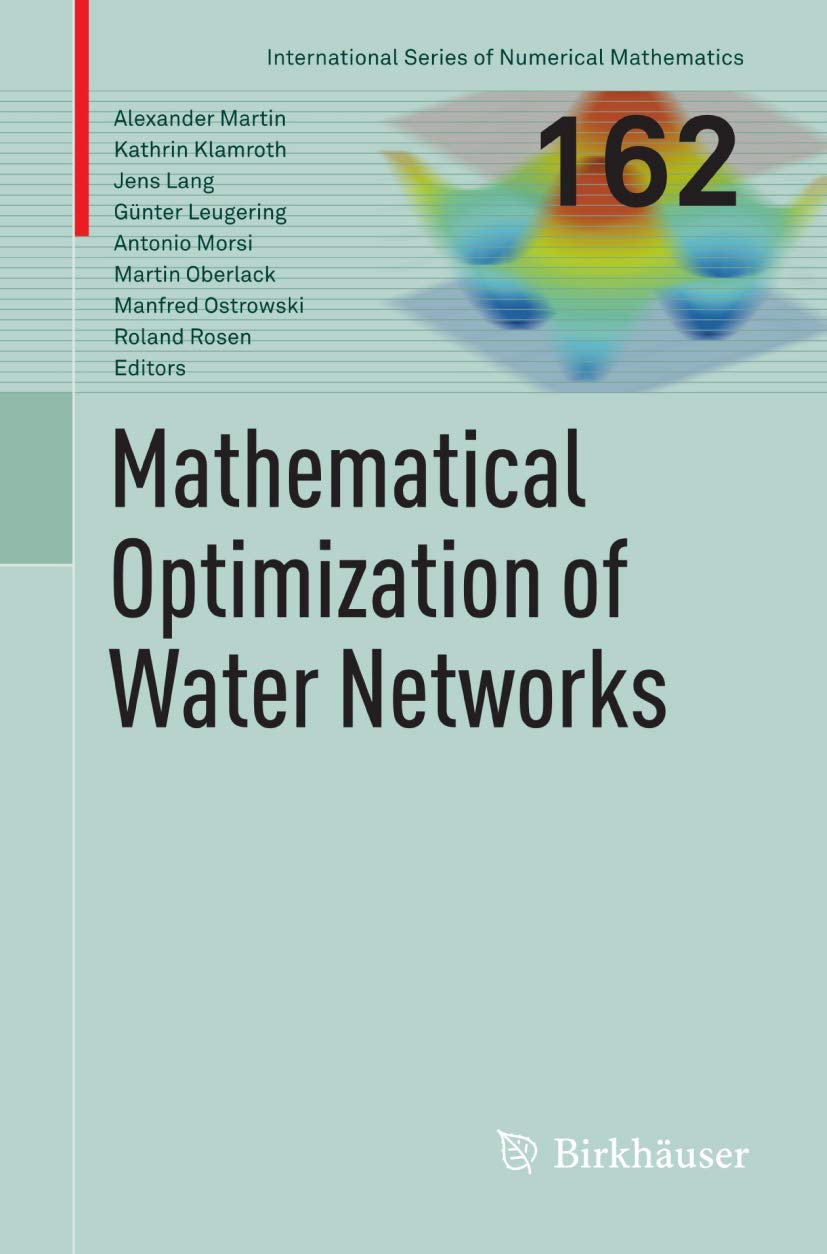
In this review of Mathematical Optimization of Water Networks readers will find a focused, technical examination of models and methods for optimizing water supply, drainage and mixed water channel systems. The book is best for engineers, researchers and advanced students who need a rigorous treatment of network topology, operational decisions and multi-criteria optimization; the single biggest reason to buy is its concentrated presentation of complex model systems that link consumer behavior and climate effects to optimization techniques. This review summarizes who benefits and where the book fits in a professional library.
Key Features
- Coverage of dynamic networks: Explains how drinking water consumption and rainfall interact to shape the dynamics of supply and drainage systems, helping practitioners model realistic time-varying behavior.
- Scale-aware modeling: Discusses networks that may contain hundreds or thousands of elements, offering guidance for moving from small examples to large-system formulations.
- Decision types: Describes both continuous and discrete decision variables so readers can frame optimization problems that include sizing, routing and operational choices.
- Multi-criteria focus: Treats economic, social and ecological criteria explicitly, which supports balanced decision making when objectives compete.
- Model development: Presents approaches for building complex model systems and using them to derive optimal water management decisions, useful for applied research and implementation planning.
Who It's For
The book is aimed at civil and environmental engineers, operations researchers and graduate students who need a rigorous foundation in network optimization applied to water systems. It suits readers who already understand basic optimization and numerical methods and who want detailed examples of how to scale models to real-world network sizes.
Practitioners seeking quick how-to field guidance or elementary introductions to hydraulics should look elsewhere, since the book prioritizes mathematical modeling and numerical methods over step-by-step construction of physical systems or introductory tutorials.
Pros & Cons
Pros
- Comprehensive treatment of dynamic interactions between consumption and climate makes it valuable for realistic system planning.
- Addresses both continuous and discrete decisions, enabling flexible problem formulations for topology and operation.
- Explicit multi-criteria discussion supports trade-off analysis across economic, social and ecological goals.
Cons
- Not a beginner textbook; readers without prior optimization background may find the material dense.
Specifications
| Title | Mathematical Optimization of Water Networks |
| Series | International Series of Numerical Mathematics, 162 |
| Authors / Editors | Alexander Martin; Kathrin Klamroth; Jens Lang; Gunter Leugering; Antonio Morsi; Martin Oberlack; Manfred Ostrowski; Roland Rosen |
| Subject focus | Optimization of water supply, drainage and mixed water channel systems |
| Problem scale | Networks of hundreds to thousands of system elements |
| Decision types | Continuous and discrete variables |
| Optimization criteria | Economic, social and ecological objectives |
Our Verdict
Mathematical Optimization of Water Networks is a solid, technically oriented reference for advanced students and professionals who need to model and optimize large, dynamic water networks. Its emphasis on mixed decision types and multi-criteria objectives makes it good value for anyone implementing or researching optimal network topology and operation, though readers should expect a mathematically demanding presentation.
Frequently Asked Questions
Does this book address both supply and drainage systems?
Yes, it covers water supply, drainage and mixed water channel systems and their dynamic interactions.
Is prior optimization knowledge required?
Yes, the book assumes familiarity with optimization concepts and numerical methods and is not an introductory text.
Are ecological and social objectives included?
Yes, the text explicitly treats economic, social and ecological criteria and their trade-offs in optimization.
Editor's Take
A rigorous, technically oriented reference for advanced students and professionals, offering models and methods to optimize large, dynamic water networks with multi-criteria objectives.

Recently viewed
Recently viewed products will appear here as customers browse the store.