

MikroTik R11e-LTE Internal 150Mbit/s Networking Card - LTE MiniPCIe
MikroTik R11e-LTE Internal 150Mbit/s Networking Card - LTE MiniPCIe
Price subject to change. Tap below for current.
Couldn't load pickup availability
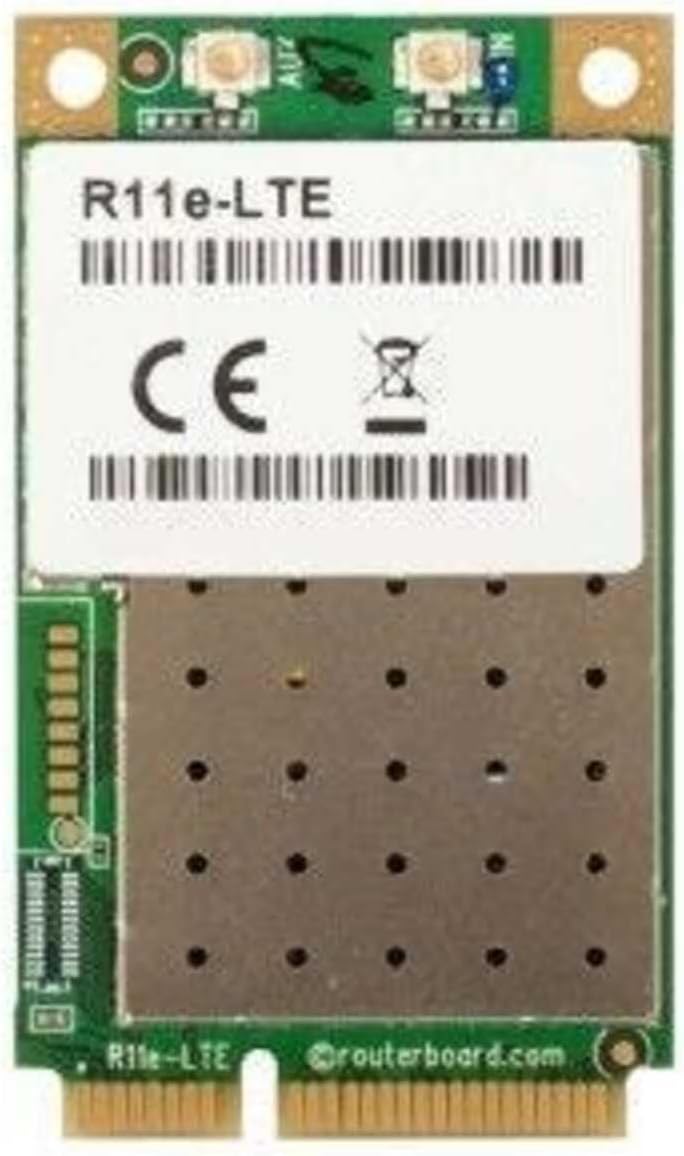
Our review of the MikroTik R11e-LTE finds it is a focused internal networking card for users who need reliable cellular connectivity inside compatible RouterOS devices. The single biggest reason to buy is its broad LTE band support combined with Category 4 speeds, which makes it a practical upgrade for sites that need up to 150Mbit/s downlink over 4G/LTE without adding an external modem. It is compact, mounts in a miniPCIe slot and offers two U.FL antenna connections for routing appliances that already run RouterOS.
Key Features
- Band support: Includes support for bands 1/2/3/5/7/8/20/38/40 so it works on a wide range of regional LTE networks.
- Category 4 LTE: Delivers up to 150Mbit/s downlink and 50Mbit/s uplink for high throughput mobile broadband use.
- 3G fallback: Offers 3G Category R7 speeds for areas where LTE is unavailable, keeping connections live at lower rates.
- MiniPCIe format: Installs directly into devices with a miniPCIe slot, simplifying deployment in compatible RouterOS hardware.
- Dual U.FL connectors: Two U.FL antenna ports allow connection to external antennas for improved reception in weak signal locations.
Who It's For
This card is aimed at network integrators, small office routers and advanced home users who run MikroTik RouterOS hardware with a miniPCIe slot and need built-in cellular WAN without an external USB modem. It is especially useful in remote or temporary deployments where wired broadband is not available or as a failover link for business continuity.
Users who should look elsewhere include anyone without a RouterOS device that accepts miniPCIe cards or those who require the latest LTE categories or 5G speeds; the R11e-LTE is LTE Category 4 only and will not meet needs for higher carrier aggregation or 5G performance.
Pros & Cons
Pros
- Compact internal form factor that integrates cleanly into many RouterOS products with miniPCIe slots.
- Good band coverage that supports multiple regional LTE deployments for flexible use.
- Physical U.FL antenna ports let installers attach high-gain antennas to improve reception.
Cons
- Limited to LTE Category 4 speeds, so it will not deliver newer higher-speed cellular standards like LTE Advanced or 5G.
Specifications
| Model | R11e-LTE |
| Form factor | miniPCIe |
| LTE category | Category 4 (150Mbit/s down, 50Mbit/s up) |
| 3G support | 3G Category R7 (21Mbit/s down, 5.76Mbit/s up) |
| Supported bands | 1,2,3,5,7,8,20,38,40 |
| Antenna connectors | 2 x U.FL |
Our Verdict
The R11e-LTE is a sensible, cost effective internal LTE card for anyone using MikroTik RouterOS devices with a miniPCIe slot who needs dependable cellular WAN at up to 150Mbit/s. It is good value when integrated connectivity and antenna flexibility matter, but buyers seeking cutting edge cellular speeds should choose a newer module or external solution.
Frequently Asked Questions
Will this card work in any MikroTik device?
The card fits MikroTik products that have a miniPCIe slot and run RouterOS, but it is not compatible with models that lack a miniPCIe slot such as RB800.
What speeds can I expect?
It supports LTE Category 4 with up to 150Mbit/s downlink and 50Mbit/s uplink; in areas without LTE it will fall back to 3G at lower speeds.
Do I need external antennas?
External antennas are optional but recommended in weak signal areas since the card uses two U.FL connectors to attach external antennas for better reception.
Editor's Take
The R11e-LTE is a compact internal LTE miniPCIe card for MikroTik RouterOS devices that delivers up to 150Mbit/s downlink and broad band support, making it a good value for integrated cellular WAN where 5G is not required.

Recently viewed
Recently viewed products will appear here as customers browse the store.