

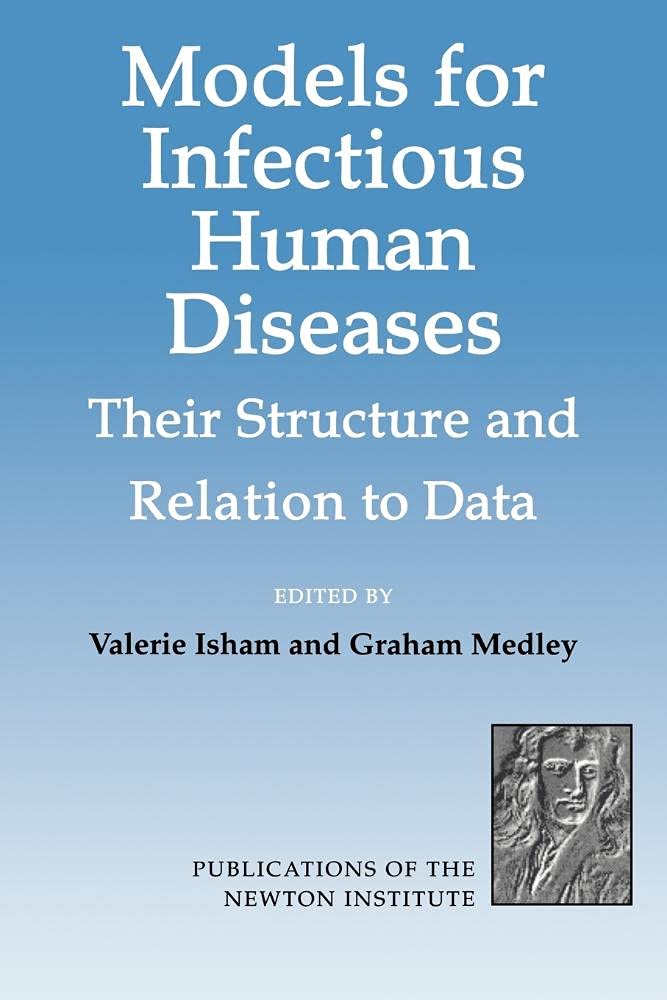
Models for Infectious Human Diseases: Their Structure and Relation
Models for Infectious Human Diseases: Their Structure and Relation
Price subject to change. Tap below for current.
Couldn't load pickup availability
In this review of Models for Infectious Human Diseases: Their Structure and Relation to Data, the reviewer finds a rigorous collection of expert papers that will most benefit researchers and graduate students seeking quantitative approaches to disease dynamics. The book's single biggest reason to buy is its mix of mathematical modeling and applied case studies, which together explain how theoretical structure links to real-world data on diseases such as measles, AIDS and tropical parasitic infections. It reads as a workshop of specialists offering methods and examples for designing control strategies.
Key Features
- Interdisciplinary perspectives: Chapters combine mathematical theory with biological and medical context so readers see how models address practical epidemiological questions.
- Range of diseases: Coverage includes viral diseases and tropical parasitic infections, allowing comparison of model structure across different pathogens.
- Focus on control strategies: Several contributions explicitly discuss vaccination and treatment consequences, helping policymakers and modelers think about intervention design.
- Long development time diseases: Dedicated sections examine transmissible diseases with long incubation or development times, offering tailored modeling approaches.
- Author expertise: Papers are written by specialists in mathematics, biology and social sciences, giving depth and varied methodological perspectives.
Who It's For
This volume is best for academic readers: epidemiologists, applied mathematicians, and graduate students who want concrete examples of how models are fitted to and interpreted in relation to data. The book is particularly useful for those working on infectious disease control, vaccination policy or long-term infection dynamics.
Readers looking for a beginner textbook or a light popular science overview should look elsewhere; the material assumes familiarity with quantitative methods and interest in specialist research papers rather than introductory exposition.
Pros & Cons
Pros
- Offers a broad set of modeling approaches connecting structure to data, useful for applied research.
- Includes disease-specific case studies that make theoretical ideas tangible.
- Contributors from multiple disciplines increase the work's practical relevance.
Cons
- Not an introductory text; readers without mathematical background may find some chapters dense.
Specifications
| Title | Models for Infectious Human Diseases: Their Structure and Relation to Data |
| Series | Publications of the Newton Institute, Series Number 6 |
| Editors/Authors | Valerie Isham, Graham Medley |
| Subject focus | Mathematical models of infectious diseases, vaccination and control |
| Diseases covered | Viral diseases (measles, AIDS) and tropical parasitic infections |
| Approach | Quantitative methods linking model structure to data |
Our Verdict
For researchers and advanced students seeking a compendium of modeling methods tied to epidemiological data, this volume is a valuable reference that combines disciplinary expertise with practical examples on vaccination and long-term infection dynamics. It is good value for those who need rigorous, research-level treatments rather than introductory learning.
Frequently Asked Questions
Does this book include case studies on real diseases?
Yes. The volume discusses diseases such as measles, AIDS and various tropical parasitic infections with applied examples.
Is prior mathematical knowledge required?
Yes. The chapters assume familiarity with quantitative and mathematical modeling techniques and are aimed at specialists and advanced students.
Does it cover vaccination strategies?
Yes. Several sections focus on vaccination and the consequences of treatment as part of control strategy discussions.
Editor's Take
This research-level volume is recommended for researchers and advanced students who need rigorous, discipline-spanning treatments of infectious disease models linked to data; it excels at applied case studies but is not for beginners.

Recently viewed
Recently viewed products will appear here as customers browse the store.