

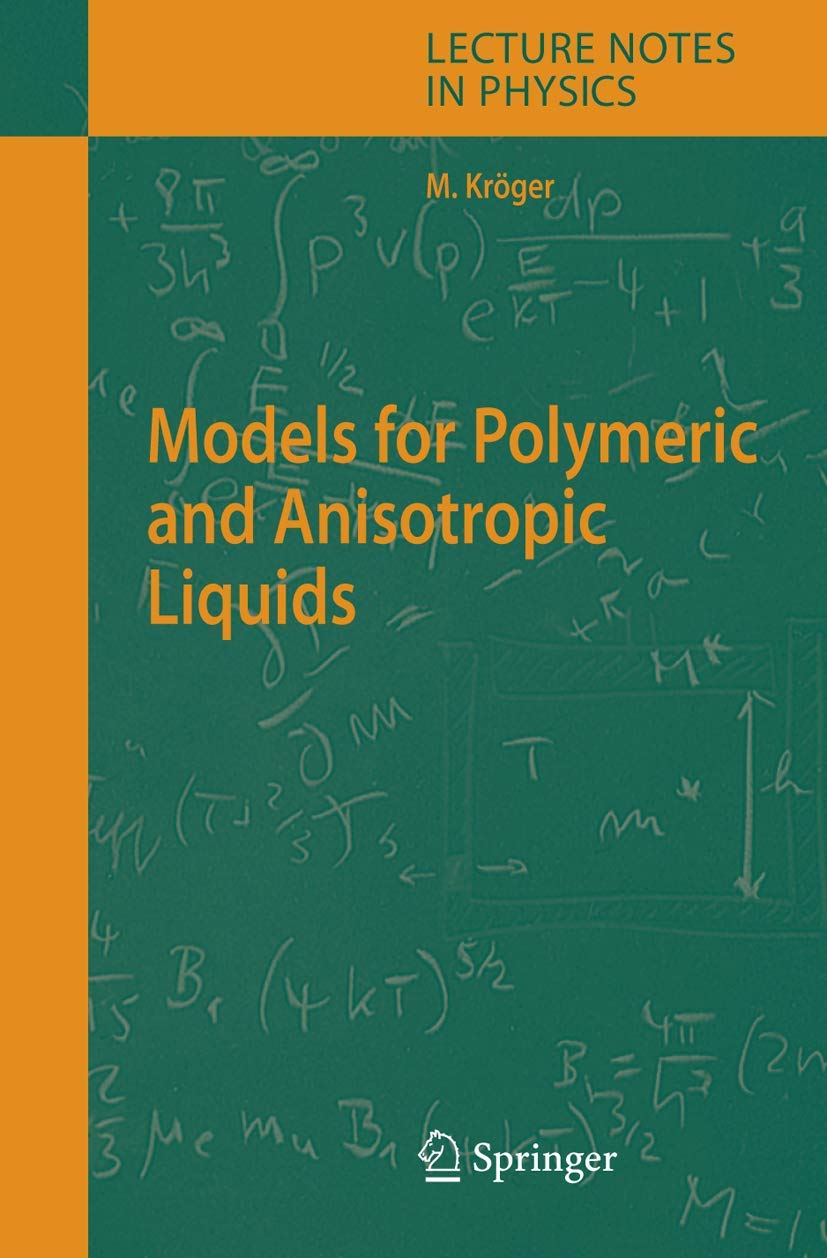
Models for Polymeric and Anisotropic Liquids - Kinetic Theory
Models for Polymeric and Anisotropic Liquids - Kinetic Theory
Price subject to change. Tap below for current.
Couldn't load pickup availability
In this review of Models for Polymeric and Anisotropic Liquids the reviewer finds a focused, technical introduction best suited to researchers and advanced students who need a compact presentation of kinetic theory and simulation methods for polymeric fluids. The single biggest reason to buy is its clear emphasis on minimal, physically meaningful models - choosing architecture, connectivity, semiflexibility, stretchability, excluded volume and hydrodynamic interaction - which helps bridge theoretical concepts and practical simulation units. This is a methodical, scholarly review aimed at readers who want a principled foundation rather than a broad survey.
Key Features
- Minimal model philosophy: Explains why models should be as simple as possible while retaining essential descriptors so readers can focus on transferable physical insight.
- Kinetic theory focus: Provides the theoretical background needed to understand the time evolution of polymeric liquid systems under external fields.
- Simulation methods: Introduces computer simulation techniques that let readers implement and test the described models for specific materials.
- Universal fluid approach: Shows how results are expressed in reference units so predictions can be adapted to different materials.
- Model descriptors explained: Covers architecture, connectivity, semiflexibility, stretchability, excluded volume and hydrodynamic interaction in a coherent framework.
Who It's For
The book is aimed at graduate students, researchers in polymer physics, and computational scientists who require a concise, rigorous account of model construction and kinetic theory for polymeric and anisotropic liquids. Those working on mesoscale simulation or needing guidance on which minimal descriptors to include in a model will find the text particularly useful.
It is less suitable for readers seeking an introductory undergraduate text, a comprehensive handbook of experimental techniques, or a broad survey of polymer chemistry; those audiences should look for more pedagogical or application-focused volumes.
Pros & Cons
Pros
- Conveys a clear methodological stance that helps readers select a minimum set of descriptors for meaningful models.
- Covers both kinetic theory and computer simulation methods, enabling interpretation of numerical results.
- Uses a universal reference-unit approach so theoretical results can be adapted to real materials.
Cons
- Dense, technical presentation may be challenging for newcomers without prior background in statistical mechanics.
Specifications
| Title | Models for Polymeric and Anisotropic Liquids (Lecture Notes in Physics, 675) |
| Author | Martin Kroger |
| Subject focus | Kinetic theory and computer simulation methods for polymeric liquids |
| Model descriptors covered | Architecture, connectivity, semiflexibility, stretchability, excluded volume, hydrodynamic interaction |
| Approach | Minimal, universal fluid models with reference units for material adaptation |
| Intended audience | Graduate students and researchers in polymer physics and computational materials |
Our Verdict
Models for Polymeric and Anisotropic Liquids is a focused, technically rigorous resource that rewards readers with prior background in statistical mechanics and simulation. It is good value for researchers and advanced students who need a principled guide to constructing and interpreting minimal models and applying kinetic theory to polymeric fluids; its concise presentation keeps the emphasis on transferable modeling choices rather than exhaustive coverage.
Frequently Asked Questions
Does this book teach simulation techniques?
Yes. It introduces computer simulation methods alongside kinetic theory so readers can implement and interpret model results.
Is this suitable for beginners?
The text is dense and assumes prior knowledge of statistical mechanics, so it is better suited to advanced students and researchers than complete beginners.
What types of polymer models are discussed?
The book covers models defined by architecture, connectivity, semiflexibility, stretchability, excluded volume and hydrodynamic interaction, with emphasis on minimal, universal descriptors.
Editor's Take
A focused, technically rigorous resource for advanced students and researchers, offering a principled guide to constructing and interpreting minimal models and applying kinetic theory to polymeric fluids.

Recently viewed
Recently viewed products will appear here as customers browse the store.