

Modulated Waves: Theory and Applications - Advanced Wave Theory
Modulated Waves: Theory and Applications - Advanced Wave Theory
Price subject to change. Tap below for current.
Couldn't load pickup availability
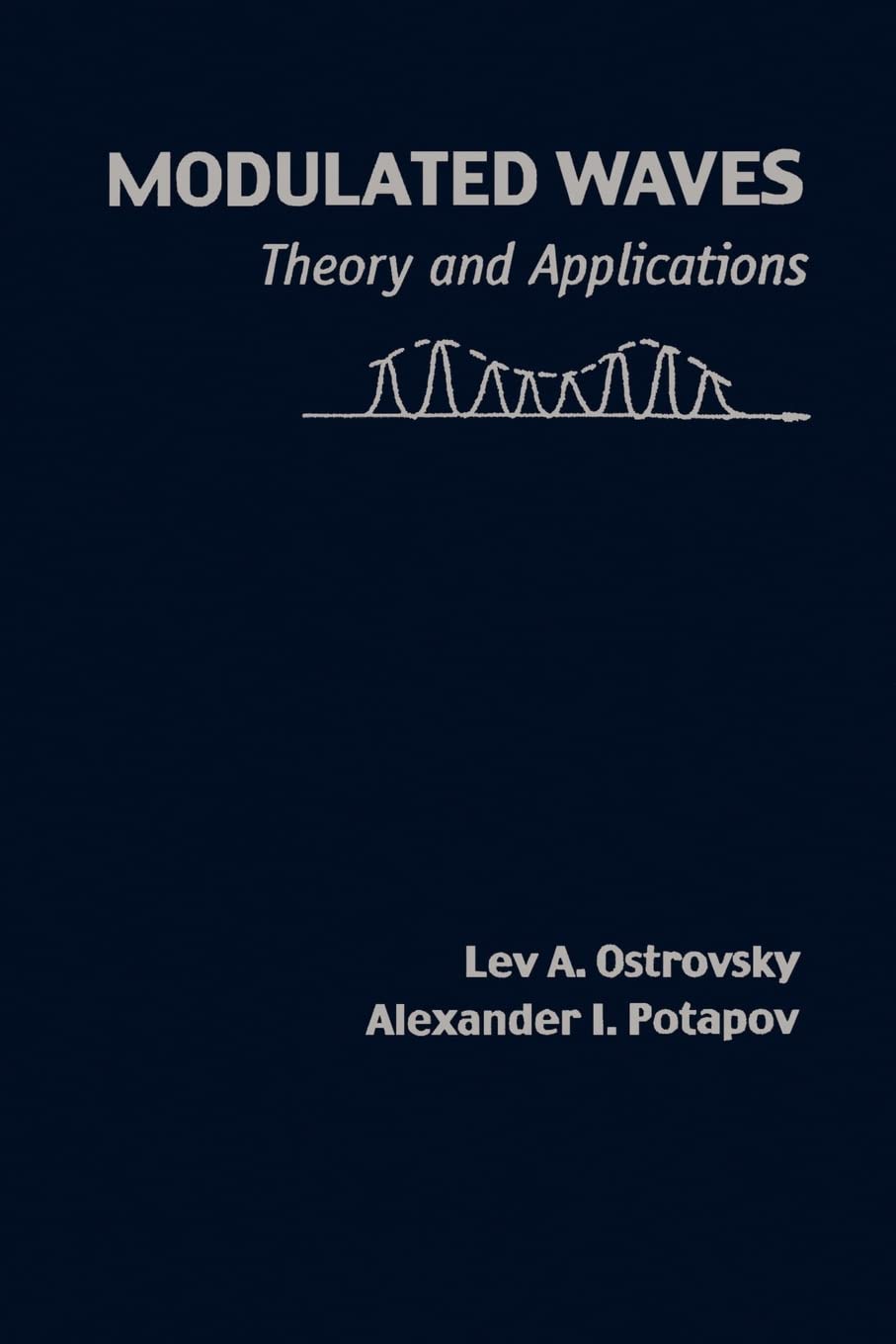
In this review of Modulated Waves: Theory and Applications the reviewer finds a rigorous, narrowly focused textbook that will appeal to specialists and advanced students. The book's single biggest reason to buy is its concentrated treatment of modulated waves and the mathematical techniques that describe slow variations in amplitude, frequency, and profile; this makes it a valuable reference for researchers working on solitons, inhomogeneous media, and applied wave phenomena. Its depth and examples from physics give concrete context without sacrificing mathematical precision.
Key Features
- Comprehensive focus: The book concentrates on modulated waves so readers can study slow variations of macroscopic parameters in isolation from broader survey material.
- Theoretical depth: Detailed mathematical analysis helps readers build a rigorous understanding of both linear and nonlinear wave behavior, including solitons.
- Applications-oriented examples: Examples drawn from different branches of physics illustrate how the theory connects to real systems such as waves in inhomogeneous media.
- Structured presentation: Material is organized to develop fundamentals from modulated-wave assumptions, making it easier to follow derivations relevant to applied problems.
- Advanced audience fit: The treatment assumes background knowledge, so readers gain more value if they already understand core wave theory and mathematical methods.
Who It's For
The primary audience is graduate students, researchers, and practitioners in applied mathematics, physics, and engineering who need a focused, mathematical account of modulated waves and related solution techniques. Those working on solitary waves, wave modulation, or the behavior of waves in inhomogeneous media will find the examples and derivations particularly useful.
Undergraduates or casual readers seeking an introductory survey of wave phenomena should look elsewhere, as the book assumes familiarity with advanced mathematical concepts and provides depth rather than a broad, elementary introduction.
Pros & Cons
Pros
- Concentrated treatment of modulated waves provides a clear pathway to understanding amplitude and frequency modulation in PDEs.
- Concrete examples from physics help bridge abstract theory and applied problems.
- Discussion of both linear and nonlinear regimes, including solitons, broadens the book's applicability within wave theory.
Cons
- Expectation of advanced background may limit accessibility to readers without prior coursework in mathematical methods for waves.
Specifications
| Title | Modulated Waves: Theory and Applications |
| Series | Johns Hopkins Studies in the Mathematical Sciences, 9 |
| Authors | Lev A. Ostrovsky, Alexander I. Potapov |
| Subject | Mathematical theory of modulated waves and applications |
| Coverage | Linear and nonlinear waves, solitons, inhomogeneous media |
| Approach | Theoretical analysis supported by physics examples |
Our Verdict
Modulated Waves is a strong, narrowly focused resource for advanced students and researchers who need rigorous coverage of wave modulation and related analytical techniques. It represents good value as a specialist reference because the blend of theory and physics examples supports both research and advanced coursework.
Frequently Asked Questions
Is this book suitable for beginners?
The book is intended for readers with prior knowledge of wave theory and advanced mathematics, so it is not ideal as a beginner textbook.
Does it cover practical applications?
Yes, the text includes examples from different branches of physics to illustrate how the theory applies to real systems.
Are both linear and nonlinear waves discussed?
Yes, the coverage includes both linear and nonlinear regimes, including treatments of solitons and waves in inhomogeneous media.
Editor's Take
Modulated Waves is a rigorous specialist reference that combines theoretical analysis and physics examples to teach modulated-wave behavior; it is best for advanced students and researchers who need a focused treatment of amplitude and frequency modulation.

Recently viewed
Recently viewed products will appear here as customers browse the store.