

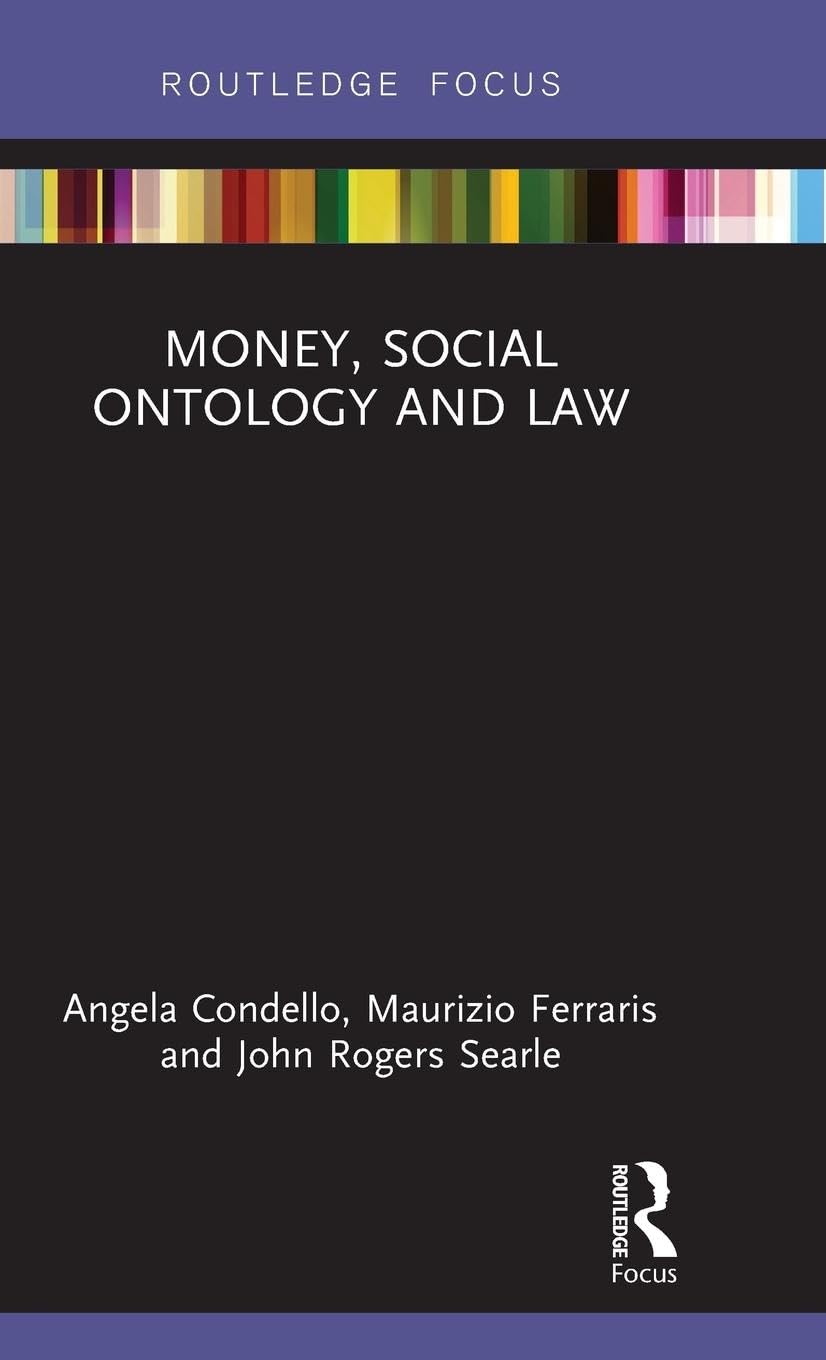
Money, Social Ontology and Law - Essential Essays on Money and Society
Money, Social Ontology and Law - Essential Essays on Money and Society
Price subject to change. Tap below for current.
Couldn't load pickup availability
In this review of Money, Social Ontology and Law the editors and contributors present a thoughtful collection that will appeal to readers who want theory-driven perspectives on why objects acquire monetary value. The book is for those interested in the intersection of law, philosophy, and economics, and its single biggest reason to buy is the way essays by Condello, Ferraris, and Searle trace money from material tokens and documents to shared social practices that sustain legal and normative orders. The review highlights the volume's focus on collective intentionality, documentality, and the material and legal technologies that make money function as a social fact.
Key Features
- Interdisciplinary essays: Brings together legal and philosophical perspectives to clarify how money is shaped by both normative law and social understanding.
- Focus on social ontology: Examines how collective intentionality and conventions underpin the status of money as a recognized social object.
- Documentality and materiality: Explores the role of physical tokens, documents, and electronic signals in conferring value and enabling trust.
- Contributions from notable thinkers: Includes work by Searle, Ferraris, and Condello that situates money within broader theories of the social and legal orders.
- Analytical rather than technical: Emphasizes conceptual clarity about money's social role rather than quantitative monetary policy models.
Who It's For
This collection is best for students and scholars of law and political philosophy, social theorists, and advanced readers in economics who seek a conceptual account of how money becomes meaningful within legal and social systems. The essays are suited to readers comfortable with theoretical argument and familiar with basic concepts of collective intentionality and legal theory.
Readers seeking an introductory textbook on monetary policy, practical guides for banking practice, or empirical macroeconomic analysis should look elsewhere; this volume is primarily philosophical and legal in orientation rather than a how-to manual for monetary management.
Pros & Cons
Pros
- Thoughtful theoretical contributions that connect legal norms to the social ontology of money.
- Clear emphasis on how documents and material tokens function together with shared conventions to create monetary status.
- Essays by recognized authors offer rigorous, concept-driven analyses useful for academic discussion.
Cons
- The book is conceptual and may feel abstract to readers seeking empirical or policy-focused treatment.
Specifications
| Title | Money, Social Ontology and Law |
| Series | Law and Politics |
| Editors / Contributors | Angela Condello, Maurizio Ferraris, John Rogers Searle |
| Subject focus | Philosophy of money, legal theory, social ontology |
| Approach | Essays exploring documentality, materiality, and collective intentionality |
| Audience | Scholars and advanced students in law, philosophy, and social theory |
Our Verdict
Money, Social Ontology and Law is a valuable collection for readers who want a rigorous, concept-driven account of how money functions as a social and legal fact. Its essays reward careful reading and are good value for scholars and graduate students seeking theoretical depth rather than empirical monetary policy guidance.
Frequently Asked Questions
Does this book focus on monetary policy?
Answer. No, the volume emphasizes philosophical and legal analysis of money rather than practical monetary policy or macroeconomic models.
Who are the main contributors?
Answer. The collection includes essays by Angela Condello, Maurizio Ferraris, and John Rogers Searle among others, bringing legal and philosophical perspectives.
Is this suitable for undergraduate readers?
Answer. It is better suited to advanced undergraduates or graduate students familiar with social ontology and legal theory due to its conceptual depth.
Editor's Take
Money, Social Ontology and Law is a rigorous, concept-driven collection that explains how documents, material tokens, and collective intentionality make money a social and legal fact; ideal for scholars and advanced students seeking theoretical depth.

Recently viewed
Recently viewed products will appear here as customers browse the store.