

Much Ado about Nothing: Theories of Space and Vacuum - Scholastic
Much Ado about Nothing: Theories of Space and Vacuum - Scholastic
Price subject to change. Tap below for current.
Couldn't load pickup availability
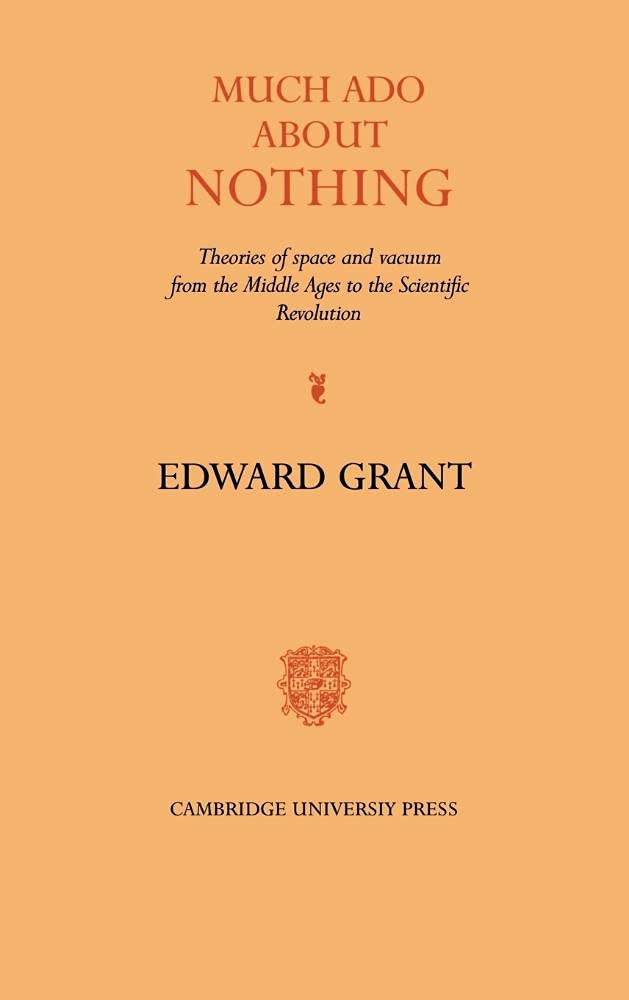
In this review of Much Ado about Nothing: Theories of Space and Vacuum from the Middle Ages to the Scientific Revolution, the reviewer finds a close, scholarly survey best suited to historians of science and advanced students. The book's single biggest reason to read it is its detailed reconstruction of medieval and early modern debates about void and extracosmic space, offering a narrative that connects scholastic Aristotelian arguments to later nonscholastic thinkers. It reads as a disciplined, research-led account rather than a popular overview, making it valuable for anyone tracing conceptual lineage in early modern physics.
Key Features
- Comprehensive historical scope: The book traces ideas about void space from the fourteenth to the early eighteenth century, giving readers a long-range view of intellectual development.
- Scholastic analysis: It provides a detailed description of Aristotelian scholastic arguments for and against the existence of void space, useful for specialists in medieval philosophy.
- Connection to the Scientific Revolution: The text examines how scholastic debates may have influenced nonscholastic authors who helped shape modern science, clarifying intellectual continuity.
- Focus on extracosmic space: The second part emphasizes infinite, extracosmic void space, offering rare sustained treatment of this specific topic.
- Concluding synthesis: The final chapter uniquely summarizes the book's findings and situates them within broader historiography, aiding readers looking for interpretation as well as exposition.
Who It's For
The book is aimed primarily at academics, graduate students, and advanced undergraduates interested in the history of physics, medieval philosophy, or the origins of modern space concepts; it assumes some familiarity with Aristotelian terminology and early modern debates. Readers seeking primary-source translations or a textbook-style introduction should be prepared for dense argumentation rather than simplified summaries.
Those outside scholarly or specialist interest-casual readers, early undergraduates, or general science enthusiasts-may find the level of detail and the focus on scholastic argumentation less accessible and should look for broader surveys instead.
Pros & Cons
Pros
- Thorough documentation of scholastic positions gives a rare, consolidated account of medieval arguments about void space.
- Clear linkage between medieval debates and later nonscholastic interpretations helps chart intellectual influence into the Scientific Revolution.
- The focused treatment of infinite, extracosmic void space fills a gap in many histories of early cosmology.
Cons
- The scholarly tone and dense analysis may be challenging for readers without background in Aristotelian or early modern philosophy.
Specifications
| Title | Much Ado about Nothing: Theories of Space and Vacuum from the Middle Ages to the Scientific Revolution |
| Author | Edward Grant |
| Period covered | Fourteenth to early eighteenth centuries |
| Major topics | Void space, extracosmic/infinite space, scholastic Aristotelian arguments |
| Focus | Influence of scholastic ideas on nonscholastic authors of the Scientific Revolution |
| Concluding material | Unique concluding chapter synthesizing findings |
Our Verdict
Edward Grant's study is a rigorous, well-documented account that any serious student of the history of physics or medieval philosophy should consider. It is especially good value for readers who need a detailed treatment of scholastic arguments about void and a careful argument for intellectual continuity into the Scientific Revolution, though casual readers may prefer a more accessible overview.
Frequently Asked Questions
Does this book cover primary medieval texts?
The book analyzes scholastic arguments in detail and draws on primary materials, but it is presented as a scholarly survey rather than a direct-source translation volume.
Is prior knowledge required to understand the book?
Some familiarity with Aristotelian concepts and early modern intellectual history is helpful; the tone is aimed at specialists and advanced students.
Does the book discuss the Scientific Revolution directly?
Yes, it examines how scholastic discussions of void space may have influenced nonscholastic authors who contributed to the Scientific Revolution.
Editor's Take
Edward Grant's study is a rigorous, well-documented account ideal for scholars tracing scholastic arguments about void and their influence on the Scientific Revolution; it offers strong value for specialists though it is dense for casual readers.

Recently viewed
Recently viewed products will appear here as customers browse the store.