

MX3 M.2 AI Accelerator - HighPerformance M.2 Vision Accelerator
MX3 M.2 AI Accelerator - HighPerformance M.2 Vision Accelerator
Price subject to change. Tap below for current.
Couldn't load pickup availability
In this review the MX3 M.2 AI Accelerator is evaluated for developers and system integrators who need compact, efficient ondevice processing for computer vision. The bottom line: the MX3 is best for those who want a dedicated M.2 form factor accelerator that delivers high performance for vision workloads while keeping power draw modest. Our review finds the MX3 stands out for practical integration into existing Windows, Linux, and Raspberry Pi 5 setups and for the supported SDK that makes deployment straightforward.
Key Features
- HighPerformance AI Processing: The MX3 is designed to handle demanding computer vision workloads and delivers fast inference for models used in machine vision tasks.
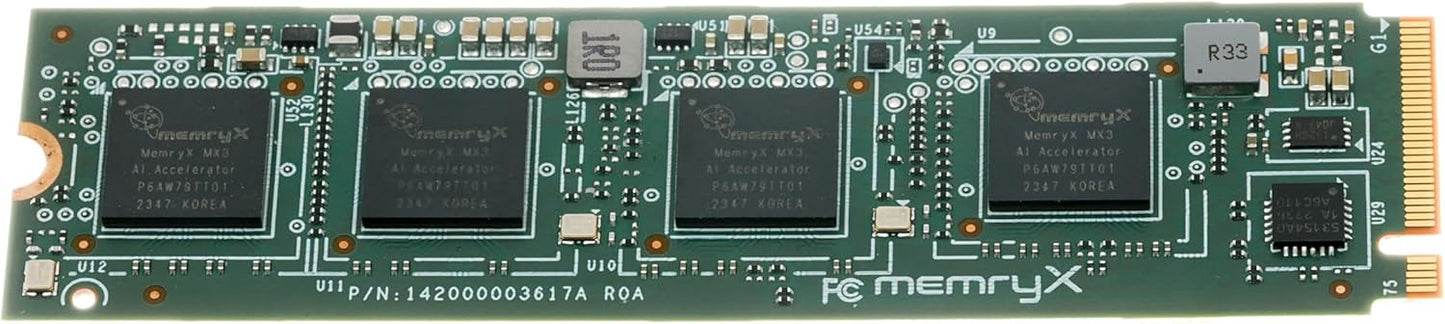
- M.2 Mkey Form Factor: The M.2 Mkey 2280 compatibility lets the MX3 slot into many internal systems and attach to a Raspberry Pi 5 via an Mkey 2280 HAT for compact deployments.
- CrossPlatform Support: Native support for Windows and Linux operating systems simplifies integration into existing development and production environments.
- Energy Efficient Design: The accelerator balances sustained performance with lower power consumption, which is helpful in embedded or thermally constrained systems.
- Comprehensive SDK: A supported SDK and developer documentation reduce integration time and help move models from prototype to deployment more quickly.
- Hardware Compatibility: Conformance to the PCISIG M.2 Mkey 2280 specification ensures predictable insertion and mechanical compatibility.
Who It's For
The MX3 is ideal for AI engineers, robotics developers, and edge vision integrators who need a small, installable accelerator that fits M.2 slots or a Raspberry Pi 5 HAT. It suits projects where ondevice inference performance and energy efficiency matter more than maximum cloud scale.
Those who should look elsewhere include teams that require a full GPU ecosystem or extremely broad thirdparty driver support; the MX3 is focused on optimized vision inference and relies on its SDK and platform compatibility rather than a general purpose GPU software stack.
Pros & Cons
Pros
- Compact M.2 Mkey 2280 form factor makes it easy to add to many systems without redesigning hardware.
- Strong performance for computer vision inference while keeping power consumption lower than many larger accelerators.
- Comprehensive SDK and documentation streamline development and deployment on Windows, Linux, and Raspberry Pi 5.
Cons
- Not intended as a dropin replacement for general purpose GPUs; best for vision workloads supported by the SDK.
Specifications
| Product | MX3 M.2 AI Accelerator |
| Form factor | M.2 Mkey 2280 |
| Primary use | Computer vision and AI inference |
| OS support | Windows, Linux |
| Raspberry Pi support | Compatible with Raspberry Pi 5 via Mkey 2280 HAT |
| SDK and docs | Comprehensive SDK and developer documentation available at the MemryX developer website |
| Design focus | High performance with energy efficiency |
Our Verdict
The MX3 M.2 AI Accelerator is a practical choice for edge vision projects and small form factor systems where strong inference performance and low power draw are priorities. Its M.2 Mkey design and supported SDK make it good value for integrators and developers who want a focused, supported accelerator rather than a general purpose GPU.
Frequently Asked Questions
Can the MX3 be used with a Raspberry Pi?
Yes, the MX3 is compatible with the Raspberry Pi 5 when used with an Mkey 2280 HAT that accepts M.2 Mkey modules.
Which operating systems are supported?
The MX3 supports Windows and Linux, and the SDK provides the tools and documentation to deploy models on those platforms.
Where can I find SDK and documentation?
Software and documentation are available on the MemryX developer website, which hosts the SDK and integration guides.
Editor's Take
The MX3 M.2 AI Accelerator is a focused, energy efficient choice for edge computer vision, offering strong ondevice inference in an M.2 Mkey 2280 form factor with a helpful SDK for integration.

Recently viewed
Recently viewed products will appear here as customers browse the store.