

Partial Differential Equations - Undergraduate Text on Methods
Partial Differential Equations - Undergraduate Text on Methods
Price subject to change. Tap below for current.
Couldn't load pickup availability
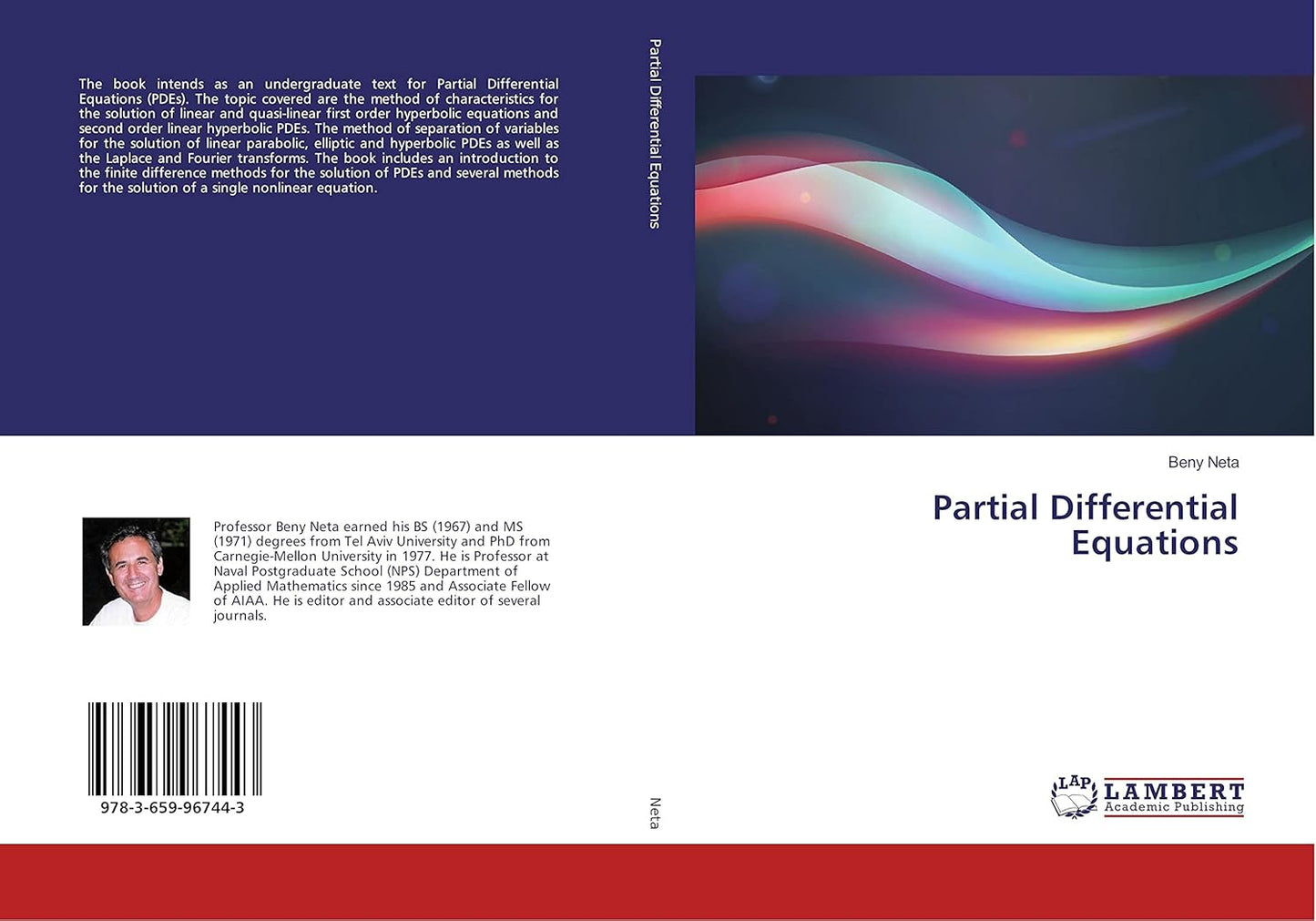
In this review of Partial Differential Equations the bottom line is straightforward: this book is a focused undergraduate text for students who need a clear, methods-oriented introduction to PDEs. The author emphasizes practical solution techniques rather than abstract existence theory, so readers will get hands-on exposure to the method of characteristics, separation of variables, and transform methods that are commonly used in engineering and applied mathematics courses.
Key Features
- Method of characteristics: Presents step-by-step use of characteristics for linear and quasi-linear first order hyperbolic equations, which helps students build intuition for wave propagation and transport problems.
- Second order hyperbolic equations: Covers solution approaches for second order linear hyperbolic PDEs so readers can tackle classical wave equations encountered in physics and engineering.
- Separation of variables: Demonstrates separation of variables for parabolic, elliptic and hyperbolic problems, supplying a practical toolkit for solving boundary value problems.
- Transform methods: Introduces Laplace and Fourier transforms with worked examples to simplify linear PDEs with appropriate initial or boundary conditions.
- Numerical introduction: Includes an introduction to finite difference methods, giving beginners a starting point for numerical solution of PDEs.
- Nonlinear techniques: Presents several methods for solving a single nonlinear equation, useful for connecting linear theory to modest nonlinear problems.
Who It's For
Partial Differential Equations is best for upper-level undergraduates in mathematics, physics, or engineering who are taking a first course in PDEs and prefer concrete solution methods over abstract functional analysis. The text is suitable as a course companion when the syllabus emphasizes classical techniques and worked examples.
Students seeking a rigorous treatment of existence and uniqueness in Sobolev spaces or a graduate-level theoretical approach should look elsewhere; this book is targeted to practical problem solving and method exposure rather than deep modern PDE theory.
Pros & Cons
Pros
- Clear presentation of the method of characteristics that builds practical skill for first order hyperbolic problems.
- Comprehensive worked coverage of separation of variables across equation types, improving boundary value problem competence.
- Useful introduction to Laplace and Fourier transforms and finite difference methods for applied work and computational follow-up.
Cons
- Limited emphasis on advanced theoretical frameworks means it is not a substitute for a graduate-level PDE text.
Specifications
| Title | Partial Differential Equations |
| Author | Beny Neta |
| Intended level | Undergraduate |
| Topics covered | Characteristics; separation of variables; Laplace and Fourier transforms |
| Numerical content | Introduction to finite difference methods |
| Nonlinear methods | Several approaches for a single nonlinear equation |
Our Verdict
Partial Differential Equations is a solid, practice-focused undergraduate text that equips students with a set of classical solution methods. It represents good value for courses emphasizing applied techniques and worked examples, though readers seeking advanced theoretical rigor should supplement it with a higher-level reference.
Frequently Asked Questions
Is this book suitable for an introductory PDE course?
Yes. It is designed as an undergraduate text with emphasis on practical solution methods commonly taught in introductory courses.
Does it cover numerical methods?
It includes an introduction to finite difference methods to give a basic numerical perspective.
Will this book teach advanced PDE theory?
No. The focus is on methods and examples rather than graduate-level existence and functional analytic theory.
Editor's Take
A practice-focused undergraduate PDE text that teaches classical solution methods like characteristics, separation of variables, transforms and basic finite difference techniques; ideal for applied courses but not for advanced theoretical study.

Recently viewed
Recently viewed products will appear here as customers browse the store.