

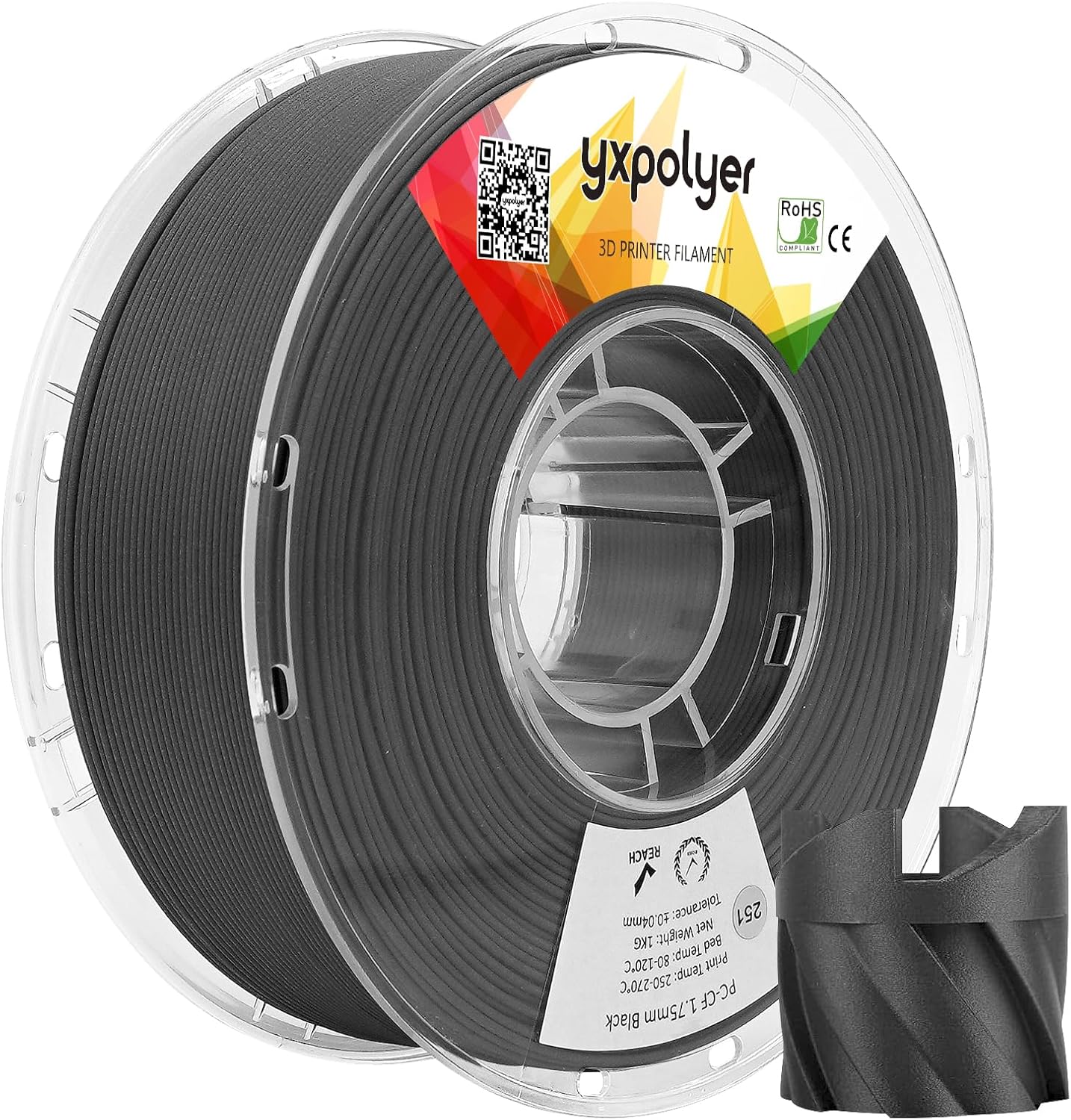
PC-CF Filament Polycarbonate Carbon Fiber 1.75mm 1kg - High Heat
PC-CF Filament Polycarbonate Carbon Fiber 1.75mm 1kg - High Heat
Price subject to change. Tap below for current.
Couldn't load pickup availability
In this review the YXPOLYER PC-CF filament is assessed for makers and engineers who need a tougher, heat resistant material for demanding prints. The bottom line: this polycarbonate reinforced with carbon fiber is best for functional parts that require higher stiffness and reduced warping, and it delivers on dimensional stability and heat resistance up to 140 C. It is not an everyday PLA substitute but offers a clear benefit where strength, low shrinkage and faster throughput matter.
Key Features
- Carbon fiber reinforcement: The 15% carbon fiber content increases stiffness and strength while helping reduce warping for more accurate parts.
- High temperature resistance: Rated to withstand temperatures up to 140 C, making it suitable for parts exposed to heat.
- Good balance of toughness: The reinforcement level preserves flexural strength and elongation so parts remain durable without excessive brittleness.
- Beginner friendly printing: Self-supporting prints peel off cleanly and the filament runs well with a single nozzle when using recommended higher nozzle temperatures around 280 C.
- Faster printing capability: Higher flowability supports significantly faster infill speeds up to 350 mm/s while recommending slower speeds for overhangs and bridges.
- Lightweight performance: Lower density than some alternatives gives high strength-to-weight parts compared to PET-CF alternatives.
Who It's For
The filament is aimed at hobbyists, makers and small shops producing functional components, jigs, and end-use parts that need improved stiffness, dimensional accuracy, and heat resistance. It is a strong option when prints must survive higher temperature environments or when reduced warping is important.
People who should look elsewhere include anyone seeking an easy drop-in replacement for PLA at low temperatures or those unwilling to use higher nozzle temperatures and a hardened nozzle; the material prints best at elevated temperatures and requires a printer set up for polycarbonate blends.
Pros & Cons
Pros
- Superior stiffness and dimensional stability from 15% carbon fiber reinforcement.
- High heat tolerance up to 140 C for functional, temperature-exposed parts.
- Fast printing capability with improved flowability, allowing higher infill speeds.
- Good balance of toughness and elongation that avoids becoming overly brittle.
Cons
- Requires higher nozzle temperatures and careful tuning; some users report mixed layer adhesion results if settings are not optimized.
- May need a hardened nozzle and printer capable of sustained high-temperature extrusion for best results.
Specifications
| Material | Polycarbonate reinforced with 15% carbon fiber |
| Diameter | 1.75 mm |
| Spool weight | 1 kg |
| Recommended nozzle temp | Around 280 C |
| Heat resistance | Up to 140 C |
| Print speed capability | Infill up to 350 mm/s; max stable for some features 200 mm/s |
Our Verdict
The PC-CF filament is a smart choice for users needing heat resistant, stiff, and low-warp parts; it offers strong value when you need faster throughput and lightweight strength compared with PET-CF. Buyers should ensure their printer can handle higher extrusion temperatures and consider a hardened nozzle for long-term reliability, but for functional engineering prints this filament performs well.
Frequently Asked Questions
What temperature should I print this filament at?
Prints perform best at higher temperatures, around 280 C for strong layer adhesion.
Is this filament easier to print than other PC-CF options?
It is described as beginner friendly and self-supporting, but users must still tune temperature and speed to avoid adhesion issues.
How fast can I print with this filament?
The filament supports higher flowability with infill speeds up to 350 mm/s; slower speeds are recommended for overhangs, bridges and bottom layers.
Editor's Take
The PC-CF filament is ideal for producing heat resistant, stiff, and low-warp functional parts; it delivers strong value for engineering prints if your printer can handle higher extrusion temperatures.

Recently viewed
Recently viewed products will appear here as customers browse the store.