

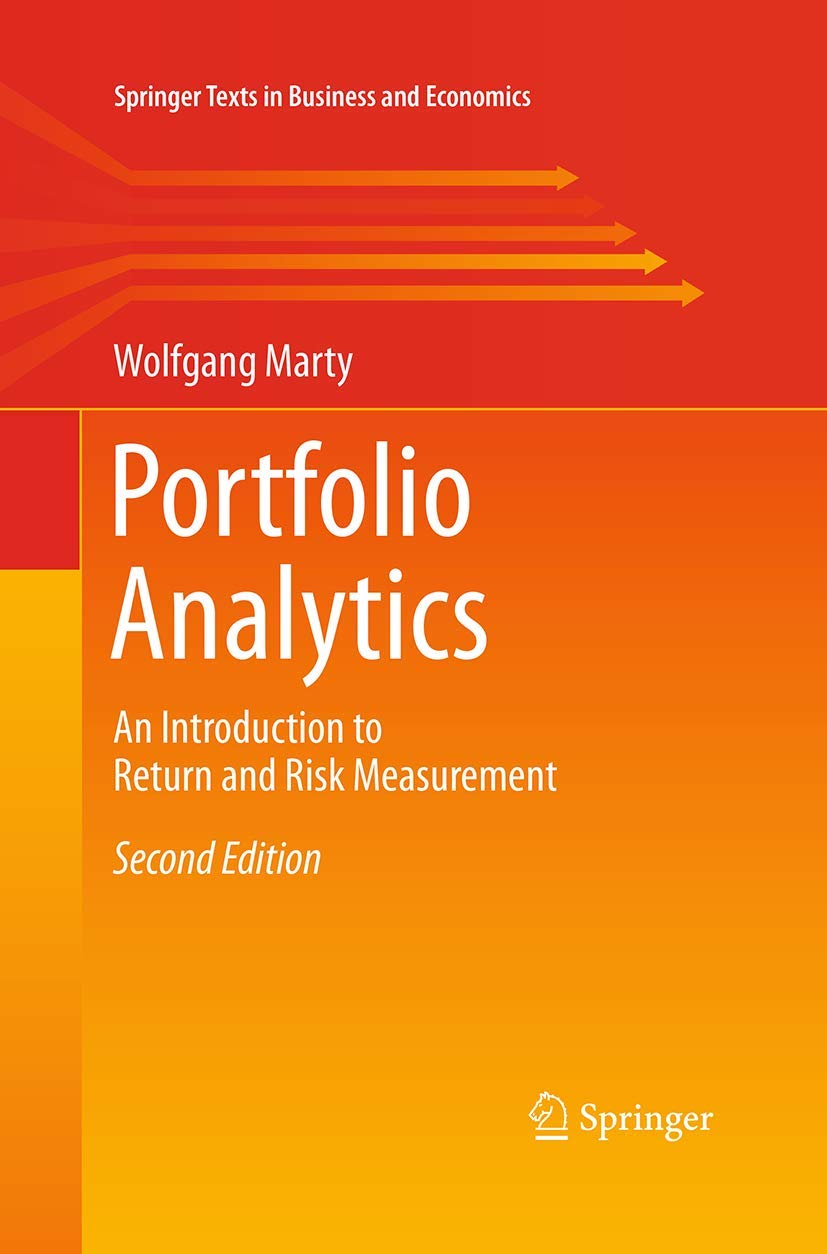
Portfolio Analytics: An Introduction to Return and Risk Measurement
Portfolio Analytics: An Introduction to Return and Risk Measurement
Price subject to change. Tap below for current.
Couldn't load pickup availability
In this review of Portfolio Analytics: An Introduction to Return and Risk Measurement the author presents a clear, methodical textbook aimed at students and practitioners who need a rigorous yet practical introduction to performance measurement and risk analysis. The single biggest reason to buy is its focused treatment of return metrics and how they relate to risk, particularly the comparison of the time-weighted rate of return and the money-weighted rate of return, which the book treats with clarity and real-world relevance. This review highlights where the book excels and who will benefit most.
Key Features
- Return measurement: A thorough introduction to return concepts gives readers a solid foundation for performance evaluation in investment contexts.
- TWR vs MWR comparison: Clear explanations of the time-weighted rate of return and money-weighted rate of return help practitioners choose the correct metric for reporting and decision making.
- Tracking error analysis: Multiple tracking error measures are analyzed so readers can understand deviations from benchmarks and the implications for portfolio oversight.
- Ex-post vs ex-ante risk: The contrast between realized and expected risk figures helps bridge theory and applied risk management practices.
- Modern portfolio theory application: Coverage of MPT demonstrates how realistic constraints affect optimized portfolio construction.
- Investment controlling focus: The book concludes with practical aspects of investment controlling, useful for those responsible for monitoring portfolios.
Who It's For
This book is best for graduate students in finance, investment analysts, and portfolio controllers who need a compact, technically sound reference to return measurement and risk evaluation. Its emphasis on TWR, MWR and tracking errors makes it particularly useful for professionals preparing reports or assessing manager performance.
Readers who need broad coverage of asset pricing theory or an introductory personal finance guide should look elsewhere; this text assumes interest in measurement techniques and applied portfolio construction rather than elementary investing tips or extensive empirical case studies.
Pros & Cons
Pros
- Focused treatment of return measurement makes the central concepts accessible to readers with quantitative backgrounds.
- Direct comparison of TWR and MWR clarifies when each metric is appropriate for performance evaluation.
- Practical discussion of tracking errors and ex-post vs ex-ante risk helps link measurement to governance and reporting.
- Inclusion of constraint effects on optimized portfolios gives realistic perspectives on MPT implementation.
Cons
- The book is narrowly focused on measurement and control, so readers seeking broad investment theory or numerous empirical examples may find it limited.
- It assumes some prior quantitative knowledge, which could challenge complete beginners.
Specifications
| Title | Portfolio Analytics: An Introduction to Return and Risk Measurement |
| Series | Springer Texts in Business and Economics |
| Author | Wolfgang Marty |
| Main topics | Return measurement, TWR, MWR, tracking error, risk figures, MPT |
| Audience | Students, investment analysts, portfolio controllers |
| Focus | Investment controlling and applied portfolio construction |
Our Verdict
Portfolio Analytics is a concise, well-structured textbook for anyone who needs a practical, measurement-focused guide to return and risk assessment. Its clear comparison of TWR and MWR and its applied discussion of tracking errors and constraint-driven portfolio construction make it good value for students and practitioners seeking a targeted reference in investment controlling.
Frequently Asked Questions
Does the book explain when to use TWR versus MWR?
Yes, it provides a direct comparison that clarifies the contexts where time-weighted or money-weighted returns are appropriate for performance reporting.
Is this suitable for someone new to finance?
The text assumes some quantitative background, so beginners without prior exposure to return concepts may find it challenging.
Does it cover portfolio construction theory?
It covers modern portfolio theory with emphasis on how practical constraints affect optimized portfolios rather than an exhaustive theoretical treatment.
Editor's Take
A concise, measurement-focused textbook that clearly compares TWR and MWR and links tracking error and constrained MPT to investment controlling, making it a strong reference for students and practitioners.

Recently viewed
Recently viewed products will appear here as customers browse the store.