

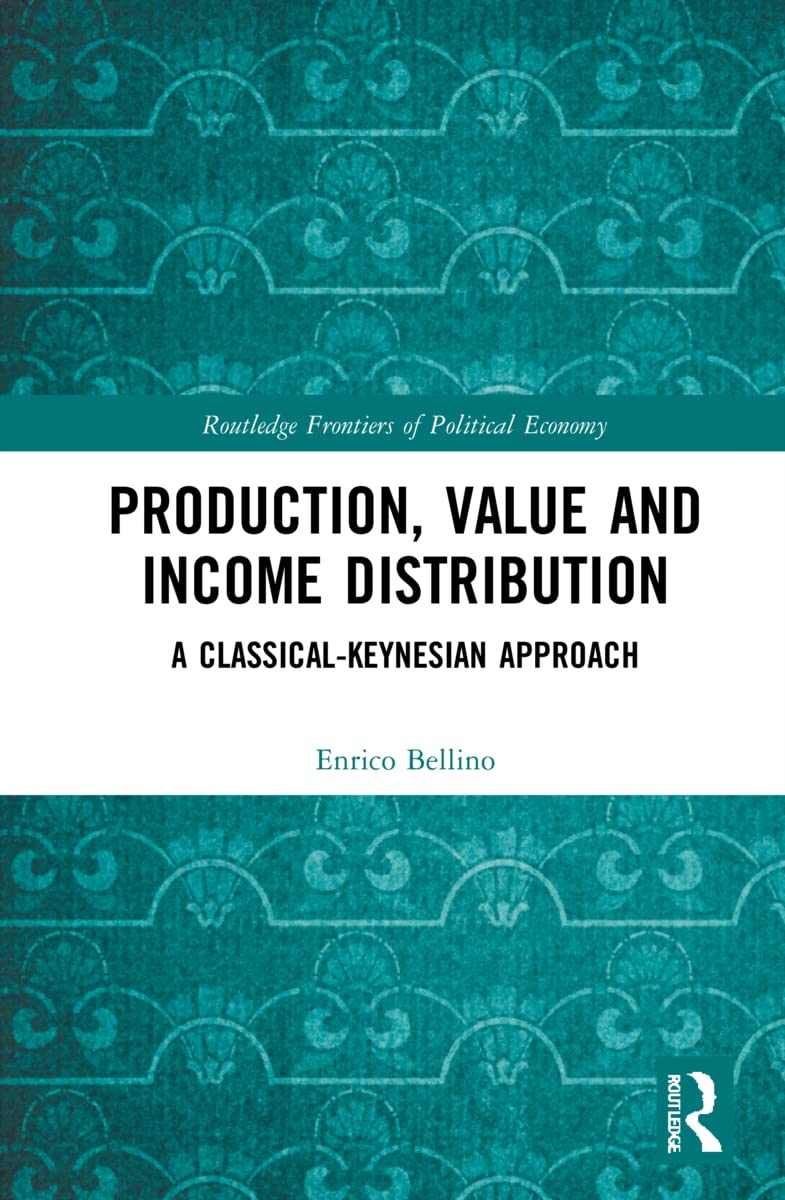
Production, Value and Income Distribution - ClassicalKeynesian
Production, Value and Income Distribution - ClassicalKeynesian
Price subject to change. Tap below for current.
Couldn't load pickup availability
In this review of Production, Value and Income Distribution the reviewer finds a focused academic treatment that will appeal to readers interested in alternatives to marginalist economics. Enrico Bellino frames a clear case for integrating the classical political economy tradition with Keynesian employment theory, making the book a solid choice for graduate students, researchers and informed readers who want a rigorous, theory-driven exploration of how wages, profits, values and labour employment interrelate. The single biggest reason to buy is its sustained effort to revive Sraffa-style analysis for contemporary policy questions.
Key Features
- Classical-Keynesian framing: Presents a consistent integration of classical political economy with Keynesian employment theory to rethink distribution and macroeconomic outcomes.
- Historical foundations: Re-examines contributions from Smith, Ricardo and Marx to show how classical insights remain relevant to modern distributional questions.
- Sraffa-influenced formalism: Uses the Sraffa tradition to reformulate classical concepts in clearer, modern analytical terms for economists familiar with political economy literature.
- Policy relevance: Connects theoretical analysis to the goal of enabling decent living standards by identifying instruments that affect wages and employment.
- Critical of neoclassical marginalism: Offers sustained critique of mainstream approaches, useful for readers seeking alternative frameworks for distribution and value.
Who It's For
The book is best suited to graduate students in economics, scholars of economic history and political economy, and policy researchers who already have some exposure to classical and Keynesian theories and want a cohesive treatment that links wages, profits and employment. Its focus on theory and historical roots makes it a good fit for seminar reading and course use.
Readers looking for an introductory textbook, applied empirical methods, or lightweight popular explanations should look elsewhere; this is not a how-to guide for practitioners nor an introductory primer for those without some prior training in economic thought.
Pros & Cons
Pros
- Provides a coherent alternative approach by combining classical and Keynesian ideas for understanding income distribution.
- Recasts classical authors with modern Sraffa-style clarity, aiding comparative theoretical study.
- Addresses policy implications by linking distributional theory to employment and dignified living standards.
Cons
- Highly theoretical focus may limit accessibility for readers seeking empirical analysis or introductory exposition.
Specifications
| Title | Production, Value and Income Distribution |
| Series | Routledge Frontiers of Political Economy |
| Author | Enrico Bellino |
| Perspective | Classical-Keynesian, Sraffa-influenced |
| Topics covered | Wages, profits, values, labour employment, policy instruments |
| Approach | Theoretical and historical analysis |
Our Verdict
Production, Value and Income Distribution is a valuable, theory-rich book for readers committed to understanding distribution through the lens of classical political economy integrated with Keynesian employment theory. It is good value for graduate students and scholars who want a rigorous alternative to neoclassical frameworks and are comfortable with theoretical, historically grounded argumentation.
Frequently Asked Questions
Does this book include empirical case studies?
No. The book emphasizes theoretical and historical analysis rather than empirical case work.
Is prior familiarity with classical economists required?
Some prior exposure to Smith, Ricardo, Marx or Sraffa will help readers follow the arguments more easily.
Will this help with policy analysis?
Yes, it connects theory to policy instruments for wages and employment, but primarily from a conceptual standpoint rather than providing technical policy toolkits.
Editor's Take
A theory-rich, historically grounded book that integrates classical political economy and Keynesian employment theory; recommended for graduate students and scholars seeking a rigorous alternative to neoclassical approaches.

Recently viewed
Recently viewed products will appear here as customers browse the store.