

Profinite Groups - Authoritative Introduction and Reference
Profinite Groups - Authoritative Introduction and Reference
Price subject to change. Tap below for current.
Couldn't load pickup availability
In this review of Profinite Groups the book is recommended for graduate students and researchers who need a clear, self-contained introduction to profinite groups and a durable reference. The single biggest reason to buy is its balance of accessible exposition and depth: it covers foundational material while emphasizing free constructions, and the second edition adds new appendices that update the theory of free profinite groups. Readers will find both basic facts and specialist tools in one volume, making it practical for learning and for consultation during research.
Key Features
- Self-contained exposition: The text develops profinite groups from basic facts to advanced topics so a reader can follow without extensive external prerequisites.
- Free constructions emphasis: Detailed treatment of free profinite groups and the structure of their subgroups gives concrete tools for constructing and analysing examples.
- Connections to Galois theory: The book shows why profinite groups are Galois groups, which is valuable for algebraic number theory contexts.
- Homology and cohomology coverage: Homological methods are described with a minimum of prerequisites, making these techniques accessible to more readers.
- Updated second edition: Three new appendices include a new characterization of free profinite groups, strengthening the volume as a modern reference.
Who It's For
This book is best for advanced undergraduates, graduate students, and professional mathematicians working in algebraic number theory, group theory, or related areas who need a rigorous introduction and a reference that treats both foundations and specialized constructions. Its self-contained nature makes it suitable for course use or independent study.
Those seeking a casual or elementary overview of group theory for recreational use should look elsewhere; the material assumes mathematical maturity and is focused on profinite and residually finite contexts rather than elementary finite group theory.
Pros & Cons
Pros
- Comprehensive, self-contained treatment that supports independent study.
- Strong emphasis on free profinite groups and subgroup structure useful for constructive work.
- Includes homology and cohomology with minimal prerequisites, widening accessibility.
- New appendices expand and update the theory, increasing the book's long-term value.
Cons
- Material assumes a level of mathematical maturity that may be challenging for beginners.
- Focused specialty content means it is not a general introduction to all group theory topics.
Specifications
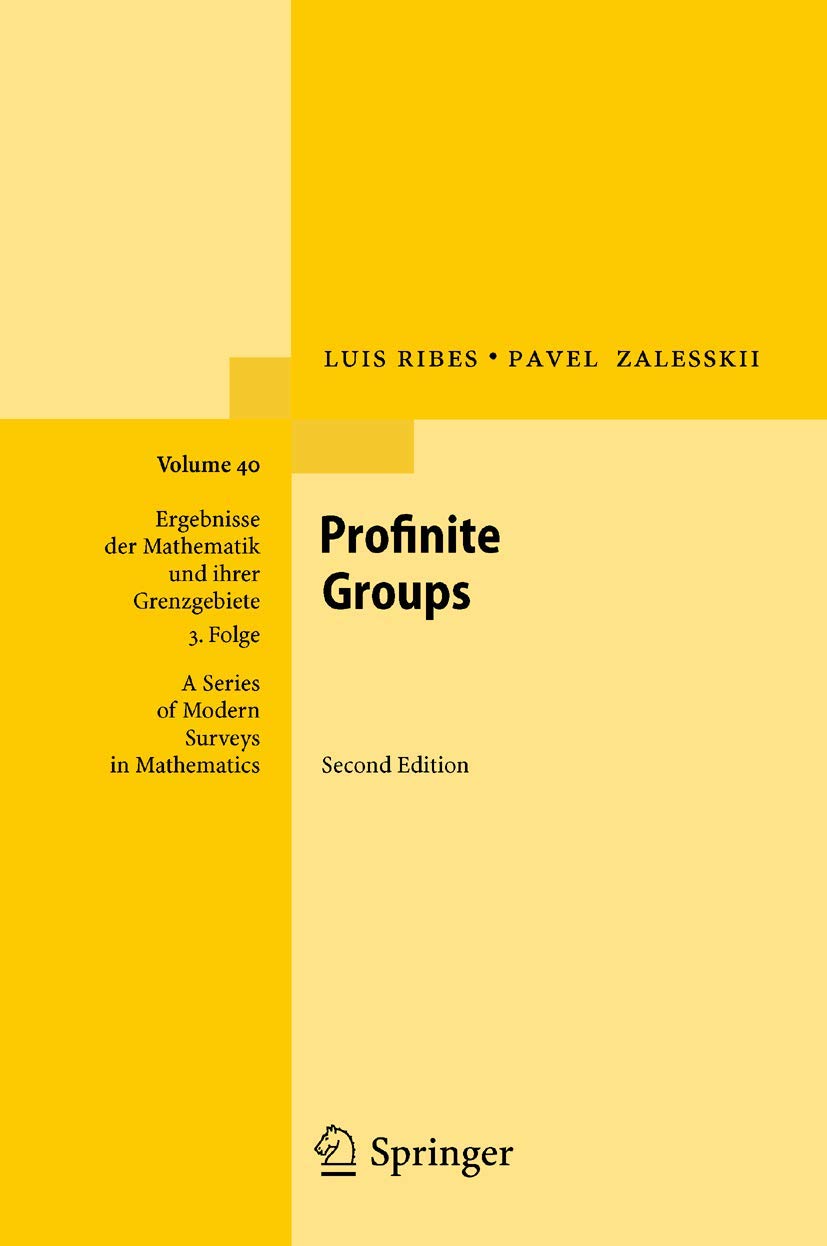
| Title | Profinite Groups |
| Series | Ergebnisse der Mathematik und ihrer Grenzgebiete. 3. Folge, 40 |
| Authors | Luis Ribes, Pavel Zalesskii |
| Edition | Second edition (contains three new appendices) |
| Primary topics | Profinite groups, free profinite groups, homology, cohomology, Galois groups |
| Intended audience | Graduate students and specialists in algebra and number theory |
Our Verdict
Profinite Groups is a well-crafted, authoritative introduction and reference that rewards readers with the right background. It is good value for graduate students and researchers who need both foundational coverage and detailed treatments of free constructions and cohomological methods. Those seeking a light survey should consider a more elementary text, but for its scope this volume stands as a durable resource.
Frequently Asked Questions
Does this book require prior group theory experience?
Yes. It assumes mathematical maturity and familiarity with basic group theory and algebra at the undergraduate level.
Is there new material in this edition?
Yes. The second edition adds three appendices, including a new characterization of free profinite groups.
Is homology covered in depth?
The book describes homology and cohomology with minimal prerequisites, enough to apply these methods to profinite groups without extensive background texts.
Editor's Take
Profinite Groups is a well-crafted, self-contained introduction and reference that is especially valuable for graduate students and researchers needing detailed treatment of free profinite groups and cohomological methods.

Recently viewed
Recently viewed products will appear here as customers browse the store.