

Quantitative Modeling of Derivative Securities - Practical Pricing
Quantitative Modeling of Derivative Securities - Practical Pricing
Price subject to change. Tap below for current.
Couldn't load pickup availability
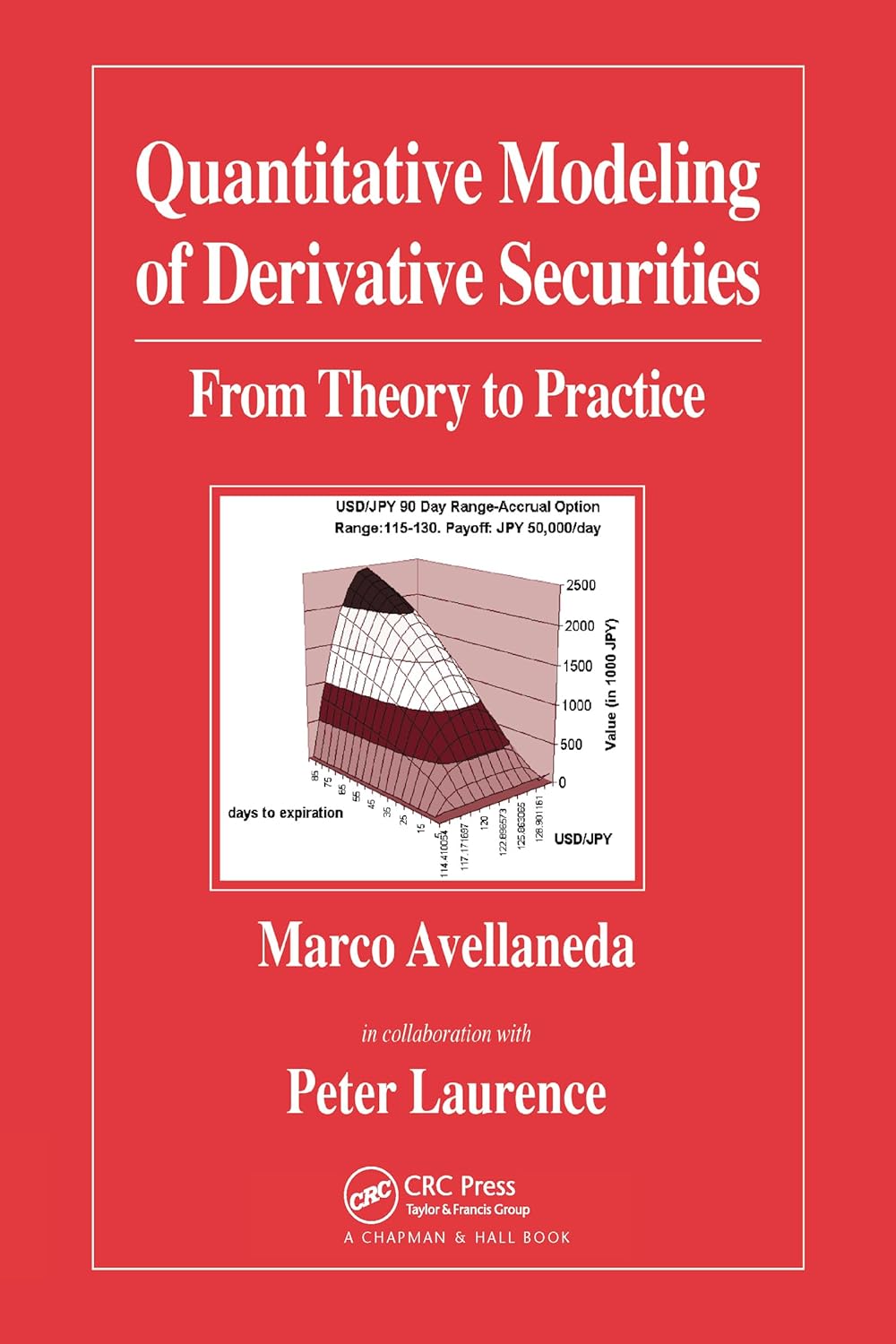
In this review of Quantitative Modeling of Derivative Securities the bottom line is clear: this is a practical, graduate-level text for analysts and traders who must move from arbitrage theory to real-world pricing and hedging. Marco Avellaneda and Peter Laurence present a stepwise, financial engineering approach that emphasizes relative-value reasoning over abstract proofs. The book's single biggest reason to buy is its focus on applying theoretical ideas to the concrete design and analysis of derivative products, helping the reader bridge the gap between novice intuition and technical research.
Key Features
- Applied focus: The book emphasizes applying arbitrage theory to actual product design so readers can translate models into trading decisions.
- Progressive development: Concepts are developed progressively, allowing a reader to build on fundamentals and tackle more complex pricing and hedging topics.
- Hedging emphasis: Detailed treatment of hedging and relative-value ideas gives practical guidance for managing risk across instruments.
- Targeted problems: Problems are chosen to reflect the real technical issues that analysts and traders face in practice, reinforcing learning by doing.
- Bridges theory and practice: The text is written to move a reader from introductory knowledge to the level required to read technical and research literature.
Who It's For
This book is well suited for quantitative analysts, derivatives traders, and graduate students in finance who already have some familiarity with probability and basic arbitrage concepts and want a hands-on, engineering-oriented treatment. It is also useful for risk managers who need a deeper understanding of pricing and hedging mechanics for structured products.
Readers looking for a purely introductory overview without mathematical detail, or those seeking elementary tutorials for retail investors, should look elsewhere; the book expects a readiness to work through technical arguments and applied problems.
Pros & Cons
Pros
- Strong practical orientation that helps translate arbitrage theory into pricing workflows.
- Progressive structure makes advanced topics accessible once foundational material is mastered.
- Problem sets and examples focus on real issues traders and technical analysts encounter.
Cons
- The material assumes a level of technical maturity, so it can be challenging for readers without prior quantitative background.
Specifications
| Title | Quantitative Modeling of Derivative Securities |
| Authors | Marco Avellaneda, Peter Laurence |
| Primary focus | Applied pricing and hedging of derivatives |
| Approach | Financial engineering, progressive development |
| Intended audience | Technical analysts, traders, graduate students |
| Core themes | Arbitrage theory, relative-value, hedging |
Our Verdict
Quantitative Modeling of Derivative Securities is a strong value for practitioners who need a compact, application-focused treatment of pricing and hedging. Its engineering approach and practice-oriented problems make it especially valuable for analysts and traders who want to close the gap between textbook theory and research-level material.
Frequently Asked Questions
Is this book suitable for beginners?
The book is not for complete beginners; it assumes some quantitative background and familiarity with basic arbitrage concepts.
Does it include practical examples and problems?
Yes, the text emphasizes problems and examples chosen to mirror the technical issues traders and analysts face in practice.
Will this help with hedging strategies?
Yes, hedging and relative-value ideas are central to the book and provide actionable guidance for managing derivative risk.
Editor's Take
A practical, application-focused text that helps analysts and traders translate arbitrage theory into pricing and hedging workflows; best for readers with a quantitative background.

Recently viewed
Recently viewed products will appear here as customers browse the store.