

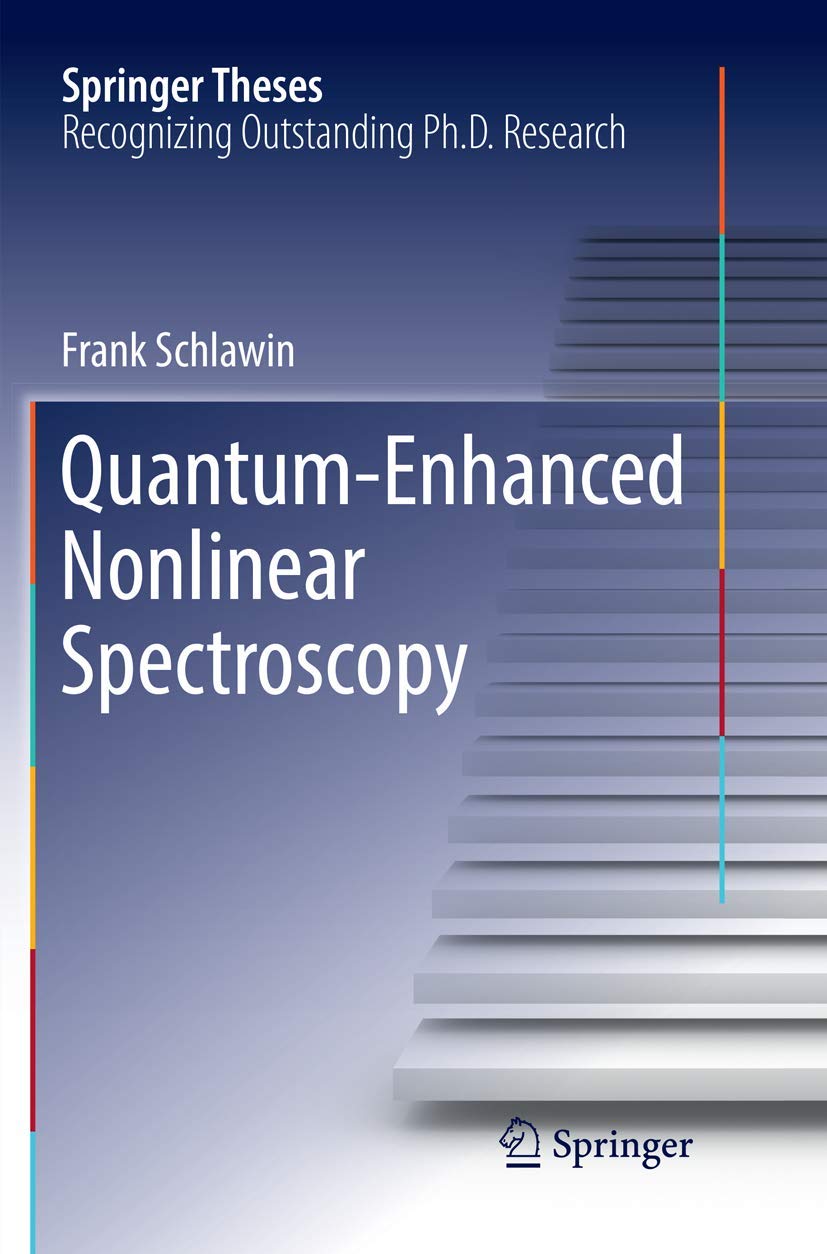
Quantum-Enhanced Nonlinear Spectroscopy - Advanced Thesis Study
Quantum-Enhanced Nonlinear Spectroscopy - Advanced Thesis Study
Price subject to change. Tap below for current.
Couldn't load pickup availability
In this review of Quantum-Enhanced Nonlinear Spectroscopy (Springer Theses) the bottom line is clear: this thesis is for graduate students and researchers who need a rigorous, quantum optics perspective on nonlinear molecular spectroscopy. Frank Schlawin presents a careful, diagrammatic foundation and then probes how entangled photon states alter two-photon transitions and the usual time-energy uncertainty limits; the single biggest reason to buy is the combination of formal derivations and practical simulation work that directly connects quantum correlation concepts to potential experimental setups.
Key Features
- Foundational theory: The thesis builds nonlinear optical signals from Glauber photon counting formalism, giving readers a clear path from quantum field theory to measurable spectroscopy signals.
- Diagrammatic formulation: A systematic diagrammatic approach is developed and shown to be the backbone for analyzing nonlinear molecular spectroscopy processes.
- Quantum correlation focus: The work investigates how entangled photon states influence two-photon transitions, illuminating where classical descriptions fail.
- Time-energy uncertainty analysis: The author analyzes the tradeoffs in simultaneous time and frequency resolution and shows cases where entangled light can change those limits for individual transitions.
- Simulated experimental setups: The thesis includes simulations of plausible experiments, helping bridge theory and potential laboratory implementation.
Who It's For
This thesis is best suited to physics or physical chemistry graduate students, postdocs, and researchers working at the intersection of quantum optics and molecular spectroscopy who want a rigorous treatment of nonlinear signals and entangled-photon effects. It is especially useful for those designing experiments or numerical studies that rely on quantum-correlated light.
It is less appropriate for casual readers or undergraduates without prior exposure to quantum optics or field-theoretic descriptions, and those seeking a broad textbook introduction to optical spectroscopy may prefer more pedagogical volumes that start from classical nonlinear optics.
Pros & Cons
Pros
- Thorough, formal derivations tie Glauber photon counting to experimental observables in nonlinear spectroscopy.
- Clear diagrammatic framework that helps organize complex multi-photon processes.
- Insightful treatment of how entangled photons can alter time-energy resolution for two-photon transitions.
- Practical simulations that suggest realistic experimental implementations of the theoretical ideas.
Cons
- The material assumes prior familiarity with quantum optics and advanced spectroscopy, which can be steep for newcomers.
Specifications
| Title | Quantum-Enhanced Nonlinear Spectroscopy (Springer Theses) |
| Author | Frank Schlawin |
| Primary subject | Nonlinear spectroscopy from a quantum optics perspective |
| Key topics | Glauber photon counting, diagrammatic formulation, entangled photon states |
| Main focus | Impact of quantum correlations on two-photon transitions and time-energy uncertainty |
| Includes | Simulation studies of possible experimental setups |
Our Verdict
Quantum-Enhanced Nonlinear Spectroscopy is a high-value, specialist thesis for researchers who need a rigorous quantum-field based account of nonlinear optical signals and the practical implications of entangled light. Buy it if you want solid theoretical groundwork plus simulation-driven ideas for experiments; otherwise seek a more introductory text first.
Frequently Asked Questions
Does the thesis explain experimental implementations?
Yes, the final chapters present simulations of possible experimental setups that could exploit quantum advantages described in the text.
Is prior knowledge required to follow the material?
Yes, readers should have background in quantum optics or advanced spectroscopy to fully grasp the formal derivations and diagrammatic methods.
What is the main novelty?
The main novelty is showing how entangled photon states can change the usual time-energy uncertainty constraints for individual two-photon transitions, supported by simulated examples.
Editor's Take
Quantum-Enhanced Nonlinear Spectroscopy is a specialist, high-value thesis offering rigorous quantum-optical derivations, diagrammatic methods, and simulations that show how entangled photons can alter two-photon transitions and measurement limits.

Recently viewed
Recently viewed products will appear here as customers browse the store.