

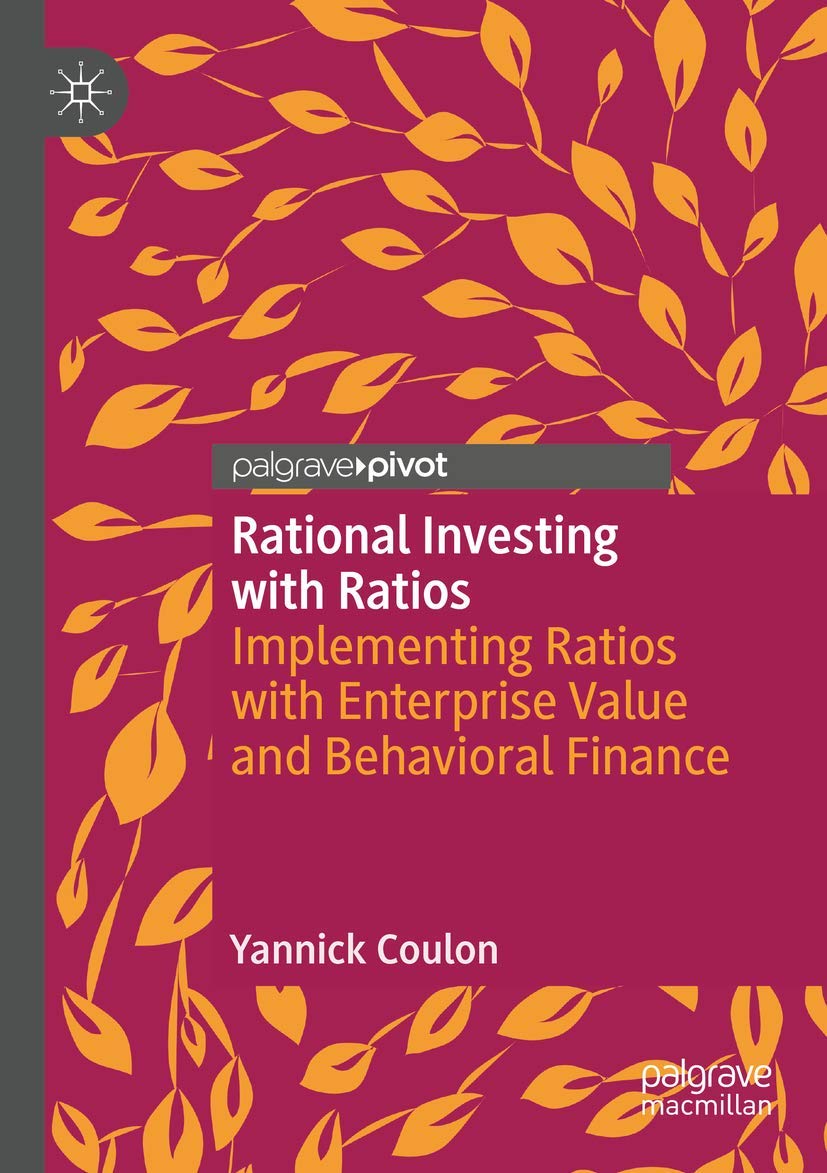
Rational Investing with Ratios: Implementing Ratios with Enterprise
Rational Investing with Ratios: Implementing Ratios with Enterprise
Price subject to change. Tap below for current.
Couldn't load pickup availability
In this review of Rational Investing with Ratios: Implementing Ratios with Enterprise Value and Behavioral Finance, the author explores how financial ratios connect accounting and market data and why that matters for valuation. This book is aimed at investors and analysts who want a principled approach to screening and company evaluation; its single biggest strength is the clear emphasis on implementation and interpretation rather than just lists of ratios. Readers get a practical, case-study driven treatment that explains when ratios are meaningful and how they fit into a broader investment framework.
Key Features
- Focus on underlying logic: Explains the proportional relationships that give ratios their interpretive power, helping readers avoid blind formula use.
- Enterprise value emphasis: Shows how to integrate ratios with enterprise value to form consistent company valuations and comparative screens.
- Behavioral finance context: Discusses how investor behavior affects ratio signals and when apparent anomalies may reflect market psychology.
- Case studies: Illustrates ratio families with multiple company examples and graphs, making abstract ideas tangible for real firms.
- Implementation guidance: Moves beyond definition to show how ratios can be incorporated into a global company vision and screening process.
Who It's For
This book is best for individual investors, financial analysts and students of corporate finance who already know basic accounting and want to deepen their practical use of ratios for valuation and screening. The emphasis on enterprise value and behavioral considerations makes it a useful bridge between accounting metrics and market-based assessment.
It is less suitable for complete beginners seeking an introductory accounting textbook or for readers looking solely for quick checklist-style ratio tables without discussion. Those who prefer high-level portfolio strategies with little focus on company-level valuation may also find parts of the book too detailed.
Pros & Cons
Pros
- Clear explanation of why ratios matter, not just what they are.
- Practical case studies and graphs that demonstrate application to real companies.
- Integration of enterprise value and behavioral finance provides context for interpretation.
Cons
- Content assumes some existing accounting and valuation knowledge, which may limit accessibility for absolute beginners.
Specifications
| Title | Rational Investing with Ratios: Implementing Ratios with Enterprise Value and Behavioral Finance |
| Author | Yannick Coulon |
| Focus areas | Financial ratios, enterprise value, behavioral finance |
| Approach | Logic and implementation with case studies and graphs |
| Use cases | Company valuation, investment screening, ratio interpretation |
| Illustrated with | Multiple company case studies and graphs |
Our Verdict
Rational Investing with Ratios is a thoughtful, implementation-oriented book that suits investors and analysts who want to use ratios as meaningful valuation tools. Its focus on enterprise value and behavioral context makes it valuable for anyone who needs to interpret ratio signals rather than simply compute them, offering solid value for readers prepared to engage with analytical detail.
Frequently Asked Questions
Does this book explain how to use ratios in valuation?
Yes, it focuses on integrating ratios with enterprise value and shows how to apply them in company valuation and screening.
Are there practical examples included?
Yes, the book uses multiple case studies and graphs built from real company data to demonstrate ratio families.
Who should avoid this book?
Absolute beginners without basic accounting knowledge may find it dense; it is aimed at readers with some financial background.
Editor's Take
Rational Investing with Ratios is a practical, implementation-focused book that helps investors and analysts use ratios with enterprise value and behavioral context; it is best for readers with some accounting background.

Recently viewed
Recently viewed products will appear here as customers browse the store.