

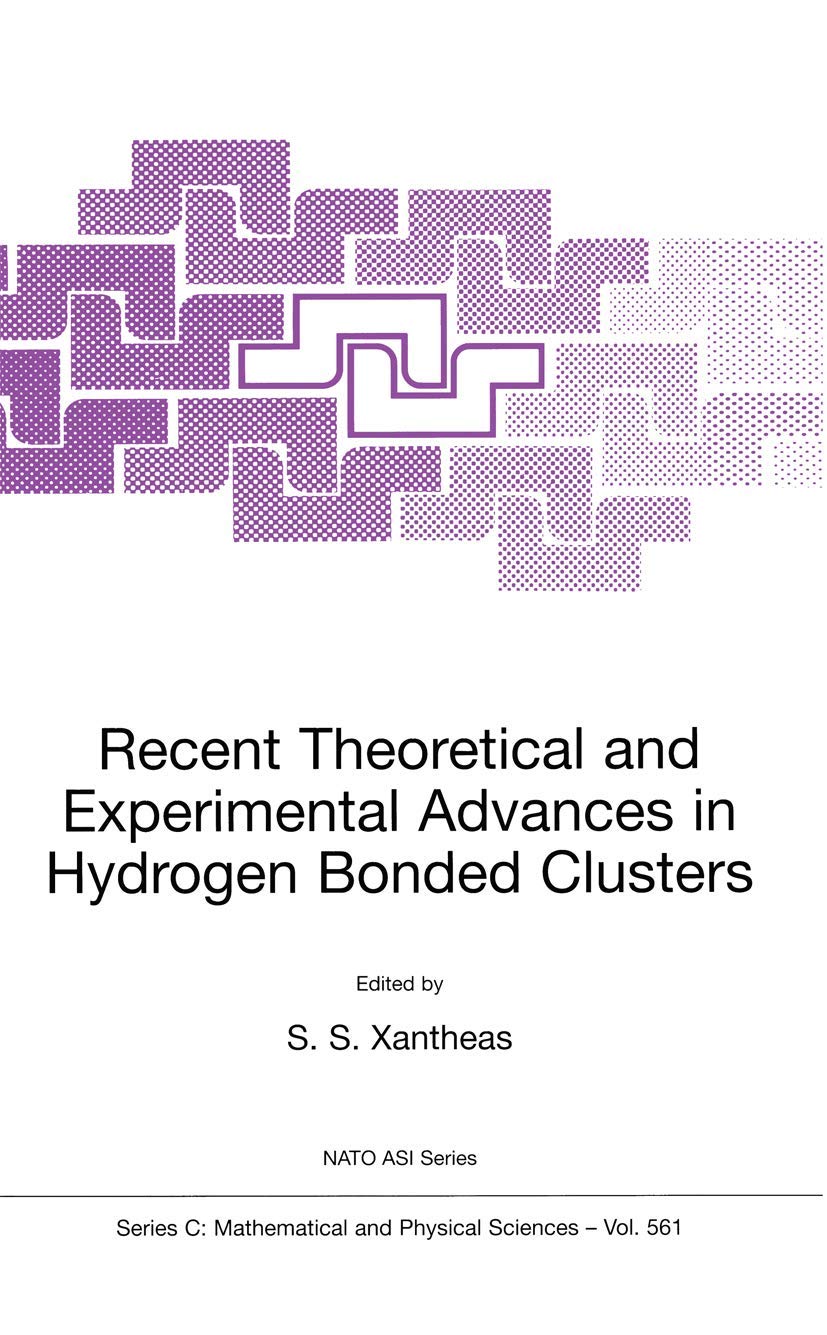
Recent Theoretical and Experimental Advances in Hydrogen Bonded
Recent Theoretical and Experimental Advances in Hydrogen Bonded
Price subject to change. Tap below for current.
Couldn't load pickup availability
In this review the focus is on Recent Theoretical and Experimental Advances in Hydrogen Bonded Clusters, a specialist volume edited by S.S. Xantheas that targets researchers and advanced students who need a rigorous look at hydrogen bonding in small aggregated systems. The book's biggest strength is its concentrated treatment of clusters as prototypes for molecular understanding of hydrogen bonding, making it most valuable for those working on aqueous solvation, atmospheric chemistry, or theoretical method benchmarking. Readers seeking a practical lab manual or a broad undergraduate textbook should look elsewhere.
Key Features
- Focused scope: The collection concentrates on hydrogen bonded clusters, providing in-depth discussion of how clusters serve as molecular prototypes for larger condensed-phase behavior.
- Theory and experiment balanced: Chapters explore both computational and experimental approaches, helping readers connect measured macroscopic properties to underlying molecular interactions.
- Benchmark relevance: The volume offers data and insights useful as benchmarks when developing comprehensive simulation models of condensed-phase systems.
- Applications highlighted: Coverage emphasizes relevance to aqueous solvation, atmospheric aerosol chemistry, and enzyme-related hydrogen bonding, showing practical contexts for the research.
- Expert editorial perspective: Edited by S.S. Xantheas, the book compiles contributions that reflect current directions in hydrogen bond research and methodological advances.
Who It's For
This book is best suited to graduate students, postdoctoral researchers, and practicing chemists or physicists who need a focused, research-level overview of hydrogen bonded clusters and their relevance to condensed-phase problems. It is an appropriate reference for scientists developing or validating computational models and for experimentalists interested in cluster studies that inform bulk behavior.
It is not designed as an introductory textbook for beginners or as a step-by-step experimental protocol collection; readers without background in physical chemistry or molecular simulation may find some chapters dense and assume prior familiarity with the field's concepts.
Pros & Cons
Pros
- Concentrated coverage of hydrogen bonded clusters provides valuable molecular-level insight for specialists.
- Integration of theoretical and experimental perspectives aids cross-disciplinary understanding and model development.
- Relevant applications to aqueous solvation and atmospheric aerosol chemistry make the material practically useful for related research.
Cons
- Not intended as an introductory text; the material assumes a strong background in physical chemistry and modeling.
Specifications
| Title | Recent Theoretical and Experimental Advances in Hydrogen Bonded Clusters |
| Series | Nato Science Series C |
| Editor / Brand | S.S. Xantheas |
| Subject area | Hydrogen bonding, clusters, physical chemistry |
| Intended audience | Researchers, graduate students, experimentalists and theorists |
| Key focus | Theory and experiment on hydrogen bonded clusters as molecular prototypes |
Our Verdict
For researchers and advanced students working on hydrogen bonding, this edited volume is a focused and valuable reference that links cluster studies to broader condensed-phase questions and model development. It represents good value for those seeking benchmark-level discussion and cross-disciplinary perspectives, though it is not aimed at novices.
Frequently Asked Questions
Is this book suitable for beginners?
No. The book assumes prior knowledge of physical chemistry and molecular simulation and is best for advanced students and researchers.
Does it include both theory and experiment?
Yes. The volume emphasizes the interplay of theoretical methods and experimental results for hydrogen bonded clusters.
Will it help with model development?
Yes. The cluster-focused discussions and benchmark insights are intended to guide development and validation of condensed-phase simulation models.
Editor's Take
This edited volume is a focused, research-level reference that links hydrogen bonded cluster studies to condensed-phase modeling and experimental benchmarks, making it valuable for advanced students and researchers.

Recently viewed
Recently viewed products will appear here as customers browse the store.