

Risk Analysis of Natural Hazards - Interdisciplinary Insights
Risk Analysis of Natural Hazards - Interdisciplinary Insights
Price subject to change. Tap below for current.
Couldn't load pickup availability
In this review of Risk Analysis of Natural Hazards: Interdisciplinary Challenges and Integrated Solutions, the book is recommended for professionals and scholars who need a rigorous, cross-disciplinary look at hazard assessment and management. The single biggest reason to buy is its integrated approach: contributors from engineering, science, philosophy, law, and the social sciences combine to bridge technical analysis and decision frameworks. Readers will find a thoughtful synthesis rather than a single-discipline manual, making it especially useful for teams that must navigate complex, overlapping risk considerations.
Key Features
- Interdisciplinary coverage: The volume brings together experts across engineering, law, philosophy, and social sciences to support comprehensive risk understanding.
- Risk assessment overview: Parts I and II provide detailed context on how different disciplines interact when assessing natural hazards, helping readers connect methods and assumptions.
- Climate change focus: A dedicated exploration of climate change impacts clarifies how shifting hazards affect assessment approaches and long-term planning.
- Theoretical frameworks: Part III presents conceptual tools for evaluating natural hazards, useful for analysts who need to justify model choices and normative approaches.
- Risk management guidance: Parts IV and V outline interdisciplinary interactions and decision frameworks that can inform policy and operational strategies.
Who It's For
This book is best for researchers, policy makers, and practitioners in risk analysis who require an integrated perspective that marries technical assessment with ethical, legal, and social considerations. It is particularly valuable for multi-disciplinary teams working on natural hazard planning, climate adaptation, or regulatory frameworks.
Those seeking a hands-on engineering textbook with step-by-step computational procedures or field manuals for specific hazard types may want a more specialized technical guide instead. This volume emphasizes synthesis, theory, and decision frameworks over procedural design details.
Pros & Cons
Pros
- Comprehensive interdisciplinary perspective that helps bridge siloed approaches to risk analysis.
- Clear treatment of climate change implications that updates conventional assessment thinking.
- Useful theoretical discussion that aids in evaluating and justifying decision frameworks.
Cons
- Not a step-by-step technical manual, so readers looking for detailed computational methods will need supplemental texts.
Specifications
| Title | Risk Analysis of Natural Hazards: Interdisciplinary Challenges and Integrated Solutions |
| Series | Risk, Governance and Society, 19 |
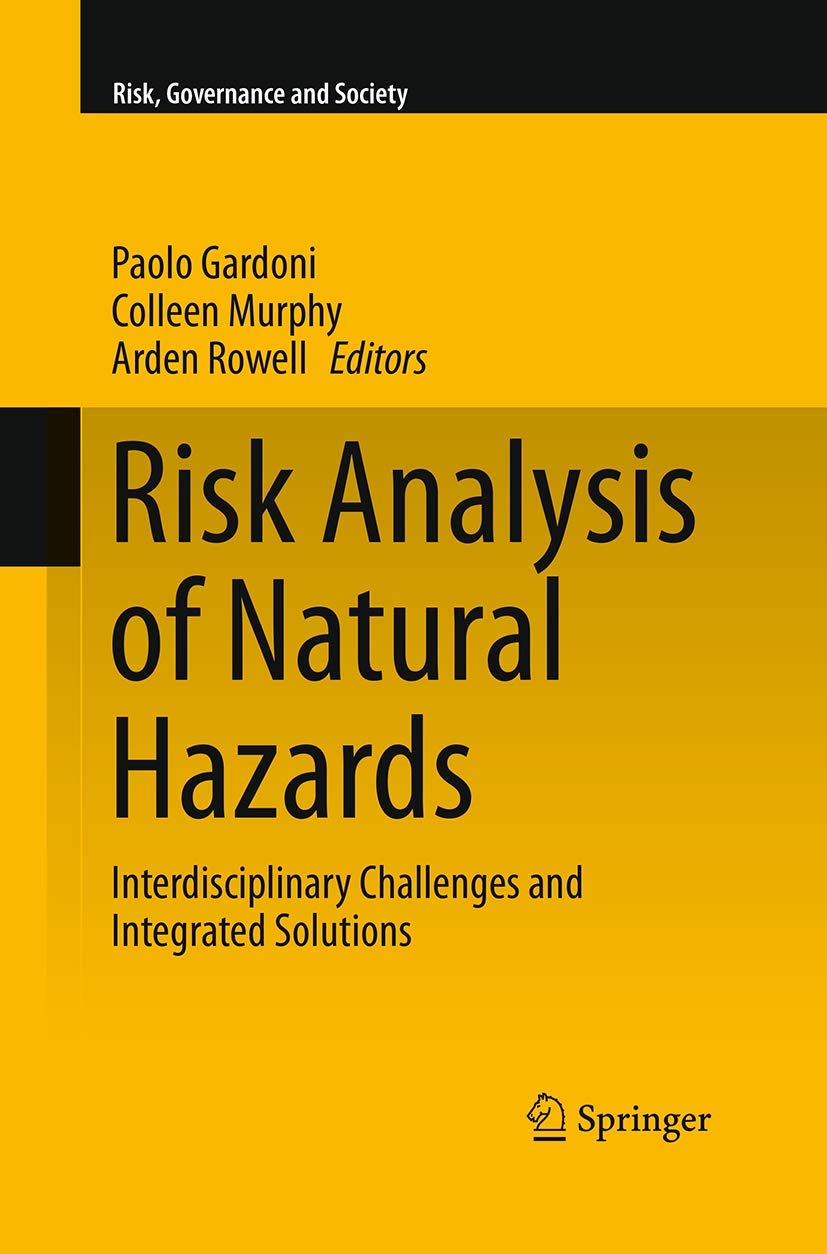
| Editors / Authors | Paolo Gardoni, Colleen Murphy, Arden Rowell |
| Coverage | Risk assessment, climate change impacts, theoretical evaluation, risk management |
| Disciplines included | Engineering, science, philosophy, law, social sciences |
| Format focus | Interdisciplinary essays and frameworks rather than procedural manuals |
Our Verdict
Risk Analysis of Natural Hazards is a strong value for interdisciplinary teams and academics who need a well-rounded synthesis of assessment and management perspectives. Its combination of climate-aware analysis and theoretical clarity makes it a useful reference when shaping policy or collaborative research across technical and social domains.
Frequently Asked Questions
Does this book cover climate change effects on hazards?
Yes. Parts I and II specifically explore the particular impacts of climate change on natural hazard assessment.
Is this a practical engineering manual?
No. The book emphasizes interdisciplinary synthesis and theoretical frameworks rather than step-by-step engineering procedures.
Who edited the volume?
The volume is edited by Paolo Gardoni, Colleen Murphy, and Arden Rowell and brings contributors from multiple fields.
Editor's Take
A rigorous interdisciplinary volume that combines climate-aware assessment, theoretical clarity, and management frameworks, ideal for researchers and multi-disciplinary teams shaping policy and risk strategies.

Recently viewed
Recently viewed products will appear here as customers browse the store.