

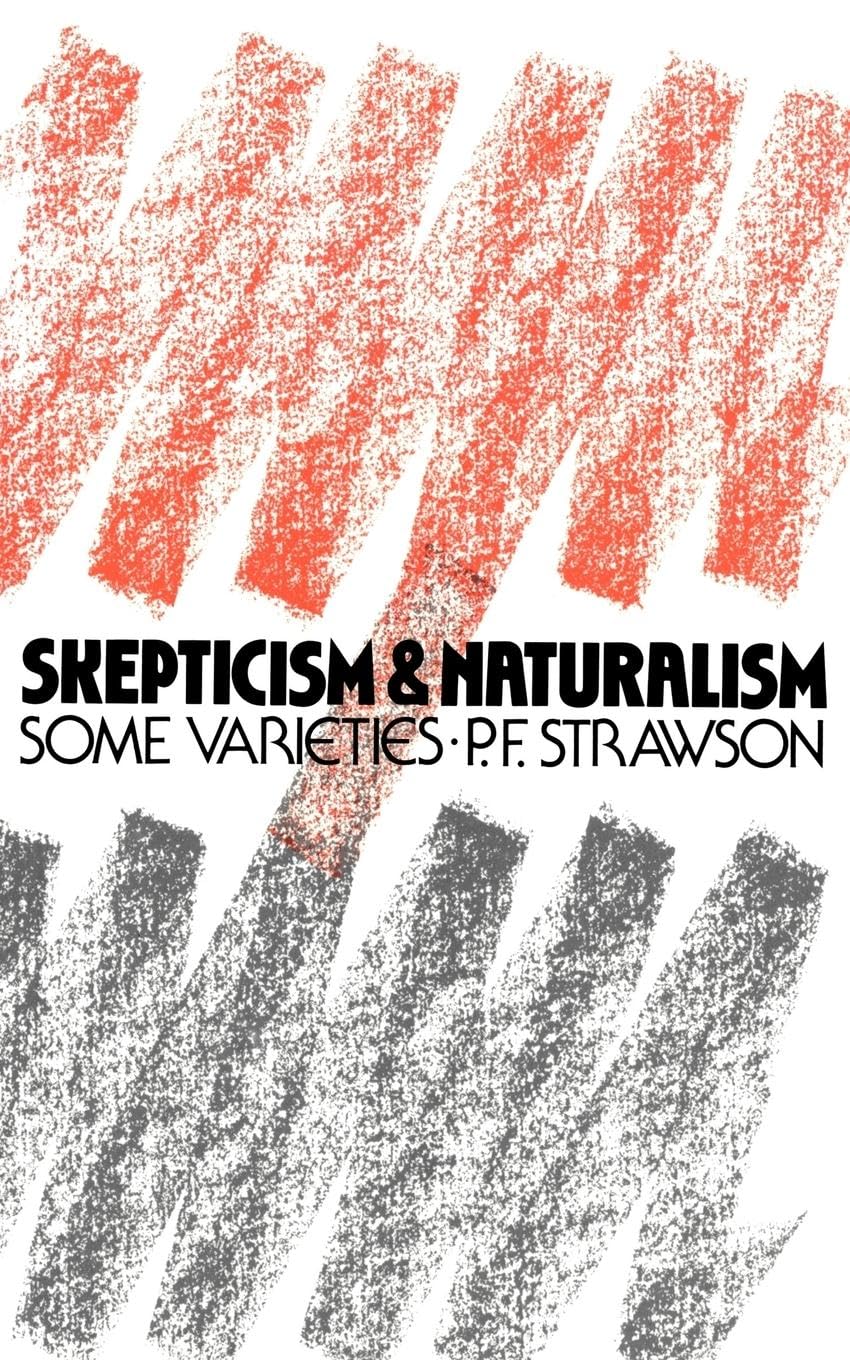
Scepticism and Naturalism: Some Varieties - Compact Philosophical
Scepticism and Naturalism: Some Varieties - Compact Philosophical
Price subject to change. Tap below for current.
Couldn't load pickup availability
Our review of Scepticism and Naturalism: Some Varieties finds it a focused, intellectually mature collection best suited to readers with prior philosophical grounding. First published in 1987 and based on Peter Strawson's 1983 Woodbridge lectures, the book offers a rigorous comparison of scepticism and naturalism and is valuable because it distills complex debates into clear, historically informed arguments. A reader seeking a concise, reflective treatment of epistemological questions will appreciate Strawson's judicious appeal to Hume and Wittgenstein and the distinction he draws between scientific and humanistic strands of naturalism.
Key Features
- Lecture origins: Based on the 1983 Woodbridge lectures, the book preserves the structure and emphasis of Strawson's original oral presentation for clarity and scholarly context.
- Philosophical focus: Concentrates on the relation between scepticism and naturalism, making complex epistemological issues accessible through comparative analysis.
- Historical engagement: Draws on Hume and Wittgenstein to situate contemporary sceptical concerns within a longer philosophical tradition.
- Readable length: As a compact volume it allows sustained engagement with central problems without requiring a large time commitment.
- Authoritative voice: Written late in Strawson's career, it reflects the mature judgments of a philosopher regarded as a leading figure in 20th century analytic philosophy.
Who It's For
This book is for graduate students, advanced undergraduates, and general readers with a solid background in analytic philosophy who want a clear, reflective account of scepticism and the varieties of naturalism. Philosophers seeking a concise synthesis of arguments from Hume and Wittgenstein will find it particularly rewarding.
Those new to epistemology or readers looking for an introductory textbook should look elsewhere, since Strawson's treatment assumes familiarity with central terms and figures and favors conceptual subtlety over elementary exposition.
Pros & Cons
Pros
- Authoritative analysis offers a thoughtful synthesis of scepticism and naturalism from a leading 20th century philosopher.
- Clear engagement with Hume and Wittgenstein helps readers trace the historical roots of contemporary debates.
- Concise format makes it practical for seminar use or focused personal study without excess length.
Cons
- Assumes prior philosophical background, which limits accessibility for beginners.
Specifications
| Title | Scepticism and Naturalism: Some Varieties |
| Series | The Woodbridge Lectures, Vol. 12 |
| Author | P.F. Strawson |
| First published | 1987 |
| Lecture year | 1983 Woodbridge lectures at Columbia University |
| Philosophical focus | Scepticism and varieties of naturalism |
Our Verdict
Scepticism and Naturalism is a compact, high-quality philosophical monograph that rewards readers who already know the landscape of analytic epistemology. Its clear, historically grounded argumentation and Strawson's mature voice make it worth buying for seminar reading or personal study, offering good value as a succinct statement by a leading philosopher.
Frequently Asked Questions
Is this book based on lectures?
Yes. It was developed from Strawson's 1983 Woodbridge lectures delivered at Columbia University.
Does the book cover Hume and Wittgenstein?
Yes. Strawson explicitly draws on Hume and Wittgenstein to frame his discussion of scepticism and naturalism.
Is this suitable for beginners?
Not ideally; the book assumes some prior familiarity with analytic philosophy and epistemological terms.
Editor's Take
A concise, authoritative examination of scepticism and naturalism that rewards readers with prior philosophical background; ideal for seminar reading and focused study.

Recently viewed
Recently viewed products will appear here as customers browse the store.