

Sequential Change Detection and Hypothesis Testing - Practical
Sequential Change Detection and Hypothesis Testing - Practical
Price subject to change. Tap below for current.
Couldn't load pickup availability
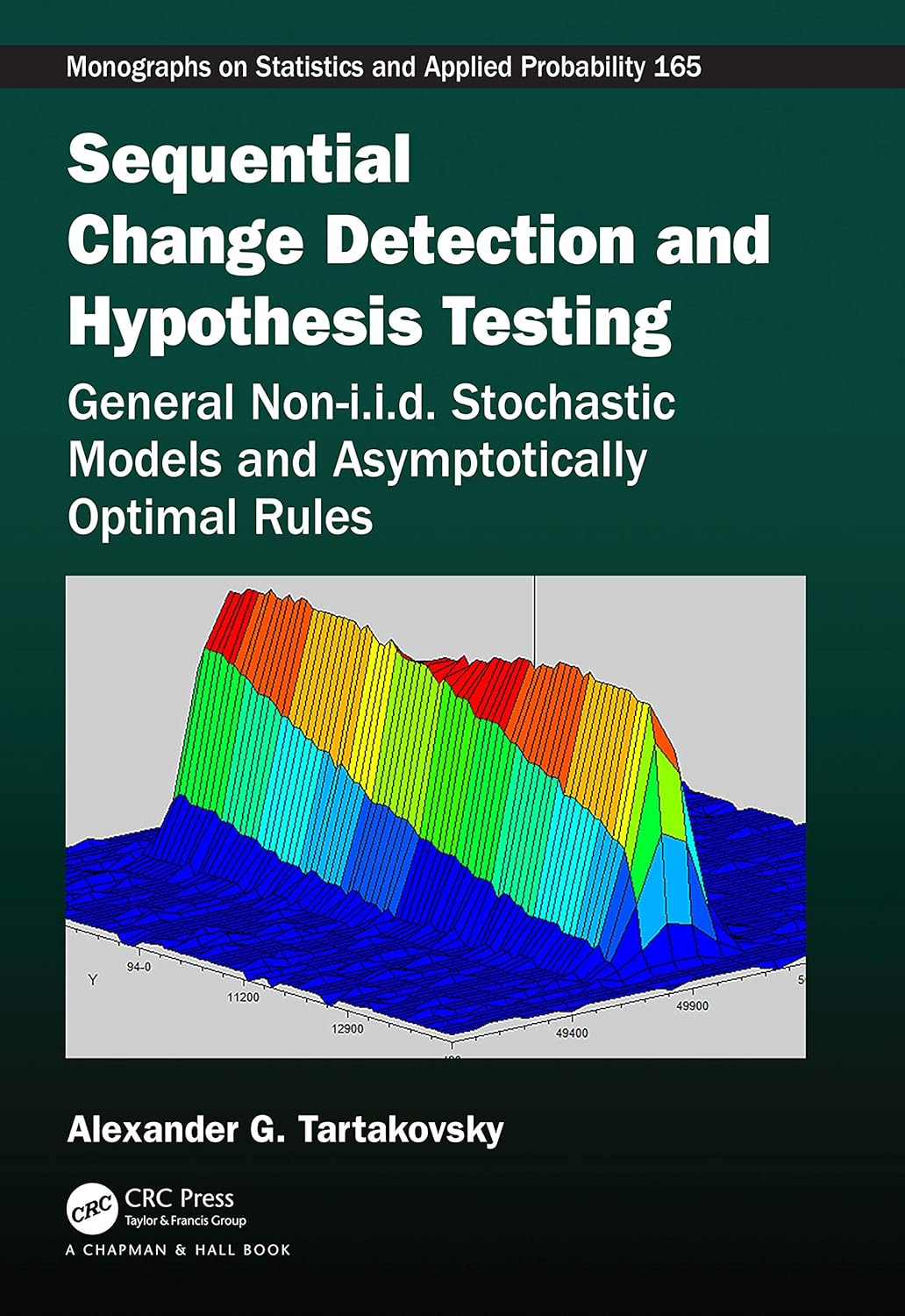
In this review of Sequential Change Detection and Hypothesis Testing the focus is squarely on advanced statisticians, researchers and practitioners who need rigorous tools for detecting abrupt changes in dependent, non-i.i.d. data streams. The book's single biggest selling point is its extension of asymptotic theory to very general stochastic models, making it especially relevant when observations are dependent or non-identically distributed. For readers seeking mathematical depth and applied direction on changepoint detection and sequential hypothesis testing, this monograph delivers a dense, theory-forward treatment.
Key Features
- General non-i.i.d. models: Extends changepoint detection theory to dependent and non-identically distributed observations, offering methods that apply to realistic, complex data streams.
- Sequential hypothesis testing: Presents a rigorous account of sequential testing approaches that help detect changes quickly while controlling error rates.
- Asymptotic theory focus: Provides detailed asymptotic results that guide performance evaluation when exact finite-sample analysis is impractical.
- Applied motivation: Connects theory to real problems such as cyberattack detection, epidemic early warning, and space object identification to illustrate relevance.
- Monograph depth: Concentrates on theoretical development suitable for graduate-level study and research rather than introductory coverage.
Who It's For
This book is best suited to graduate students, academic researchers and quantitative practitioners who already have a strong background in probability and statistics and who need a rigorous reference on sequential changepoint detection for dependent data. It will be valuable to those building detection systems in cybersecurity, epidemiology or remote sensing where data are non-i.i.d.
Those seeking a beginner textbook, a step-by-step implementation guide, or hands-on tutorials with code should look elsewhere; the monograph emphasizes theoretical development and asymptotic analysis rather than practical software recipes.
Pros & Cons
Pros
- Addresses changepoint detection for very general stochastic models, filling a gap in the literature on dependent observations.
- Strong focus on sequential hypothesis testing gives a unified framework for rapid detection with error control.
- Relevant applied examples motivate the theory for users in cybersecurity, epidemiology and space observation.
Cons
- Dense, theory-heavy presentation means a steep learning curve for readers without advanced mathematical training.
Specifications
| Title | Sequential Change Detection and Hypothesis Testing |
| Series | Chapman & Hall/CRC Monographs on Statistics and Applied Probability |
| Author | Alexander Tartakovsky |
| Scope | Sequential changepoint detection for non-i.i.d. stochastic models |
| Approach | Asymptotic theory and sequential hypothesis testing |
| Applications discussed | Cybersecurity, epidemiology, space object identification |
Our Verdict
Sequential Change Detection and Hypothesis Testing is a rigorous, high-value reference for specialists who need asymptotic theory for dependent-data changepoint detection; it is worth acquiring for research and advanced applications but not intended as an introductory or implementation guide.
Frequently Asked Questions
Does this book cover dependent data models?
Yes, the monograph explicitly extends changepoint detection theory to very general non-i.i.d. and dependent stochastic models.
Is it suitable for practitioners seeking code and examples?
The book provides applied motivation and theoretical tools but is not a how-to coding manual; readers should supplement it with implementation resources.
Who is the author and series?
The author is Alexander Tartakovsky and the book is part of the Chapman & Hall/CRC Monographs on Statistics and Applied Probability series.
Editor's Take
A rigorous, theory-forward monograph ideal for researchers and advanced practitioners needing asymptotic tools for changepoint detection in dependent, non-i.i.d. data; not a beginner or coding guide.

Recently viewed
Recently viewed products will appear here as customers browse the store.