

Statistical Methods for Social Scientists - Practical, Example-Driven
Statistical Methods for Social Scientists - Practical, Example-Driven
Price subject to change. Tap below for current.
Couldn't load pickup availability
Our review of Statistical Methods for Social Scientists finds it best suited for graduate students, researchers, and practitioners who want a practical, example-driven introduction to applied statistical techniques. The single biggest reason to buy is the book's consistent use of empirical examples and extensive Monte Carlo simulations that clarify how estimators behave in practice; this focus makes abstract methods tangible for readers who plan to apply results to real social science data. The tone is scholarly but applied, and the reviewer found the structure helpful for bridging theoretical concepts and empirical work.
Key Features
- Empirical orientation: The text deliberately motivates sections with practical examples, helping readers connect methods to real social science problems.
- Continuous examples: Several easily motivated examples are interspersed throughout the book to provide continuity and reinforce learning across chapters.
- Monte Carlo demonstrations: Extensive use of Monte Carlo simulations demonstrates estimator performance and clarifies finite-sample behavior that theory alone can obscure.
- Introductory chapter on empirical methods: The first chapter frames the use of empirical methods in social sciences, offering context for applied work and research design choices.
- Advanced discrete models: A later chapter addresses models with discrete dependent variables and unobserved variables, useful for applied researchers tackling noncontinuous outcomes.
Who It's For
Audience: This book is ideal for social science graduate students, policy researchers, and applied economists who already have basic statistical training and want to see methods used in realistic settings rather than as pure theory. The practical examples and simulations make it a good companion for empirically oriented coursework or hands-on research projects.
Who should look elsewhere: Readers seeking a purely theoretical mathematical treatment, a step-by-step software manual, or an introductory text with minimal prior statistics background may find parts of the book too advanced; those readers should consider more elementary probability or statistics primers before this one.
Pros & Cons
Pros
- Clear empirical focus ties methods to practice, making the material more relevant for applied research.
- Regular, connected examples help maintain continuity and illustrate concepts across chapters.
- Monte Carlo simulations provide concrete insight into estimator behavior and finite-sample issues.
- The first and seventh chapters cover important advanced topics not often combined in a single text.
Cons
- The material can be advanced in places, particularly chapters on discrete dependent variables and unobserved variables, so novices may struggle without prior exposure.
Specifications
| Title | Statistical Methods for Social Scientists |
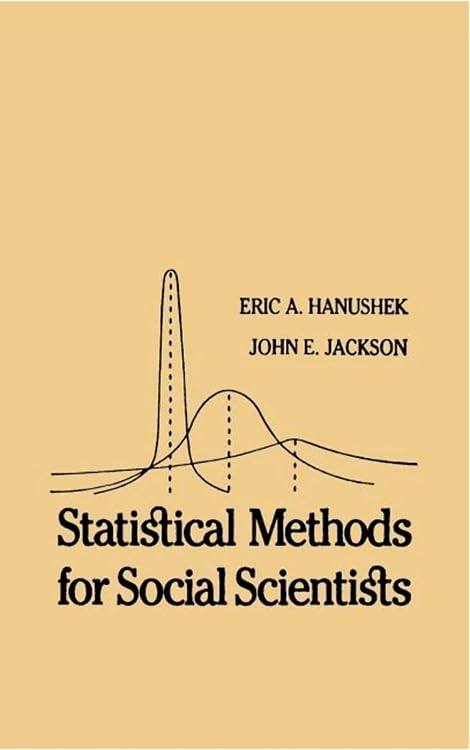
| Authors | Eric Alan HanushekJohn Edgar Jackson |
| Approach | Empirical orientation with practical examples |
| Unique elements | Extensive Monte Carlo simulations |
| Notable chapters | Chapter 1: empirical methods; Chapter 7: discrete and unobserved variables |
| Audience | Graduate students and applied researchers |
Our Verdict
Statistical Methods for Social Scientists is a valuable, application-focused text for graduate students and researchers who need methods tied to real examples and simulation evidence; its emphasis on Monte Carlo demonstrations and continuity of examples offers strong practical value despite some advanced sections that require prior statistical background.
Frequently Asked Questions
Is this book suitable for beginners?
It assumes some prior statistical knowledge; beginners may find it challenging and could benefit from a more introductory textbook first.
Does it include practical examples and code?
The book emphasizes practical examples and Monte Carlo simulations to demonstrate estimators, though it is primarily methodological rather than a software manual.
Are advanced topics covered?
Yes; the book covers advanced topics such as models with discrete dependent variables and unobserved variables in later chapters.
Editor's Take
A practical, example-driven text that uses Monte Carlo simulations to clarify estimator behavior; recommended for graduate students and applied researchers who want empirical methods tied to realistic examples.

Recently viewed
Recently viewed products will appear here as customers browse the store.