

Structural and Failure Mechanics of Sandwich Composites - Advanced
Structural and Failure Mechanics of Sandwich Composites - Advanced
Price subject to change. Tap below for current.
Couldn't load pickup availability
In this review of Structural and Failure Mechanics of Sandwich Composites the reviewer finds a focused, technically rigorous resource for engineers and researchers who need a deeper mechanics background on sandwich panels. The book's single biggest reason to buy is its emphasis on both theoretical models and three-dimensional elasticity solutions that serve as benchmarks for simplified theories; readers looking for a mathematically grounded reference to understand global buckling, wrinkling, local instabilities and face/core debonding will find it especially useful. This review highlights where the text succeeds as a reference and where a reader should supplement it with experimental handbooks.
Key Features
- Comprehensive deformation coverage: Examines important failure modes such as global buckling and wrinkling to clarify how sandwich panels behave under load.
- Theory depth: Presents both first-order and high-order sandwich panel theories so engineers can choose the appropriate model for their application.
- Elasticity benchmarks: Includes three-dimensional elasticity solutions that act as rigorous benchmarks for judging simplified plate, shell and beam theories.
- Failure mechanism focus: Discusses face/core debonding and local instabilities to inform design choices and failure mitigation strategies.
- Mechanics background: Supplies the underlying mechanics needed to understand deformation and failure rather than providing only empirical rules.
Who It's For
This book is best suited to graduate students, researchers, and practicing structural engineers who already have a grounding in elasticity and plate theory and need a reference that links rigorous analysis to sandwich panel behavior. It is appropriate for use as a course supplement in advanced solid mechanics or for engineers developing validated numerical models.
Those who should look elsewhere include readers seeking a hands-on testing manual or a practical construction guide without heavy mathematics, and professionals who need design standards, manufacturing procedures or quick empirical design charts rather than theoretical derivations.
Pros & Cons
Pros
- Covers a wide range of deformation and failure modes relevant to sandwich structures, aiding diagnosis and design.
- Provides both first-order and high-order theories so users can balance complexity and accuracy for modeling.
- Includes three-dimensional elasticity solutions that serve as objective benchmarks for simplified approaches.
Cons
- Its emphasis on theory and elasticity means it is not a practical testing handbook and may feel dense to readers seeking applied procedures.
Specifications
| Title | Structural and Failure Mechanics of Sandwich Composites |
| Series | Solid Mechanics and Its Applications, 121 |
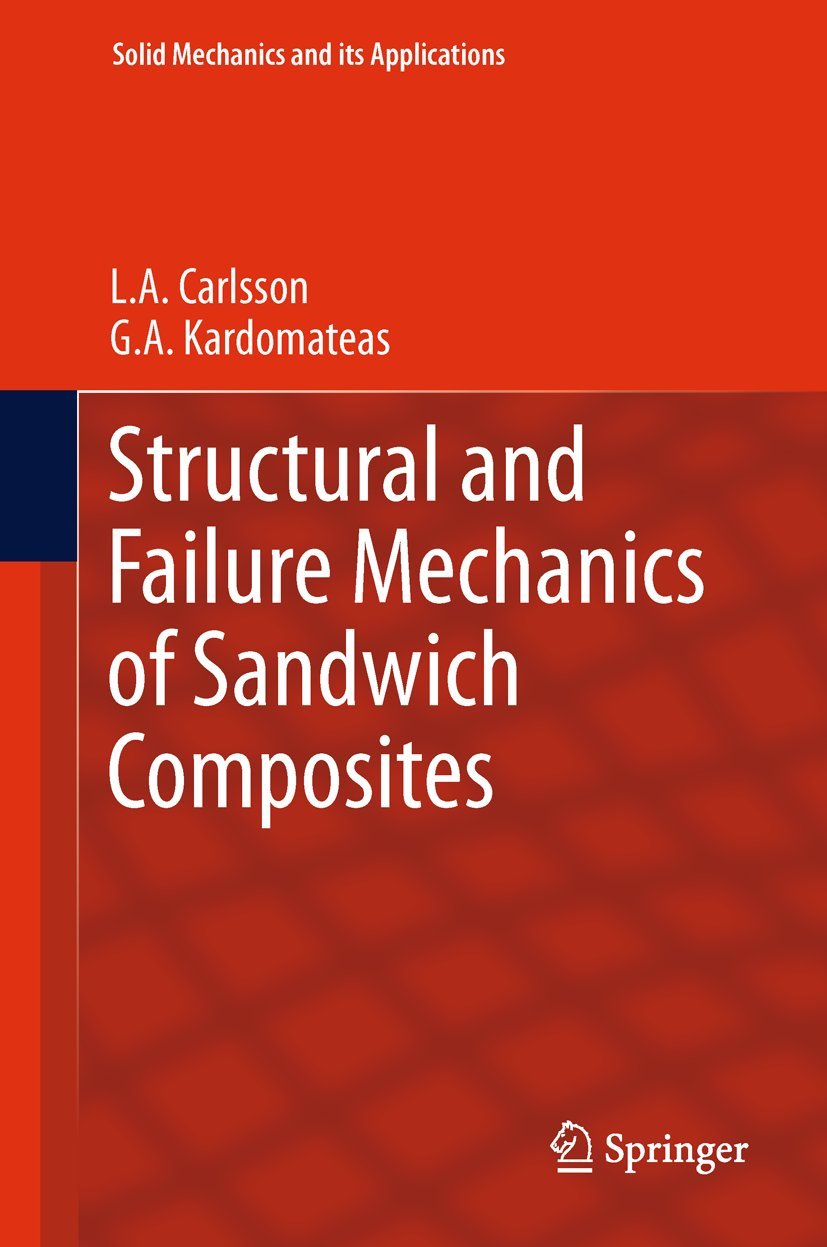
| Authors | L.A. A. Carlsson, G.A. Kardomateas |
| Coverage | Global buckling, wrinkling, local instabilities, face/core debonding |
| Theoretical content | First-order and high-order sandwich panel theories; 3D elasticity solutions |
| Intended audience | Graduate students, researchers, structural engineers |
Our Verdict
Structural and Failure Mechanics of Sandwich Composites is a strong, theory-forward reference for anyone who needs rigorous insight into sandwich panel behavior and failure modes. It is good value for engineers and researchers who will use its elasticity benchmarks to validate models, but less suitable as a step-by-step testing or fabrication manual.
Frequently Asked Questions
Does the book include experimental test methods?
Answer. The text emphasizes mechanics and analytical solutions; it is not primarily a test methods handbook and readers should consult standards or experimental guides for detailed test procedures.
Are worked three-dimensional solutions provided?
Answer. Yes, the book contains three-dimensional elasticity solutions intended to serve as benchmarks for simplified theories.
Who will benefit most from the material?
Answer. Graduate students, academic researchers and practicing structural engineers developing or validating models for sandwich panels will benefit most.
Editor's Take
A rigorous, theory-focused reference that links sandwich panel failure modes to first-order, high-order and 3D elasticity solutions; ideal for engineers and researchers validating models.

Recently viewed
Recently viewed products will appear here as customers browse the store.