

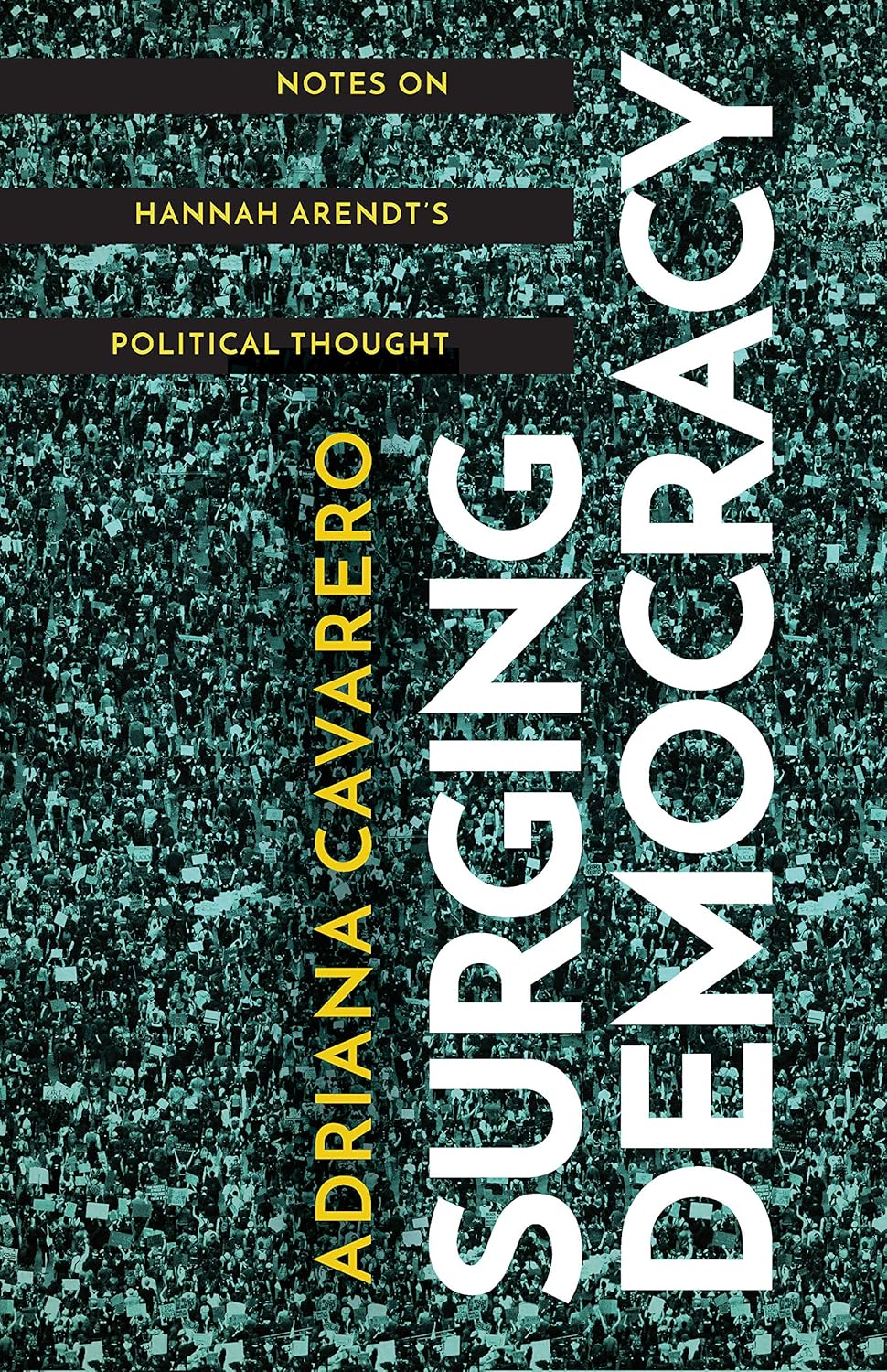
Surging Democracy: Notes on Hannah Arendts Political Thought
Surging Democracy: Notes on Hannah Arendts Political Thought
Price subject to change. Tap below for current.
Couldn't load pickup availability
In this review of Surging Democracy: Notes on Hannah Arendts Political Thought, the reviewer finds a compact, provocative intervention for readers interested in contemporary political theory. Adriana Cavarero builds on Arendtian ideas to sketch a model of democracy grounded in public plurality rather than violence, making this book especially valuable for scholars and activists seeking a fresh interpretive lens. The writing is intellectually engaged and accessible enough for informed readers, and the work stands out for its emphasis on the spontaneous, nonviolent creativity of bodies coming together in public as the seed of democratic life.
Key Features
- Arendtian foundations: Cavarero repeatedly grounds her argument in Hannah Arendt's view of politics as a participatory experience, clarifying how Arendtian concepts apply to current democratic challenges.
- Comparative reading: The book draws on Emile Zola, Elias Canetti, Boris Pasternak, and Roland Barthes to broaden the philosophical and literary context around democratic action.
- Engagement with contemporary thinkers: By addressing Judith Butler and others, Cavarero connects classical theory to ongoing debates about dissent and public life.
- Focus on plurality: The core benefit is a renewed model of democracy that emphasizes the spontaneous encounter of plural bodies in public as a source of political creativity.
- Nonviolent emphasis: The work foregrounds nonviolence as the genesis of democratic emergence, offering an alternative to readings that center force or conflict.
Who It's For
Scholars of political theory, graduate students in philosophy or political science, and engaged activists will find this book most useful; it provides a compact, conceptually rich reflection on how democratic agency can be understood without recourse to violence. Those teaching courses on Arendt, contemporary political thought, or democratic theory may assign chapters for seminar discussion.
Readers looking for an empirical handbook, a policy manual, or a broad survey of social movements should look elsewhere, as the book is an interpretive essay that prioritizes philosophical argument and literary examples over empirical case studies.
Pros & Cons
Pros
- Offers a clear, philosophically grounded reinterpretation of Arendt that is useful for theory-oriented readers.
- Engages diverse literary and theoretical figures to illuminate democratic plurality in unexpected ways.
- Stresses nonviolent, spontaneous public assemblage as a constructive democratic resource.
Cons
- The book is primarily theoretical and may feel abstract to readers seeking concrete policy or empirical analysis.
Specifications
| Title | Surging Democracy: Notes on Hannah Arendts Political Thought |
| Author | Adriana Cavarero |
| Focus | Democracy, Arendtian political thought, plurality |
| Notable engagements | Judith Butler; Emile Zola; Elias Canetti; Boris Pasternak; Roland Barthes |
| Key theme | Nonviolent creativity of public plurality |
Our Verdict
Cavarero delivers a concise and thought-provoking reinterpretation of Arendt that will reward readers who seek a philosophically sophisticated account of democratic life rooted in plurality and nonviolence. It is strong value for anyone wanting a conceptual corrective to violence-centered narratives of politics.
Frequently Asked Questions
Does the book require prior knowledge of Arendt?
Answer. Familiarity with Arendt helps but is not strictly required; Cavarero explicates key Arendtian ideas as she builds her argument.
Is this a practical guide to activism?
Answer. No, the book is a theoretical reflection emphasizing conceptual clarity over practical instructions for organizing.
Which other thinkers are discussed?
Answer. The book engages literary and philosophical figures including Emile Zola, Elias Canetti, Boris Pasternak, Roland Barthes, and addresses Judith Butler.
Editor's Take
Cavarero offers a concise, thought-provoking reinterpretation of Arendt that highlights democratic plurality and nonviolence, making it valuable for scholars and engaged readers seeking a conceptual alternative to force-centered accounts.

Recently viewed
Recently viewed products will appear here as customers browse the store.