

The American Journal of Psychology 1902 Vol. 13 - Time Perception
The American Journal of Psychology 1902 Vol. 13 - Time Perception
Price subject to change. Tap below for current.
Couldn't load pickup availability
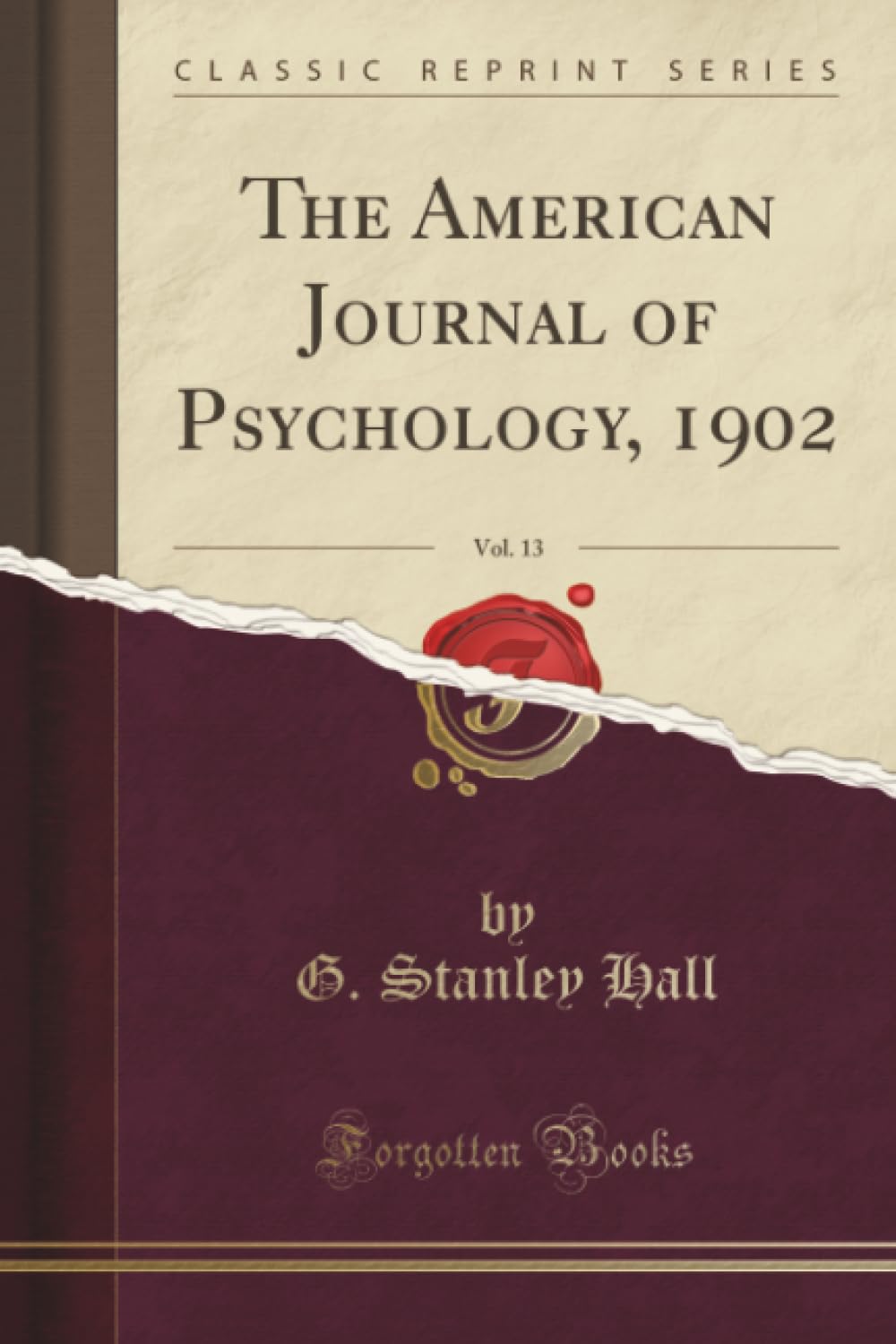
In this review of The American Journal of Psychology, 1902, Vol. 13, the focus is on a focused academic investigation into the judgement of time intervals. This reprint is best for students, researchers, and historians of psychology who need a primary-source study of temporal perception and the influence of sensory filling on estimation. The single biggest reason to buy is the detailed experimental and theoretical discussion linking earlier work by Mach, Fechner, and Weber to observed fluctuations in time judgement, providing a compact, original account useful for citation and close study.
Key Features
- Primary-source analysis: Presents the author's experimental approach to the judgement of time intervals, valuable for historical and methodological reference.
- Comparative context: Discusses prior studies by Mach, Fechner, Estel, and Weber, helping readers connect classical findings to the author's conclusions.
- Sensory focus: Explores the impact of auditory and visual stimulation on perception, clarifying how modality affects time estimation.
- Filling impressions: Investigates how the type and number of filling impressions alter time judgement, offering specific variables for replication or critique.
- Organic factors: Considers the role of organic functions in temporal perception, broadening the study beyond pure psychophysics to physiological influence.
Who It's For
This volume is aimed at graduate students and researchers in psychology and cognitive science who need a historical, experiment-driven account of time perception and methods. It suits anyone preparing literature reviews, historical overviews, or methodological comparisons in psychophysics and perception studies.
Readers seeking a modern textbook introduction, quick practical guidance, or extensive contemporary data sets should look elsewhere; this reprint is most valuable as a classic, original report rather than a current methods manual.
Pros & Cons
Pros
- Detailed experimental description that supports scholarly citation and close reading.
- Clear linkage to earlier foundational work, providing historical continuity in perception research.
- Specific focus on auditory versus visual effects, useful for modality comparisons.
- Insightful treatment of how filling impressions and organic factors influence time estimates.
Cons
- As a classic reprint, it does not include modern updates or contemporary replications.
Specifications
| Title | The American Journal of Psychology, 1902, Vol. 13 |
| Author / Editor | G. Stanley Hall |
| Subject | Judgement of time intervals; perception |
| Historical context | Discusses Mach, Fechner, Estel, and Weber |
| Focus areas | Auditory and visual stimulation; filling impressions; organic functions |
Our Verdict
For scholars and students who value original experimental reports, this reprint delivers a focused, well-contextualized study of temporal judgement that remains useful for historical and methodological work. It is good value as a primary-source reference but not a substitute for modern overviews or recent empirical reviews.
Frequently Asked Questions
Does this volume include experimental methods?
Yes. The text describes experiments and observations on time judgement and the variables that affect estimation.
Is this reprint suitable for beginners?
It is best for readers with some background in psychology or psychophysics; beginners may prefer a modern introductory text first.
Does the book compare different sensory modalities?
Yes. The author examines the impact of auditory and visual stimulation on the perception of time intervals.
Editor's Take
This reprint is a focused, historically grounded study of time judgement valuable to scholars and students for its experimental descriptions and links to foundational work, though it lacks modern updates.

Recently viewed
Recently viewed products will appear here as customers browse the store.