

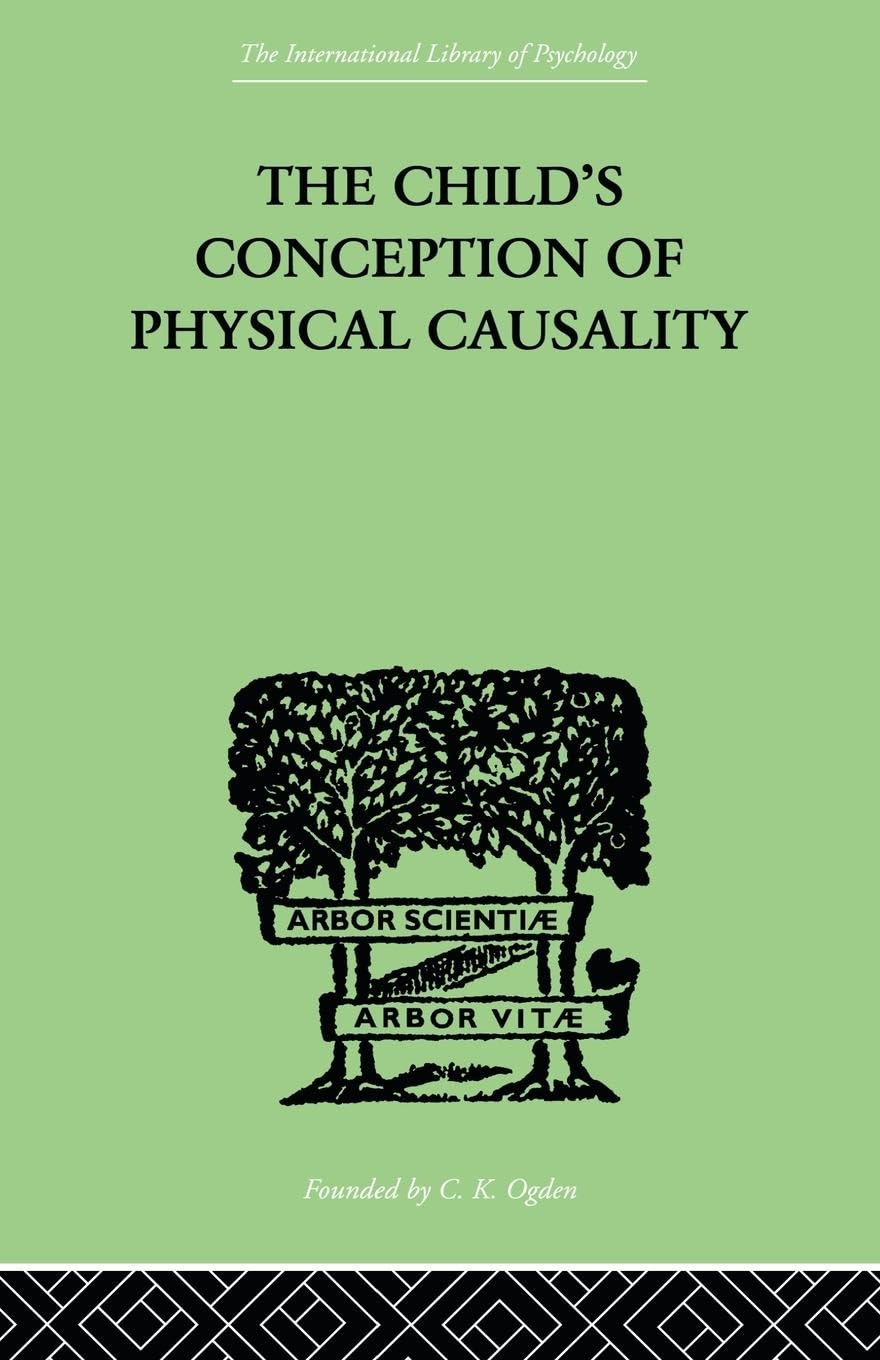
The Child's Conception of Physical Causality - Classic Piaget
The Child's Conception of Physical Causality - Classic Piaget
Price subject to change. Tap below for current.
Couldn't load pickup availability
Our review of The Child's Conception of Physical Causality explains why this early Jean Piaget work remains essential reading for anyone studying how children think about the physical world. The book is best for researchers, developmental psychologists, and teachers who want a methodical account of experimental tasks that reveal children's intuitive theories about objects, motion, and causality. It stands out because Piaget pairs careful empirical data with clear descriptions of experimental setups, making the text both a historical landmark and a practical source of ideas for designing child-centered studies.
Key Features
- Empirical experiments: A rich collection of systematically organized tasks that demonstrate how children reason about physical phenomena, useful for replicable classroom or lab work.
- Developmental focus: Detailed observations highlight the progression of children's conceptions of causality across ages, supporting comparative studies of cognitive maturation.
- Clear methodology: Piaget's descriptions of experimental procedures make it easier for readers to understand how findings were obtained and to adapt tasks for new samples.
- Interpretive commentary: The book links raw data to theoretical claims about thought development, helping readers connect observation with broader psychological ideas.
- New introduction: Jaan Valsiner's introduction places Piaget's work in historical context, clarifying its continuing relevance for contemporary developmental psychology.
Who It's For
This volume is primarily for graduate students, researchers, and experienced educators who want primary-source access to Piaget's early experimental program. Its focus on task-based empirical data makes it particularly valuable for those designing studies of thinking, perception, and physical reasoning in children.
Readers seeking a brief overview or a modern textbook summarizing decades of developmental research should look elsewhere, since this book presents original experiments and interpretation rather than a contemporary literature review or applied classroom curriculum.
Pros & Cons
Pros
- Provides a deep trove of empirical data that can be adapted for new experimental work or teaching demonstrations.
- Systematic task descriptions make replication and classroom use straightforward for trained readers.
- Balances observation and interpretation, offering insight into both methods and theory in developmental psychology.
Cons
- Not a quick primer; readers without background in developmental methods may find the material dense.
Specifications
| Title | The Child's Conception of Physical Causality |
| Series | The International Library of Psychology: Developmental Psychology, 80 |
| Author / Brand | Jean Piaget |
| Content Focus | Experimental tasks and empirical data on children's physical reasoning |
| Introduction | New introduction by Jaan Valsiner |
| Intended Audience | Researchers, graduate students, educators |
Our Verdict
The book is a durable, valuable resource for anyone serious about the development of thought; its empirical richness and clear task descriptions make it excellent value for researchers and advanced students who will use the material as a methodological and theoretical reference.
Frequently Asked Questions
Does this book include experimental procedures?
Yes, Piaget provides detailed descriptions of the tasks and observations used to probe children's physical reasoning.
Is it suitable for classroom teachers?
It is useful for teachers who want to adapt experiments, but it is written at a research level rather than as a curriculum guide.
Who wrote the introduction?
The new introduction is by Jaan Valsiner, who situates Piaget's work in historical and theoretical perspective.
Editor's Take
A durable, empirical resource for researchers and advanced students, this Piaget book offers rich experimental data and clear task descriptions that make it worth consulting for studies of children's physical reasoning.

Recently viewed
Recently viewed products will appear here as customers browse the store.