

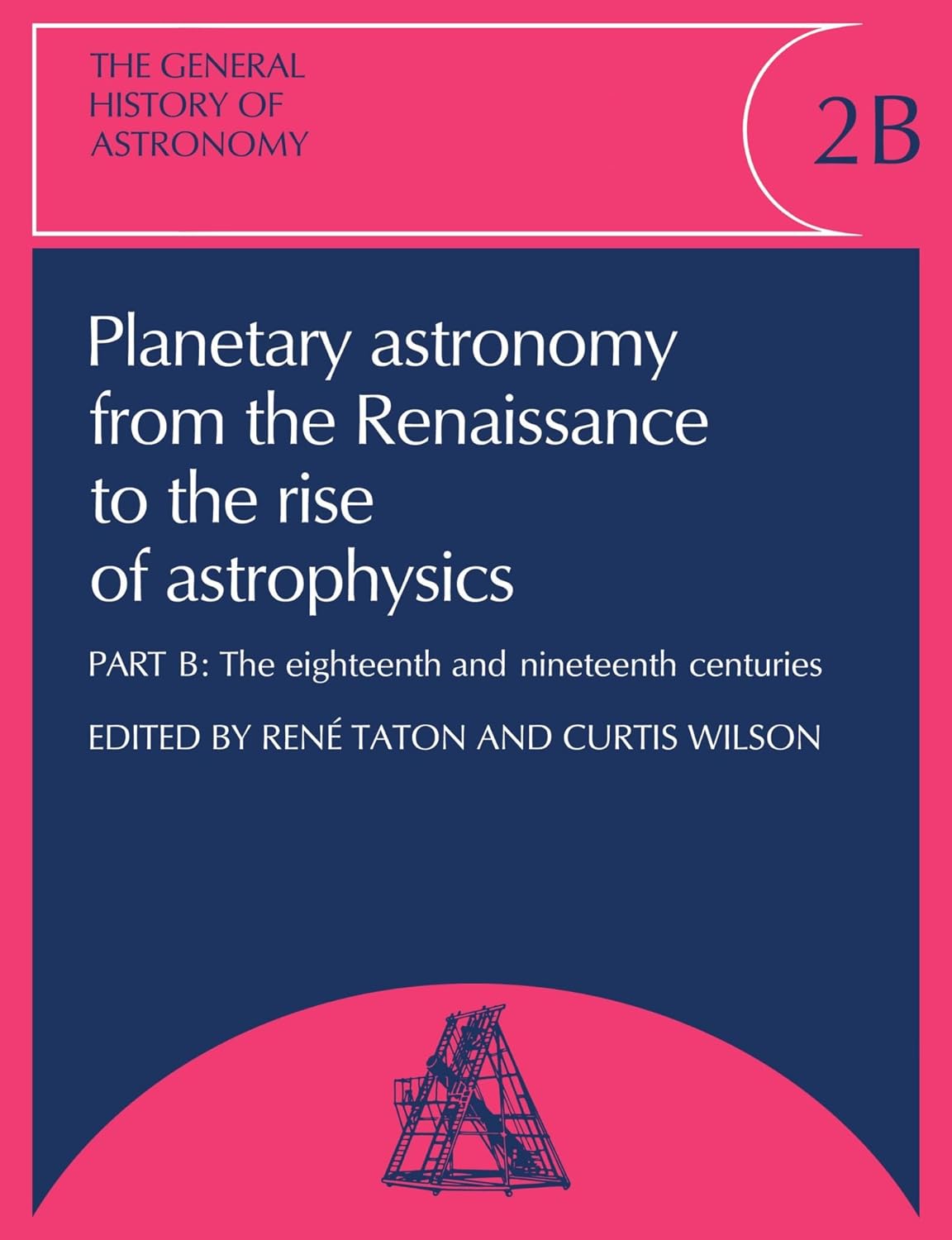
The General History of Astronomy: Volume 2 - Planetary Astronomy
The General History of Astronomy: Volume 2 - Planetary Astronomy
Price subject to change. Tap below for current.
Couldn't load pickup availability
In this review of The General History of Astronomy: Volume 2, Planetary Astronomy from the Renaissance to the Rise of Astrophysics, the bottom line is clear: this is a scholarly, detail-rich volume for readers who want a deep historical synthesis of celestial mechanics and observational advances from the 17th through 19th centuries. The book's chief appeal is its balanced combination of biographical context and technical development, tracing how Newton's inverse-square law was received and how mathematical celestial mechanics advanced through Clairaut, Euler, LeVerrier, Newcomb, Hill, and Poincare. For historians of science and advanced students, it serves as a reliable, single-source narrative.
Key Features
- Multi-author scholarship: Twelve contributors bring focused expertise so chapters reflect specialist knowledge across periods and topics.
- Historical narrative: The reception of Newton and subsequent debates are explained clearly to show how ideas spread and evolved.
- Celestial mechanics emphasis: Detailed attention to mathematical development from Clairaut and Euler to Poincare helps readers follow theoretical progress.
- Observation and theory balance: Chapters highlight key observational discoveries alongside theoretical advances to illustrate their rapprochement.
- Biographical detail: Short studies of major astronomers illuminate the interactions and intellectual context behind discoveries.
Who It's For
This volume is best for academic readers, graduate students, and serious amateurs who want a deep, historically grounded account of planetary astronomy and celestial mechanics. Readers with prior knowledge of basic physics or mathematics will get the most from the discussions of Newtonian and post-Newtonian theory.
Those seeking an introductory popular history or a heavily illustrated coffee-table book should look elsewhere; this text is focused on scholarly narrative and technical development rather than broad popularization or extensive visual material.
Pros & Cons
Pros
- Authoritative multi-author approach provides specialist insight across chapters.
- Clear coverage of the reception of Newton's law makes the intellectual history accessible.
- Strong focus on the evolution of mathematical celestial mechanics offers depth for researchers.
Cons
- Not intended as a beginner-friendly popular account, so some chapters assume prior technical background.
Specifications
| Title | The General History of Astronomy: Volume 2, Planetary Astronomy |
| Subtitle | Planetary Astronomy from the Renaissance to the Rise of Astrophysics (Part B) |
| Editors/Authors | Rene Taton, Curtis Wilson, Michael Hoskin; twelve contributing authors |
| Scope | History of celestial mechanics and observational discovery, 18th-19th centuries |
| Coverage | Reception of Newton; Clairaut, Euler, LeVerrier, Newcomb, Hill, Poincare |
| Balance | Emphasis on mathematical theory with chapters on observational rapprochement |
Our Verdict
The General History of Astronomy: Volume 2 is a worthwhile purchase for historians of science and advanced students who need a compact, expert synthesis of planetary astronomy from the Renaissance through the rise of astrophysics. Its multi-author structure and emphasis on mathematical development make it good value as a reference and course supplement, though casual readers may find the technical chapters demanding.
Frequently Asked Questions
Does this volume focus on biographies or theory?
Answer. It balances both, supplying biographical context while giving substantial attention to the mathematical theory of celestial mechanics.
Is prior mathematical knowledge required?
Answer. Some chapters assume familiarity with basic mechanics and mathematical methods, so prior background helps.
Who contributed to the book?
Answer. The volume is edited/compiled under Rene Taton, Curtis Wilson and Michael Hoskin and contains chapters by twelve different specialist authors.
Editor's Take
A scholarly, multi-author synthesis of planetary astronomy from Newton to Poincare; ideal for historians and advanced students who need a detailed, balanced account of celestial mechanics and observational discovery.

Recently viewed
Recently viewed products will appear here as customers browse the store.