

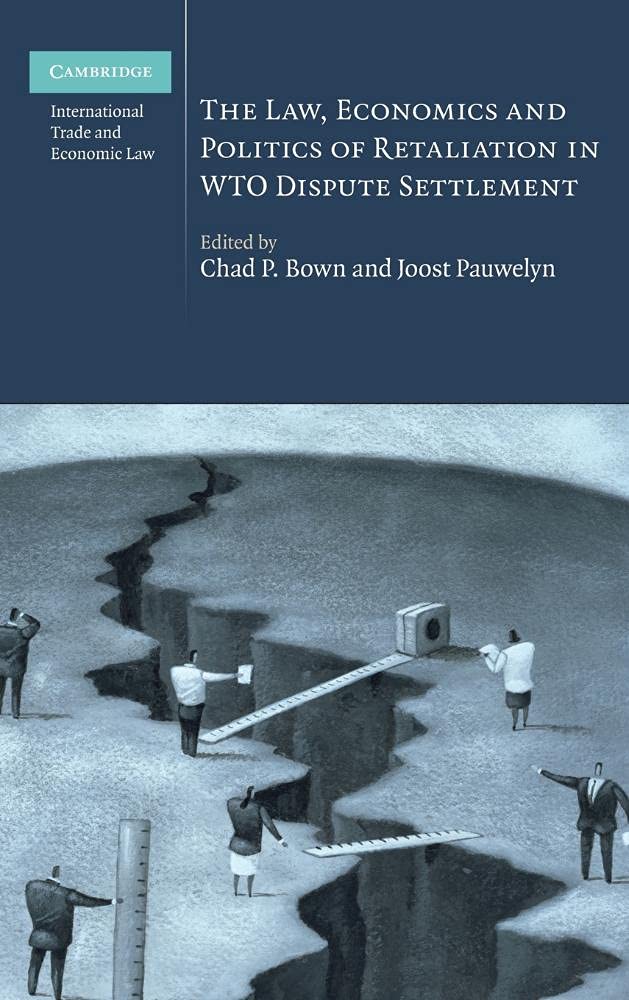
The Law, Economics and Politics of Retaliation in WTO Dispute
The Law, Economics and Politics of Retaliation in WTO Dispute
Price subject to change. Tap below for current.
Couldn't load pickup availability
In this review of The Law, Economics and Politics of Retaliation in WTO Dispute Settlement, the reviewer finds a rigorous, multi-author assessment best suited to legal scholars, trade economists and policy practitioners who need a detailed account of how WTO retaliation works. The book's single biggest reason to buy is its combination of legal analysis, economic calculation and firsthand political accounts, which together clarify both the rules and the practical choices states face when seeking authorization to retaliate. This review focuses on the book's usefulness for research and policy design rather than casual reading.
Key Features
- Comprehensive legal analysis: The volume reviews the WTO rules on permissible retaliation and helps readers understand the procedural and doctrinal contours of authorized sanctions.
- Economic assessment: Contributors evaluate the economic rationale and calculations behind retaliation, which aids policymakers in weighing costs and benefits.
- Firsthand case accounts: Chapters present experiences from countries that obtained WTO authorization to retaliate, offering practical lessons from the United States, the EC, Mexico and Antigua.
- Multidisciplinary perspectives: The book combines scholarship from academics, trade diplomats and practitioners to provide balanced legal, economic and political viewpoints.
- Series context: As part of the Cambridge International Trade and Economic Law series, the book situates retaliation within wider trade law debates and institutional practice.
Who It's For
This volume is aimed primarily at academic researchers, international trade lawyers and government trade officials who require detailed, source-based analysis of retaliation in WTO dispute settlement. Its dense, multi-author structure and focus on legal doctrine and economic reasoning make it a strong reference for policy memos, litigation strategy and graduate study.
Less suitable for a general reader seeking a brief overview, or for those wanting a single-author narrative; readers without prior familiarity with WTO dispute settlement procedures may find some chapters technical and preferable as a reference rather than casual reading.
Pros & Cons
Pros
- Wide-ranging contributions provide a thorough look at both the legal rules and the economic logic behind authorized retaliation.
- Firsthand country case studies supply practical insights into how retaliation plays out politically and administratively.
- Cross-disciplinary authorship strengthens the book's relevance for lawyers, economists and policymakers.
Cons
- Multi-author format means chapter depth and tone vary, which can make the book uneven for readers seeking a single unified voice.
Specifications
| Title | The Law, Economics and Politics of Retaliation in WTO Dispute Settlement |
| Series | Cambridge International Trade and Economic Law, Series Number 3 |
| Editors | Chad P. Bown, Joost Pauwelyn |
| Content focus | Legal rules, economic rationale, political case studies |
| Contributors | More than thirty academics, diplomats and practitioners |
| Case studies | Includes experiences of the United States, the EC, Mexico and Antigua |
Our Verdict
For specialists in trade law and policy, this volume is a valuable, well-documented resource that combines doctrinal analysis with economic modeling and practical case narratives; it represents good value as a research reference even if its multi-author format occasionally produces uneven chapters.
Frequently Asked Questions
Does the book explain how WTO retaliation is authorized?
The volume provides detailed analysis of the legal rules and arbitration practice that govern when and how WTO members can obtain authorization to retaliate.
Are there real-world examples in the book?
Yes; contributors include firsthand accounts from countries such as the United States, the EC, Mexico and Antigua that obtained WTO authorization to retaliate.
Is this suitable for non-specialists?
While informative, the book is best for readers with some background in trade law or economics, as several chapters are technical and aimed at researchers and practitioners.
Editor's Take
This multi-author volume is a rigorous, well-documented resource for trade law scholars and policymakers, combining legal analysis, economic assessment and firsthand case studies to clarify WTO retaliation despite some uneven chapter tones.

Recently viewed
Recently viewed products will appear here as customers browse the store.