

The Method of Volume Averaging - Rigorous Transport in Porous Media
The Method of Volume Averaging - Rigorous Transport in Porous Media
Price subject to change. Tap below for current.
Couldn't load pickup availability
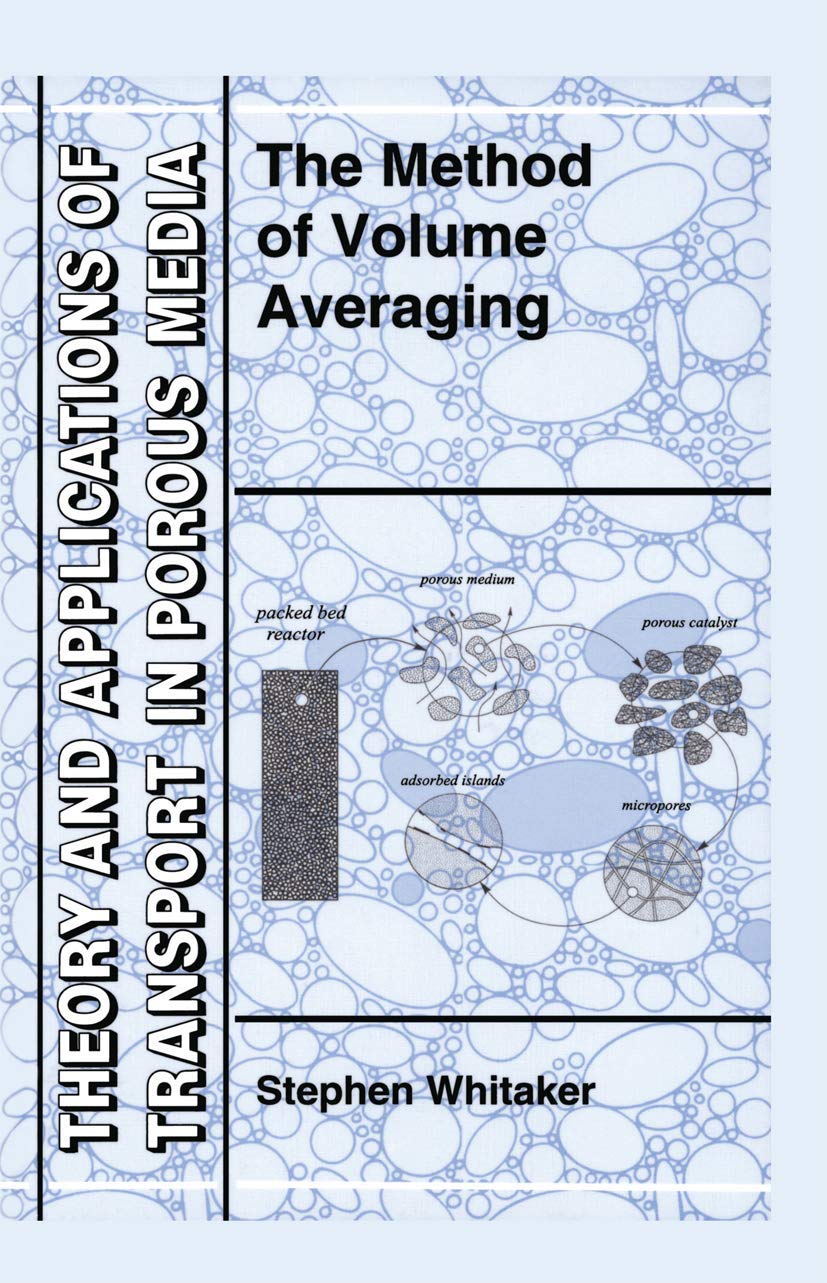
In this review of The Method of Volume Averaging, the book is presented as a focused, graduate-level resource for engineers and scientists working on multiphase transport in porous media. The single biggest reason to buy is its rigorous, course-tested presentation that links classical continuum physics to practical methods for predicting effective transport coefficients, making it especially useful for those who need a solid theoretical foundation and worked problems to apply in research or advanced coursework.
Key Features
- Course-based development: Material originates from a ten-week graduate course and delivers a coherent sequence of concepts that build from fundamentals to applications.
- Rigorous theoretical basis: Emphasizes a continuum physics foundation so readers can follow the derivation of spatially smoothed equations with mathematical clarity.
- Predictive transport methods: Provides a method for predicting effective transport coefficients that appear in averaged equations, aiding model development for multiphase systems.
- Practical problems included: Each chapter contains problems that reinforce theory and applications, helping readers test understanding with relevant exercises.
- Instructor support available: Detailed solutions for all problems are available from the author, which benefits instructors and self-learners who need worked answers.
Who It's For
The Method of Volume Averaging is best suited to graduate students, researchers, and practicing engineers in fields such as chemical engineering, civil and environmental engineering, and hydrology who require a rigorous treatment of transport in porous media. Readers who need both derivations and a path to compute effective coefficients will find the text especially valuable.
It is less appropriate for casual readers or undergraduates without prior continuum mechanics or transport theory background; those audiences should seek an introductory text before tackling this course-level presentation.
Pros & Cons
Pros
- Clear, course-tested structure that supports progressive learning of complex ideas.
- Strong link between continuum physics and averaged equations, aiding theoretical understanding.
- Includes practical problems and available detailed solutions, which help cement learning.
Cons
- Assumes advanced prerequisites, so it is not an introductory treatment for novices.
Specifications
| Title | The Method of Volume Averaging (Theory and Applications of Transport in Porous Media) |
| Author | S. Whitaker |
| Scope | Multiphase systems and transport in porous media |
| Origin | Based on a ten-week graduate course taught over 20 years |
| Includes | Chapter problems with solutions available from the author |
| Approach | Classical continuum physics with spatially smoothed equations |
Our Verdict
For graduate students and researchers who need a rigorous, course-proven foundation in averaging methods for porous media transport, this book is an excellent value. Its combination of mathematical derivation, predictive approaches for transport coefficients, and chapter problems with available solutions makes it a practical reference for advanced study and research.
Frequently Asked Questions
Is this book suitable for classroom use?
Yes; the material is based on a ten-week graduate course and includes problems and instructor solutions that support classroom adoption.
Does the book include practical examples for engineers?
While the focus is theoretical, each chapter contains problems and applications that guide practical use of the averaged equations and transport coefficient predictions.
What background is recommended?
A solid foundation in continuum mechanics and transport theory is recommended before using this text.
Editor's Take
A rigorous, course-proven graduate text that links continuum physics to practical methods for predicting effective transport coefficients in porous media; ideal for researchers and advanced students.

Recently viewed
Recently viewed products will appear here as customers browse the store.