

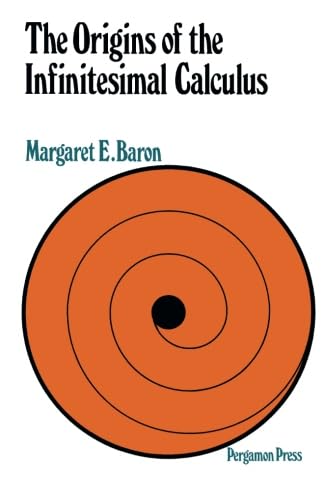
The Origins of Infinitesimal Calculus - Historical Study and Analysis
The Origins of Infinitesimal Calculus - Historical Study and Analysis
Price subject to change. Tap below for current.
Couldn't load pickup availability
In this review of The Origins of Infinitesimal Calculus, the reviewer finds a scholarly, deeply documented account ideal for readers who want the historical development behind mathematical techniques. The book is best for those seeking context rather than quick technique: it traces Greek, Hindu and Arabic sources and follows seventeenth century advances to show how infinitesimal methods emerged. This review highlights the book's archival documentation, focus on changing proof structures, and its value for historians and mathematically mature readers.
Key Features
- Detailed historical scope: The book examines Greek, Hindu, and Arabic sources to show the long foundations that informed seventeenth century infinitesimal methods, giving readers a broad chronological view.
- Documented development: Chapters include careful documentation of sources and methods, which helps readers verify claims and follow the evolution of ideas.
- Focus on core concepts: Discussion of tangents, arcs, and the composition of motions clarifies how central notions were reformulated during the development of calculus.
- Linking differential and integral processes: The text traces how methods of differentiation and integration became conceptually connected, useful for understanding modern calculus foundations.
- Analysis of proof structure: Consideration of changes in proof techniques shows how presentation and rigor evolved alongside new rules for tangents and quadrature.
- 1969 edition: As a historical edition, it reflects scholarship and editorial choices of its time, valuable for provenance and citation.
Who It's For
The Origins of Infinitesimal Calculus is primarily for historians of mathematics, graduate students, and mathematicians interested in the conceptual origins of calculus rather than introductory computations. Readers who appreciate archival detail and the interplay of cultures in mathematical development will find the chapters rewarding and illuminating.
It is less suitable for beginners seeking a textbook-style introduction to techniques or for casual readers wanting light reading. Those looking for modern pedagogical exercises or step-by-step problem sets should look elsewhere, as the emphasis here is historical analysis and documentation.
Pros & Cons
Pros
- Comprehensive historical coverage that situates seventeenth century work within Greek, Hindu, and Arabic traditions.
- Careful documentation that supports further scholarly research and citation.
- Clear treatment of how concepts like tangents and quadrature evolved, aiding conceptual understanding.
- The book links differential and integral methods, useful for readers studying the foundations of calculus.
Cons
- The 1969 edition reflects scholarship of its era and may not include later historiographical revisions or recent discoveries.
- Not intended as a practical introduction to calculus techniques, so it lacks pedagogical exercises for novices.
Specifications
| Title | The Origins of Infinitesimal Calculus |
| Author | Margaret E. Baron |
| Edition | 1969 edition |
| Subject focus | Historical development of infinitesimal methods |
| Coverage | Greek, Hindu, Arabic sources; seventeenth century developments |
| Key topics | Tangents, quadrature, composition of motions, link between differential and integral |
Our Verdict
The Origins of Infinitesimal Calculus is a strong choice for scholars and advanced students who want a documented, contextual study of how calculus developed. Its value lies in archival detail and conceptual analysis rather than as a teaching text, making it good value for research libraries and serious readers interested in the historical foundations of calculus.
Frequently Asked Questions
Does this book cover non-European sources?
Yes; it explicitly treats Greek, Hindu, and Arabic sources as part of the development of infinitesimal methods.
Is this a how-to calculus textbook?
No; the book is a historical and analytical study and does not function as a practical instructional textbook with exercises.
Which edition is referenced?
The review and specifications refer to the 1969 edition of the work.
Editor's Take
A well-documented historical study that traces Greek, Hindu, and Arabic sources to seventeenth century infinitesimal methods; best for scholars and advanced students who want conceptual foundations rather than a teaching text.

Recently viewed
Recently viewed products will appear here as customers browse the store.