

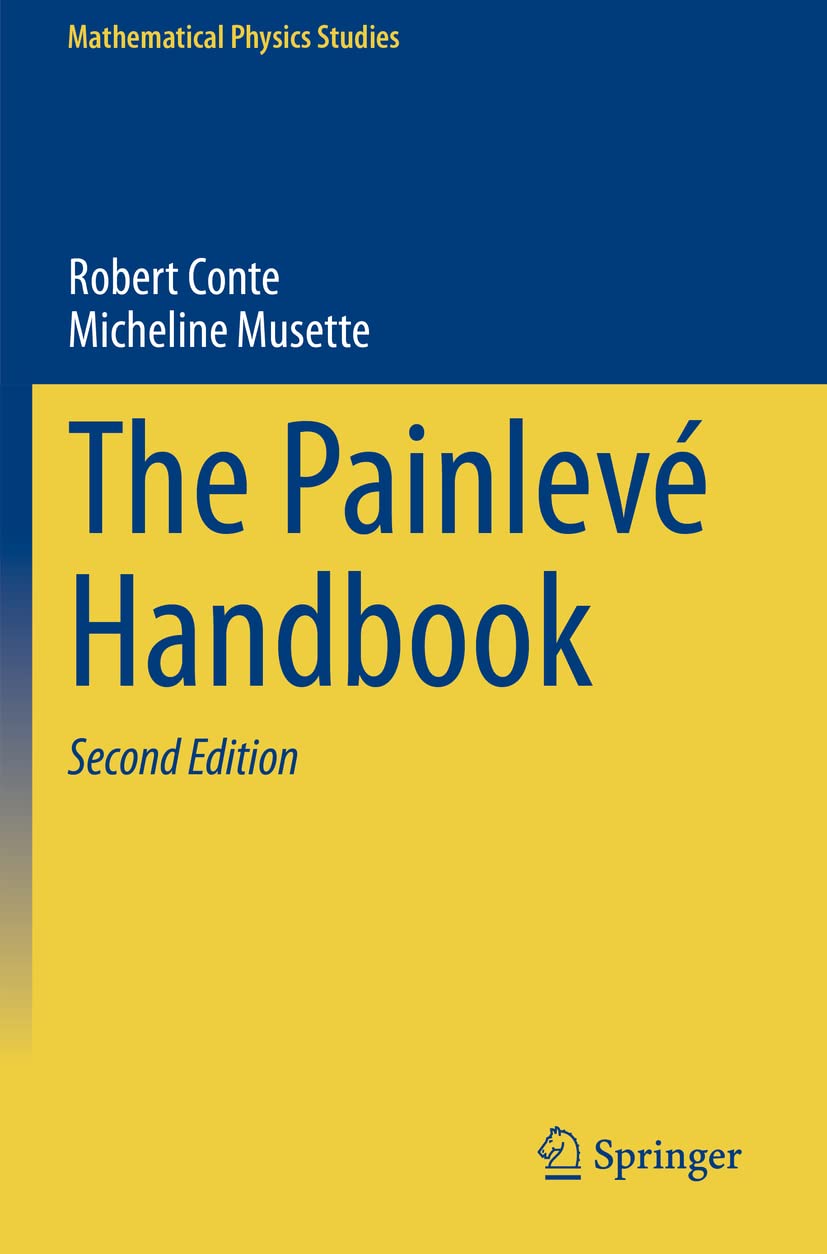
The Painleve Handbook - Practical Guide to Singularity Analysis
The Painleve Handbook - Practical Guide to Singularity Analysis
Price subject to change. Tap below for current.
Couldn't load pickup availability
In this review of The Painleve Handbook, the reviewer finds a rigorous and practical reference aimed at mathematicians and physicists working with nonlinear differential and difference equations; the single biggest reason to buy is its clear demonstration of how Painleve analysis becomes an algorithmic tool to construct explicit solutions to integrable and physically relevant equations. This second edition is noticeably updated and expanded, making it a useful companion for researchers and advanced graduate students who need direct worked examples and recent theoretical context to apply singularity analysis.
Key Features
- Comprehensive exposition: The book walks through the singularity analysis of differential and difference equations step by step, helping readers apply the Painleve test in practical problems.
- Algorithmic approach: Emphasis on algorithmic construction of explicit solutions makes the methods reproducible for both ordinary and partial differential equations.
- Illustrative examples: Integrable equations such as the nonlinear Schrodinger and Korteweg-de Vries equations are treated in detail to show method application.
- Physically relevant cases: Numerous examples, including the Kuramoto-Sivashinsky and Kolmogorov-Petrovski-Piskunov equations, connect theory to real-world models.
- Updated theory: The second edition incorporates recent insights from Nevanlinna theory and extended analysis for the cubic and quintic Ginzburg-Landau equations.
Who It's For
The Painleve Handbook is best for researchers, postdocs, and advanced graduate students in mathematical physics or applied mathematics who already have a solid grounding in differential equations and complex analysis and who want a hands-on guide to singularity analysis and explicit solution construction. Its algorithmic orientation and worked examples make it suitable as a desk reference when attacking nonlinear integrable models.
Readers seeking an introductory textbook on ordinary differential equations or a casual overview of integrable systems should look elsewhere; the book assumes familiarity with advanced material and is not designed as an elementary introduction for beginners.
Pros & Cons
Pros
- Detailed, example-driven presentation of the Painleve test that supports reproducible solution methods.
- Coverage of both differential and difference equations which broadens applicability to discrete models.
- Inclusion of modern theoretical context, such as Nevanlinna theory, enhances the second edition's relevance.
Cons
- The material presumes advanced background and is not accessible to readers without prior graduate-level training.
Specifications
| Title | The Painleve Handbook (Mathematical Physics Studies) |
| Authors | Robert Conte, Micheline Musette |
| Edition | Second edition, revised and expanded |
| Scope | Singularity analysis of differential and difference equations |
| Illustrated with | Nonlinear Schrodinger, Korteweg-de-Vries, Henon-Heiles, Ginzburg-Landau equations |
| Applications | Kuramoto-Sivashinsky, Kolmogorov-Petrovski-Piskunov, and other physical models |
Our Verdict
The Painleve Handbook is a substantial and practical reference for practitioners in mathematical physics who need a rigorous, example-rich guide to Painleve analysis. While it assumes a high level of background knowledge, its algorithmic focus and updated content make it good value for researchers and advanced students seeking to apply singularity methods to integrable and physically motivated equations.
Frequently Asked Questions
Does this edition include new material?
Yes, the second edition is extensively revised, updated, and expanded and includes recent insights from Nevanlinna theory and expanded analysis for Ginzburg-Landau equations.
Are worked examples provided?
Yes, the book includes detailed examples such as the nonlinear Schrodinger and Korteweg-de-Vries equations and several physically relevant models to illustrate methods.
Is this suitable for beginners?
No, the text assumes advanced background in differential equations and complex analysis and is best for graduate-level readers and researchers.
Editor's Take
The Painleve Handbook is a rigorous, example-rich reference for researchers and advanced students; its algorithmic Painleve analysis and updated theory make it a valuable tool for constructing explicit solutions to nonlinear equations.

Recently viewed
Recently viewed products will appear here as customers browse the store.