

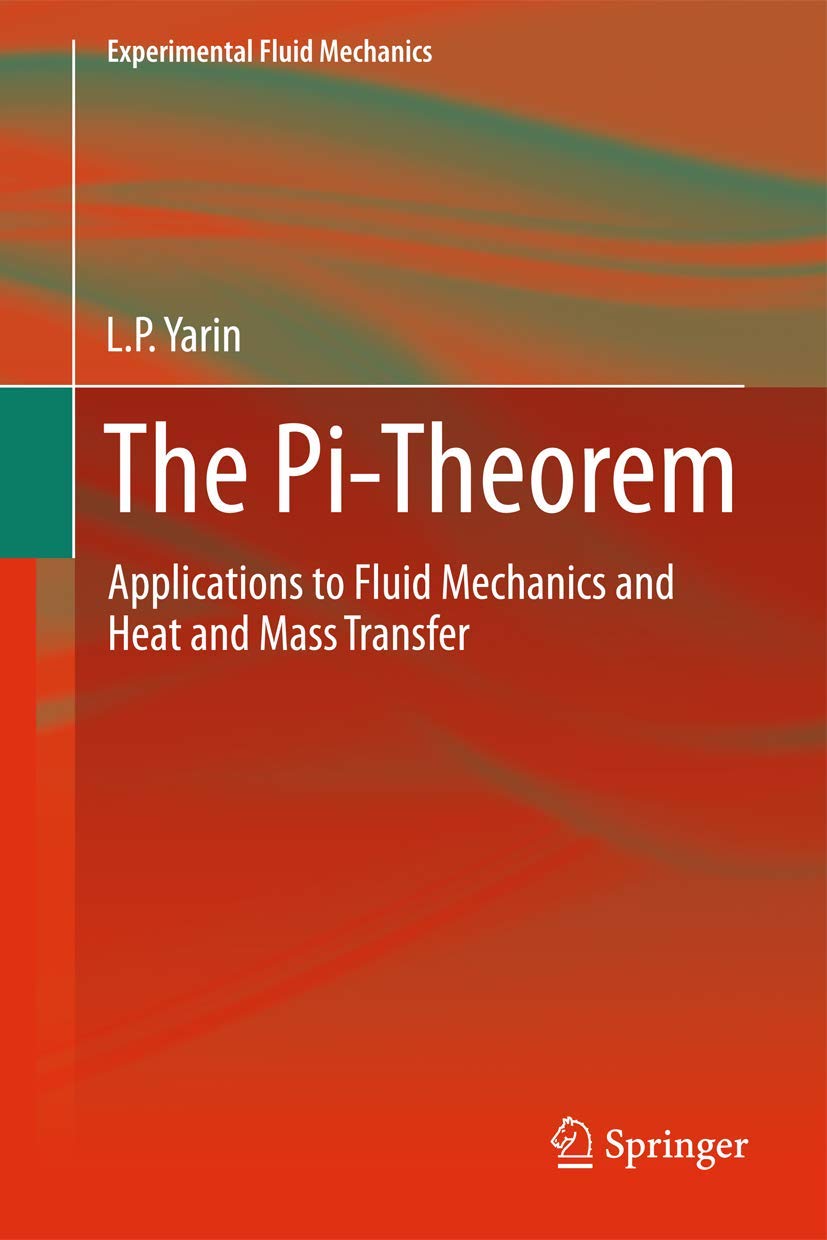
The Pi-Theorem: Applications to Fluid Mechanics and Heat and Mass
The Pi-Theorem: Applications to Fluid Mechanics and Heat and Mass
Price subject to change. Tap below for current.
Couldn't load pickup availability
In this review of The Pi-Theorem: Applications to Fluid Mechanics and Heat and Mass Transfer, the bottom line is clear: this is a focused, practical resource for experimentalists and graduate students who want a conceptual toolset for planning and interpreting experiments. The author presents the Pi-theorem as a way to extract physical scalings from governing equations, and the book's strongest appeal is its direct linking of dimensional analysis to experimental design and interpretation. Readers seeking hands-on guidance for fluids experiments will find the book consistently useful.
Key Features
- Pi-theorem focus: The book demonstrates how to apply the Pi-theorem to reduce complex fluid problems to meaningful dimensionless groups for experiment planning.
- Fluid mechanics applications: Concrete examples show how dimensional analysis illuminates flow processes across subdisciplines of experimental fluid mechanics.
- Heat and mass transfer coverage: Treatments include thermal and mass transport contexts so researchers can derive relevant similarity parameters beyond pure hydraulics.
- Conceptual grounding: A short introduction to the underlying differential equations gives readers the mathematical motivation behind the dimensional approach.
- Experimental planning value: The work emphasizes how dimensional reasoning leads to intelligent, efficient experimental designs and interpretation of results.
- Cross-disciplinary reach: Examples and approaches cut across many subdisciplines, making the material useful to a broad experimental fluids community.
Who It's For
The Pi-Theorem is best suited to graduate students, researchers, and experimental engineers who work with fluid mechanics, heat transfer, or mass transport and want to strengthen their intuition for scaling and similarity. It assumes the reader has some familiarity with differential equations and basic transport concepts and rewards those who plan or interpret laboratory or field experiments.
Those looking for a beginner textbook in introductory fluid mechanics or a heavily mathematical treatise on advanced theoretical hydrodynamics may want a different title; this book is practical and applied rather than a comprehensive beginner primer or an exhaustive theoretical monograph.
Pros & Cons
Pros
- Practical emphasis on the Pi-theorem helps experimentalists design and interpret tests with clearer physical motivation.
- Coverage of heat and mass transfer extends the book's usefulness beyond pure fluid flow problems.
- Clear linkage between differential equations and dimensional analysis provides conceptual rigor without unnecessary complexity.
Cons
- Not a step-by-step beginner textbook on fluid mechanics, so newcomers may need supplemental introductory material.
Specifications
| Title | The Pi-Theorem: Applications to Fluid Mechanics and Heat and Mass Transfer |
| Series | Experimental Fluid Mechanics |
| Author / Brand | L.P. Yarin |
| Scope | Applications of the Pi-theorem to fluid mechanics, heat and mass transfer |
| Approach | Short PDE introduction with applied dimensional analysis techniques |
| Audience | Experimentalists, graduate students, researchers in fluid mechanics |
Our Verdict
The Pi-Theorem is a compact, practical guide that brings dimensional analysis into the center of experimental planning in fluids. Experimental researchers and advanced students will find its examples and linkage to governing equations good value for understanding similarity and scaling in both flow and transport problems.
Frequently Asked Questions
Does this book explain the mathematical basis for the Pi-theorem?
The book provides a short introduction to the underlying differential equations and shows how they motivate the Pi-theorem without becoming an exhaustive mathematical text.
Is the book suitable for heat and mass transfer topics?
Yes; the author explicitly applies the Pi-theorem to heat and mass transfer in addition to fluid mechanics, making the text relevant to those problems.
Who benefits most from reading this book?
Experimentalists and graduate students planning or interpreting fluids experiments will gain the most, especially those who already have basic familiarity with transport equations.
Editor's Take
The Pi-Theorem is a compact, practical guide that applies dimensional analysis to fluid mechanics and transport, offering experimentalists and graduate students useful tools for designing and interpreting experiments.

Recently viewed
Recently viewed products will appear here as customers browse the store.