

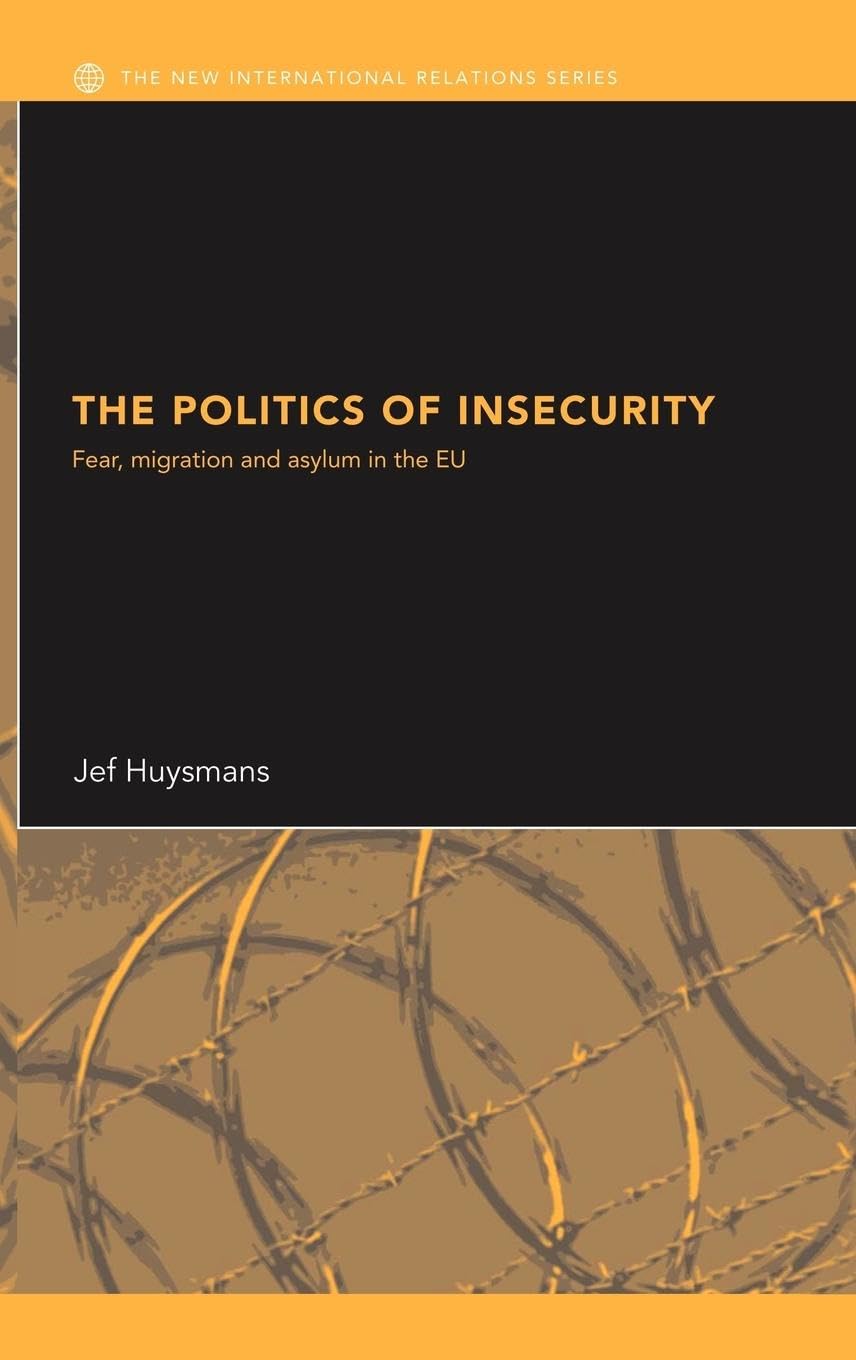
The Politics of Insecurity - Critical of Securitization Theory
The Politics of Insecurity - Critical of Securitization Theory
Price subject to change. Tap below for current.
Couldn't load pickup availability
In this review of The Politics of Insecurity, the reviewer argues this book is essential for readers who want a rigorous, theory-driven account of how security agendas form. Jef Huysmans offers a clear conceptual framework showing that security policies are not sudden responses but grow out of a continuous process pre-structured by earlier developments. The book is best for students, scholars and policy analysts seeking a critical, academic examination of securitization rather than a simple narrative of events.
Key Features
- Historical context: Traces how the aftermath of 9/11 reshaped the global security agenda, helping readers understand contemporary policy shifts.
- Theoretical framework: Develops a conceptual approach to study security that clarifies how issues become framed as security problems.
- Focus on fear and administration: Explores how the distribution and administration of fear contribute to the emergence of security policy.
- Process-oriented analysis: Argues that securitization is continuous and pre-structured, which aids interpretation of policy trajectories.
- Applied examples: Applies the theory to concrete cases, illustrating how abstract concepts operate in practice.
Who It's For
The book is aimed at graduate students, researchers and policymakers who need a deep, critical account of how security issues are socially and politically constructed. It works well for readers who appreciate careful conceptual work and want to connect theory to post-9/11 policy developments.
Those seeking a concise primer, a practitioner's handbook, or a journalistic overview of events may find the book dense; readers wanting step-by-step policy guidance should look elsewhere. This is primarily an academic, theory-focused volume.
Pros & Cons
Pros
- Provides a rigorous and coherent conceptual framework that advances understanding of security studies.
- Links theory to real-world changes after 9/11, making abstract ideas tangible for readers.
- Emphasizes the role of fear and administration, offering a nuanced lens on policy formation.
Cons
- Dense academic style may be challenging for casual readers or those new to international relations.
Specifications
| Title | The Politics of Insecurity |
| Series | New International Relations |
| Author | Jef Huysmans |
| Primary themes | Securitization, fear, security policy |
| Focus period | Post-9/11 global security agenda |
| Intended audience | Students, scholars, policy analysts |
Our Verdict
The Politics of Insecurity is a valuable academic contribution for anyone studying how security becomes constituted as policy. Its careful theoretical framework and applied examples make it a good investment for graduate students and researchers seeking depth, though readers wanting lighter or more practical guidance should prepare for dense, scholarly prose.
Frequently Asked Questions
Does the book explain the impact of 9/11?
Yes, it examines how the act of violence on 9/11 reshaped the global security agenda and elevated terrorism as a policy priority.
Is this a practical policy guide?
No, the volume is primarily theoretical and intended for academic study rather than step-by-step policy advice.
Who would benefit most from reading it?
Graduate students, researchers and analysts of international relations and security studies will gain the most from its conceptual depth.
Editor's Take
The Politics of Insecurity is a strong academic work that explains how security agendas form through continuous processes of securitization, making it valuable for graduate students and researchers despite its dense scholarly style.

Recently viewed
Recently viewed products will appear here as customers browse the store.