

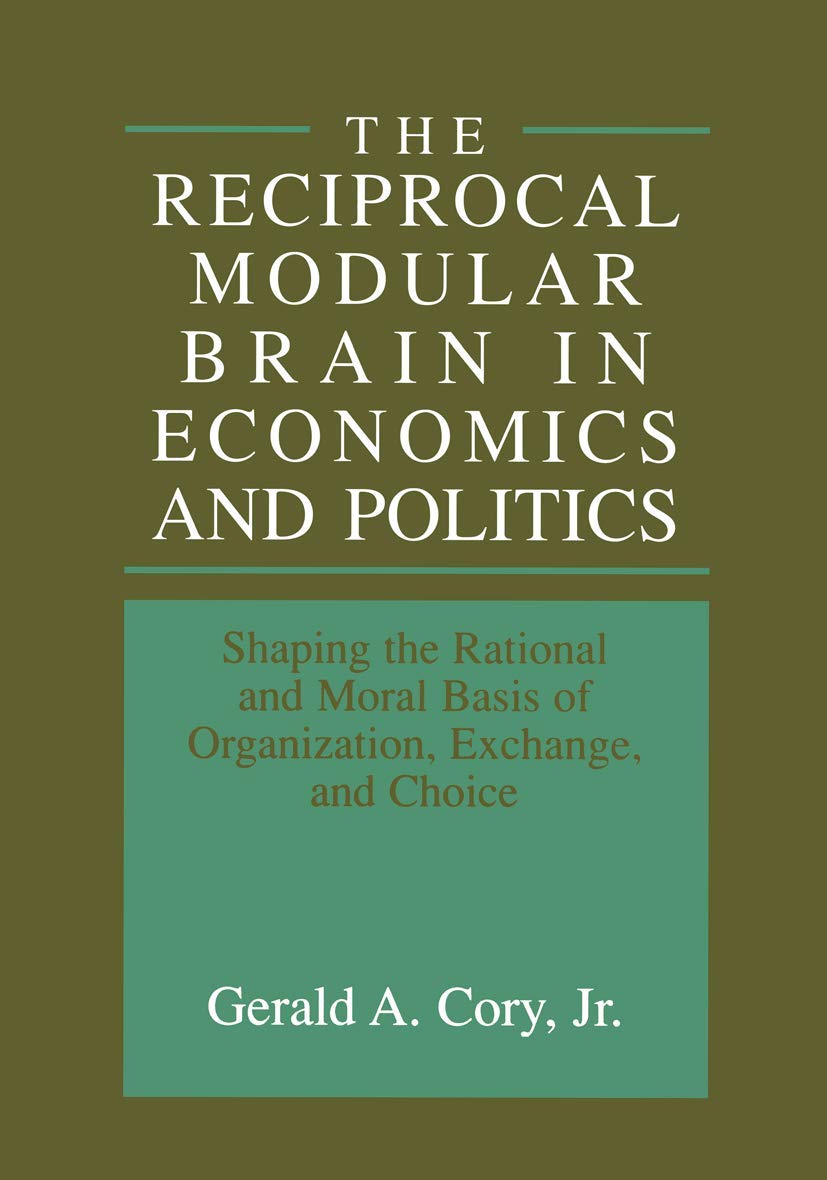
The Reciprocal Modular Brain in Economics and Politics
The Reciprocal Modular Brain in Economics and Politics
Price subject to change. Tap below for current.
Couldn't load pickup availability
In this review of The Reciprocal Modular Brain in Economics and Politics, the reviewer finds a thoughtful, academic extension of a Stanford doctoral thesis that will most appeal to readers interested in the intersection of behavior, neuroscience, and social organization. The single biggest reason to buy is the book's consistent effort to bridge disciplines: it proceeds from a behavioral ecology perspective and argues for consilience between the social and natural sciences, offering a distinctive lens on how interpersonal behavior shapes organization, exchange, and choice.
Key Features
- Consilient approach: The book deliberately attempts to unite the social and natural sciences, offering readers a framework for interdisciplinary analysis.
- Behavioral ecology perspective: It situates human choice and organization within a subfield the author calls interpersonal behavioral ecology, helping readers see social behavior in an ecological context.
- Academic origins: Built as an extension of a Stanford doctoral thesis, the work retains a scholarly rigor useful to researchers and advanced students.
- Thematic focus: The text concentrates on the rational and moral bases of organization, exchange, and choice, clarifying theoretical links between economics and politics.
- Historical continuity: It connects contemporary concerns about resource limits and ecology to interpersonal social dynamics, giving historical and conceptual depth to its arguments.
Who It's For
This book is best for graduate students, academics, and professionals in economics, political theory, neuroscience, and behavioral ecology who want a serious, theory-driven treatment of how individual behavior informs social institutions. Readers seeking interdisciplinary synthesis and an argument for consilience will find the author's perspective rewarding.
Those looking for a how-to policy primer, light popular science, or an introduction to behavioral ecology for general audiences should look elsewhere, as the work is rooted in doctoral-level scholarship and assumes familiarity with academic discourse.
Pros & Cons
Pros
- Offers a coherent case for integrating social and natural science perspectives through interpersonal behavioral ecology.
- Retains scholarly rigor from its origins as a Stanford doctoral thesis, which benefits researchers and advanced students.
- Connects ecological concerns about limited resources to social organization and moral choice, enriching debates across disciplines.
Cons
- Its academic tone and depth may be demanding for casual readers or those without background in related fields.
Specifications
| Title | The Reciprocal Modular Brain in Economics and Politics |
| Author | Gerald A. Cory Jr. |
| Origin | Extension of a Stanford doctoral thesis from the early 1970s |
| Perspective | Behavioral ecology (interpersonal behavioral ecology) |
| Focus | Rational and moral basis of organization, exchange, and choice |
| Intended audience | Graduate students, academics, and interdisciplinary researchers |
Our Verdict
The Reciprocal Modular Brain in Economics and Politics is a valuable scholarly contribution for readers seeking an interdisciplinary, theory-driven argument for uniting social and natural sciences. Its depth and rigor make it good value for graduate students and researchers who want a conceptual framework linking behavior, ecology, and institutional analysis.
Frequently Asked Questions
Does this book originate from academic research?
Yes, it extends the author's Stanford doctoral thesis from the early 1970s and maintains an academic approach.
What perspective does the book use?
The work proceeds from a behavioral ecology perspective, specifically labeled interpersonal behavioral ecology, to analyze social organization and choice.
Who will benefit most from reading it?
Graduate students, academics, and researchers interested in interdisciplinary connections between economics, politics, and behavioral science will gain the most.
Editor's Take
A rigorous, interdisciplinary work extending a Stanford thesis that offers a valuable framework for researchers and graduate students seeking to connect behavioral ecology with economics and political organization.

Recently viewed
Recently viewed products will appear here as customers browse the store.