

Theory of One: A New Theoretical Framework within GKH
Theory of One: A New Theoretical Framework within GKH
Price subject to change. Tap below for current.
Couldn't load pickup availability
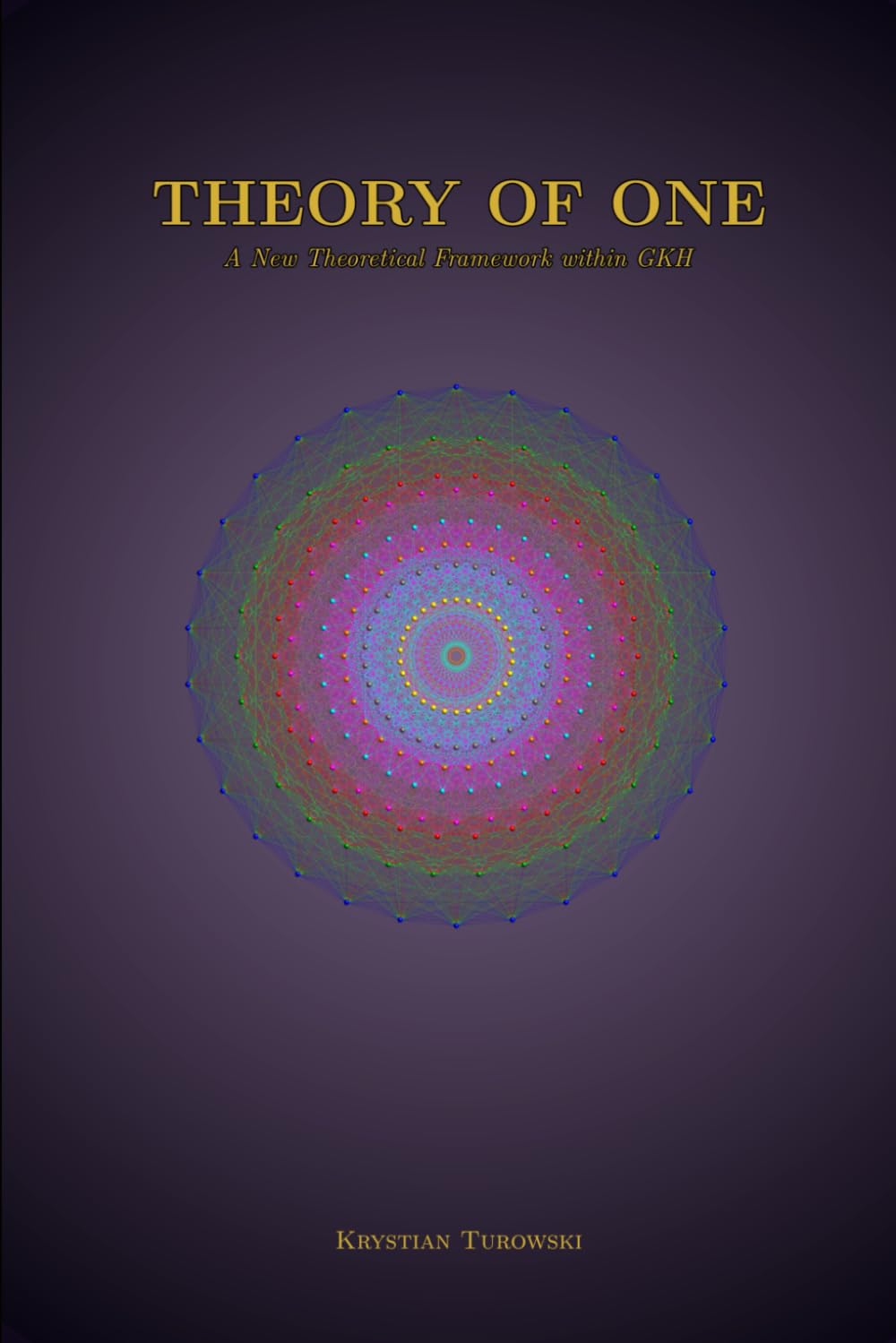
In this review of Theory of One: A New Theoretical Framework within the Golden K Hypothesis the bottom line is clear: this is a dense, original theoretical physics book for readers who want a unified, pregeometric account of reality. Krystian Turowski presents a single organizing idea - the Phason Field on a quasicrystalline E8 projection - and shows how familiar phenomena like gravity and quantum behavior can emerge. The book rewards patient, mathematically inclined readers who seek a conceptual synthesis rather than a textbook of worked exercises.
Key Features
- Unified premise: Presents a single complex scalar field, the Phason Field, as the pregeometric source from which spacetime and particles emerge, offering a coherent starting point for a broad theoretical program.
- Three core axioms: Develops Discrete Scale Symmetry, Primacy of a Golden Length, and a fractal-oscillatory spacetime to ground the framework and guide derivations.
- Gravity and quantum link: Argues gravity and quantum mechanics are complementary faces of the same entity, clarifying conceptual tensions between amplitude-based gravity and phase-based quantumness.
- Dynamic Causality: Introduces a variable-order fractional derivative that makes physical law state-dependent and participatory, which reframes causation as dynamical rather than fixed.
- Pregeometric approach: Builds the model on a quasicrystalline projection of the E8 lattice to derive structure and constants from a deeper mathematical substrate.
Who It's For
Theory of One is best suited to researchers, advanced students, and intellectually curious readers who are comfortable with abstract mathematics and open to speculative, unifying frameworks. Those working at the intersection of mathematical physics, quantum foundations, and cosmology will find the axiomatic approach and the E8 quasicrystal construction particularly interesting.
Readers seeking a conventional textbook, step-by-step calculations for standard problems, or a survey of experimental results should look elsewhere; the book emphasizes a conceptual and theoretical synthesis rather than pedagogical derivations or experimental protocols.
Pros & Cons
Pros
- Ambitious unification: offers a single, conceptually tight starting point that ties spacetime, particles, and constants to one field.
- Fresh axioms: the Golden Length and Discrete Scale Symmetry provide novel constraints that guide the theory in nontrivial ways.
- Conceptual clarity on gravity vs quantum: framing amplitude and phase as complementary helps reframe foundational debates.
Cons
- High barrier to entry: the material is abstract and demanding, limiting accessibility to nontechnical readers.
- Generally theoretical: the emphasis on a pregeometric framework leaves fewer concrete, empirical predictions in a conventional form.
Specifications
| Title | Theory of One: A New Theoretical Framework within the Golden K Hypothesis |
| Author | Krystian Turowski |
| Core object | Phason Field (complex scalar field on E8 quasicrystalline projection) |
| Core axioms | Discrete Scale Symmetry; Primacy of a Golden Length; fractal-oscillatory spacetime |
| Key mechanism | Variable-order fractional derivative (Dynamic Causality) |
| Theoretical goal | Unify gravity and quantum mechanics as amplitude and phase aspects |
Our Verdict
Theory of One is a thought-provoking, mathematically driven contribution to foundational physics that will repay careful study by specialists and committed readers. It is good value for anyone seeking a bold, unified conceptual framework; however, those wanting practical problem-solving guidance or accessible exposition should consider more conventional introductions first.
Frequently Asked Questions
Does the book provide experimental predictions?
The book focuses on conceptual unification and mathematical structure; it emphasizes framework development over detailed experimental protocols.
Is prior knowledge required?
Yes, familiarity with advanced theoretical concepts and comfort with abstract mathematics will make the material much more accessible.
How does it treat gravity and quantum mechanics?
It presents them as two aspects of the Phason Field: amplitude for gravity and phase for quantum behavior, linked through the framework's axioms.
Editor's Take
Theory of One is a thought-provoking, mathematically driven work that offers a bold, unified framework linking spacetime and quantum behavior; it is best for specialists and committed readers who welcome abstract, axiomatic approaches.

Recently viewed
Recently viewed products will appear here as customers browse the store.