

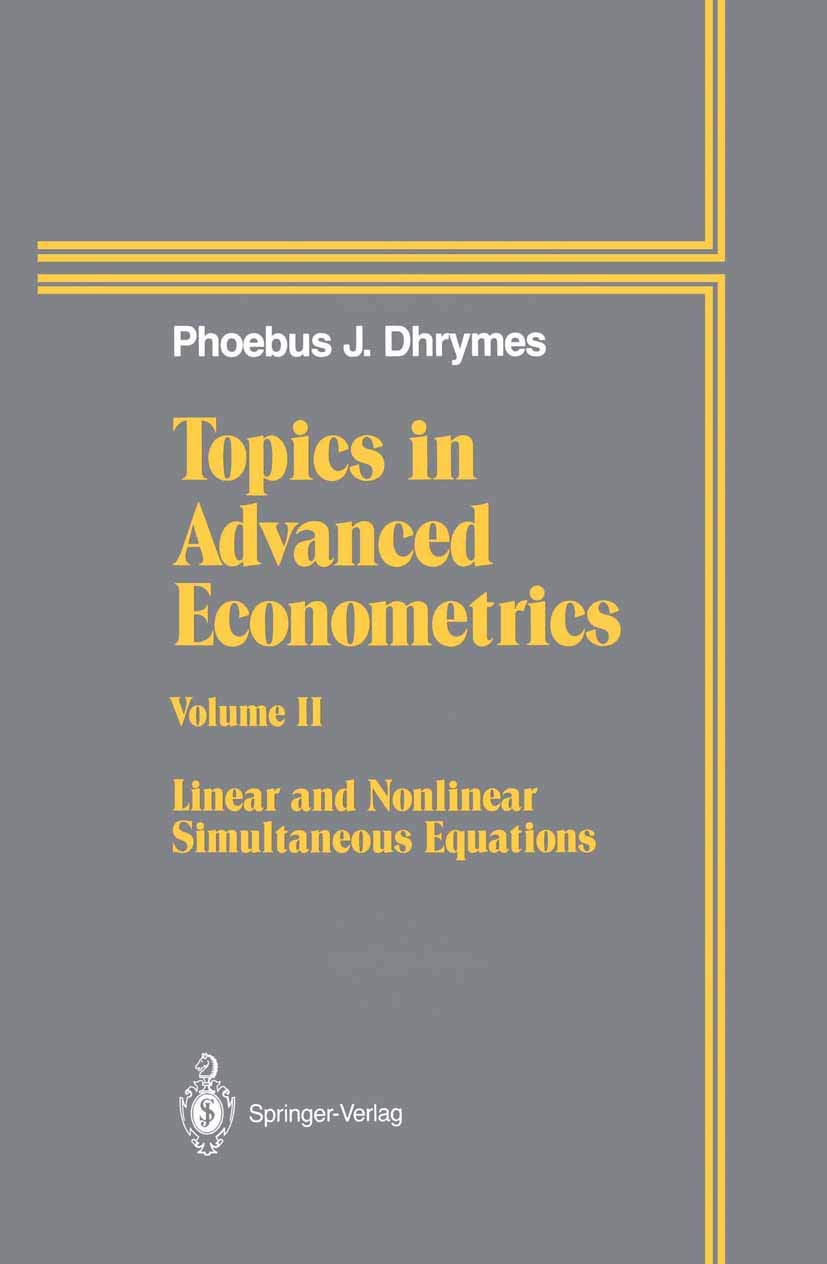
Topics In Advanced Econometrics Volume II: Linear and Nonlinear
Topics In Advanced Econometrics Volume II: Linear and Nonlinear
Price subject to change. Tap below for current.
Couldn't load pickup availability
In this review of Topics In Advanced Econometrics: Volume II, the bottom line is clear: this book is a rigorous, graduate-level resource for those focused on systems of equations beyond the general linear model. It is written principally for second year graduate students and professionals and delivers a detailed pathway from the general linear structural econometric model to the generalized method of moments. The book's greatest strength is its systematic treatment of identification, likelihood and estimation techniques for both linear and nonlinear simultaneous equation systems, making it a valuable reference for researchers needing depth rather than an introductory overview.
Key Features
- Comprehensive scope: Traces econometrics beyond the GLM by moving through GLSEM to GMM, giving readers a coherent historical and methodological arc.
- Identification focus: Dedicated coverage of the identification problem provides the theoretical foundation needed to understand when systems can be estimated consistently.
- Estimation methods: Detailed discussion of ML, 2SLS and 3SLS explains practical estimation choices for linear simultaneous equation models.
- Nonlinear systems: Treats the general nonlinear model, GNLSEM and special cases with additive errors, preparing readers for nonlinearity in applied work.
- Advanced estimators: Presents NL2SLS, NL3SLS and the GMM for GNLSEM, useful for applied researchers working with endogenous nonlinear systems.
Who It's For
The primary audience is second year graduate students in economics and econometrics, and professional researchers who require a deep, methodical treatment of simultaneous equations techniques beyond introductory texts. It is best for readers who already have familiarity with the general linear model and want to extend that foundation to structural and nonlinear systems.
Practitioners seeking quick applied recipes or beginners without prior exposure to the GLM may find the presentation dense; those readers should consider a more introductory econometrics text before approaching this volume.
Pros & Cons
Pros
- Thorough linkage from GLSEM to GMM offers a clear methodological trajectory for advanced study.
- Explicit coverage of identification and ML methods helps clarify theoretical prerequisites for estimation.
- Includes both linear (2SLS, 3SLS) and nonlinear (NL2SLS, NL3SLS) estimators, which is useful for applied research dealing with endogeneity.
- Focused chapters on GNLSEM and additive-error cases make the nonlinear material accessible to technically prepared readers.
Cons
- Material is technical and assumes graduate-level prerequisites, so it is not suitable as an introductory text.
- There is limited emphasis on software implementation or step-by-step applied examples for practitioners.
Specifications
| Title | Topics In Advanced Econometrics: Volume II |
| Subject | Linear and Nonlinear Simultaneous Equations |
| Intended audience | Second year graduate students and professionals |
| Main methods covered | Identification, ML, 2SLS, 3SLS, NL2SLS, NL3SLS |
| Nonlinear focus | General nonlinear model and GNLSEM, including additive-error cases |
| Advanced estimator | Generalized Method of Moments (GMM) |
Our Verdict
Topics In Advanced Econometrics: Volume II is a strong, methodical reference for graduate students and researchers who need rigorous coverage of simultaneous equation systems and their estimation. It provides valuable theoretical depth from identification to GMM and is good value for those who require a comprehensive technical treatment, though novices should prepare with earlier econometrics coursework.
Frequently Asked Questions
Is this book suitable for undergraduates?
No. The text is designed for second year graduate students and professionals and assumes prior exposure to the general linear model.
Does the book cover nonlinear estimation techniques?
Yes. It addresses the general nonlinear model, GNLSEM, NL2SLS, NL3SLS and the application of GMM to nonlinear systems.
Will I find practical software code or step-by-step applied examples?
The emphasis is theoretical and methodological; readers looking for detailed software implementation may need to supplement with applied resources.
Editor's Take
This volume offers rigorous, graduate-level coverage of simultaneous equation systems from identification through GMM, making it an excellent reference for researchers and second year graduate students who need theoretical depth.

Recently viewed
Recently viewed products will appear here as customers browse the store.