

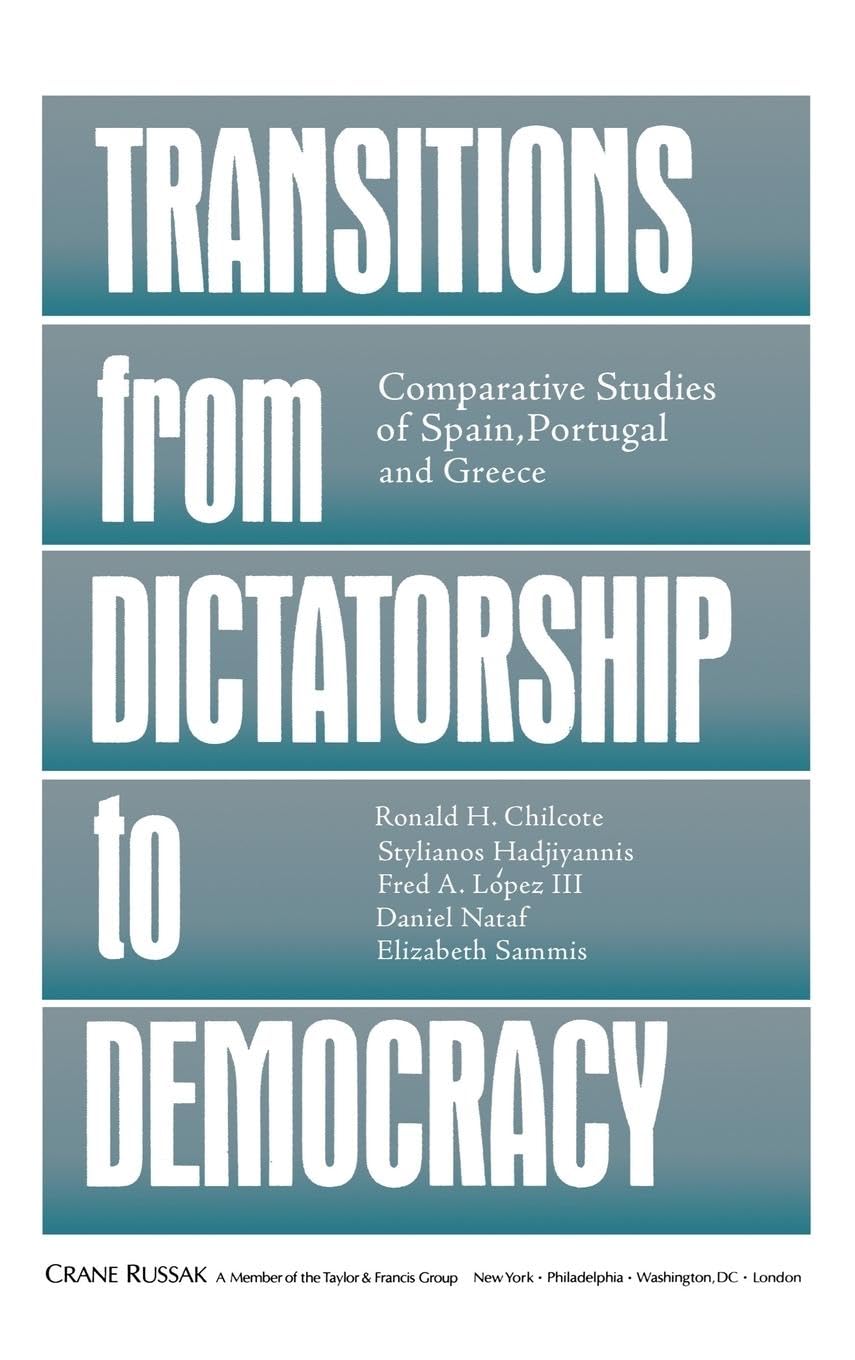
Transitions From Dictatorship To Democracy: Comparative Studies
Transitions From Dictatorship To Democracy: Comparative Studies
Price subject to change. Tap below for current.
Couldn't load pickup availability
In this review of Transitions From Dictatorship To Democracy: Comparative Studies Of Spain, Portugal And Greece, the book is recommended for readers seeking a retrospective, theoretically informed analysis of southern European transitions in the 1970s. The volume revisits Nicos Poulantzas's influential Crisis of the Dictatorships and gathers essays that probe the role of the state and social classes in the overthrow of authoritarian regimes. Its single biggest selling point is the combination of historical case studies with sustained theoretical reflection, making it useful for scholars and advanced students focused on comparative democratization.
Key Features
- Historical comparison: Offers side-by-side examinations of Spain, Portugal and Greece that clarify similarities and differences in their 1974-1975 transitions.
- Theoretical engagement: Revisits Poulantzas's original arguments and situates them in later debates about class, the state and democratization.
- Retrospective essays: Contributors provide hindsight assessments that connect the mid-1970s transformations to contemporary political developments.
- Focus on institutions: Examines the evolution of representative democracy and political parties as central mechanisms of transition.
- Class and state analysis: Pays particular attention to the roles played by social classes and state structures in overthrowing dictatorships.
Who It's For
This book is best for graduate students, researchers and readers with prior knowledge of European politics who want a comparative, theory-minded account of how Spain, Portugal and Greece moved from authoritarian regimes to representative government. It suits courses on democratization, comparative politics and leftist theory.
Readers seeking a general-audience narrative history or a richly illustrated popular account may prefer a different title, since this volume is scholarly in tone and assumes familiarity with political theory and historical context.
Pros & Cons
Pros
- Detailed comparative perspective helps clarify common patterns across three contemporaneous transitions.
- Theoretical reappraisal of Poulantzas gives readers a clear sense of continuing debates in political sociology.
- Retrospective essays connect the 1970s events to later institutional developments and party evolution.
Cons
- Scholarly tone and theoretical density may be challenging for casual readers without background in political science.
Specifications
| Title | Transitions From Dictatorship To Democracy: Comparative Studies Of Spain, Portugal And Greece |
| Editors/Contributors | Ronald H. Chilcote; Stylianos Hadjiyannis; Fred A. III Lopez; Daniel Nataf; Elizabeth Sammis |
| Original publication | First published in 1991 |
| Geographic focus | Spain, Portugal, Greece |
| Main themes | Role of the state, social classes, political parties, democratization |
| Approach | Comparative historical and theoretical essays |
Our Verdict
For readers with an academic interest in democratization, this collection is a valuable, cost-effective resource because it pairs concrete case studies with sustained theoretical discussion. Its focus on state structures and class dynamics makes it particularly useful for scholars tracing the political consequences of regime change in southern Europe.
Frequently Asked Questions
Is this book suitable for undergraduate courses?
Yes for upper-level undergraduates with background in comparative politics, though instructors should be prepared to guide students through the theoretical material.
Does the volume include primary documents from the 1970s?
The book emphasizes essays and analysis rather than collections of primary source documents.
Will this help with research on party development?
Yes, the essays explicitly address the evolution of representative democracy and political parties during and after the transitions.
Editor's Take
This scholarly collection is a strong choice for researchers and advanced students; it pairs comparative case studies of Spain, Portugal and Greece with sustained theoretical discussion of state and class roles in democratization.

Recently viewed
Recently viewed products will appear here as customers browse the store.