

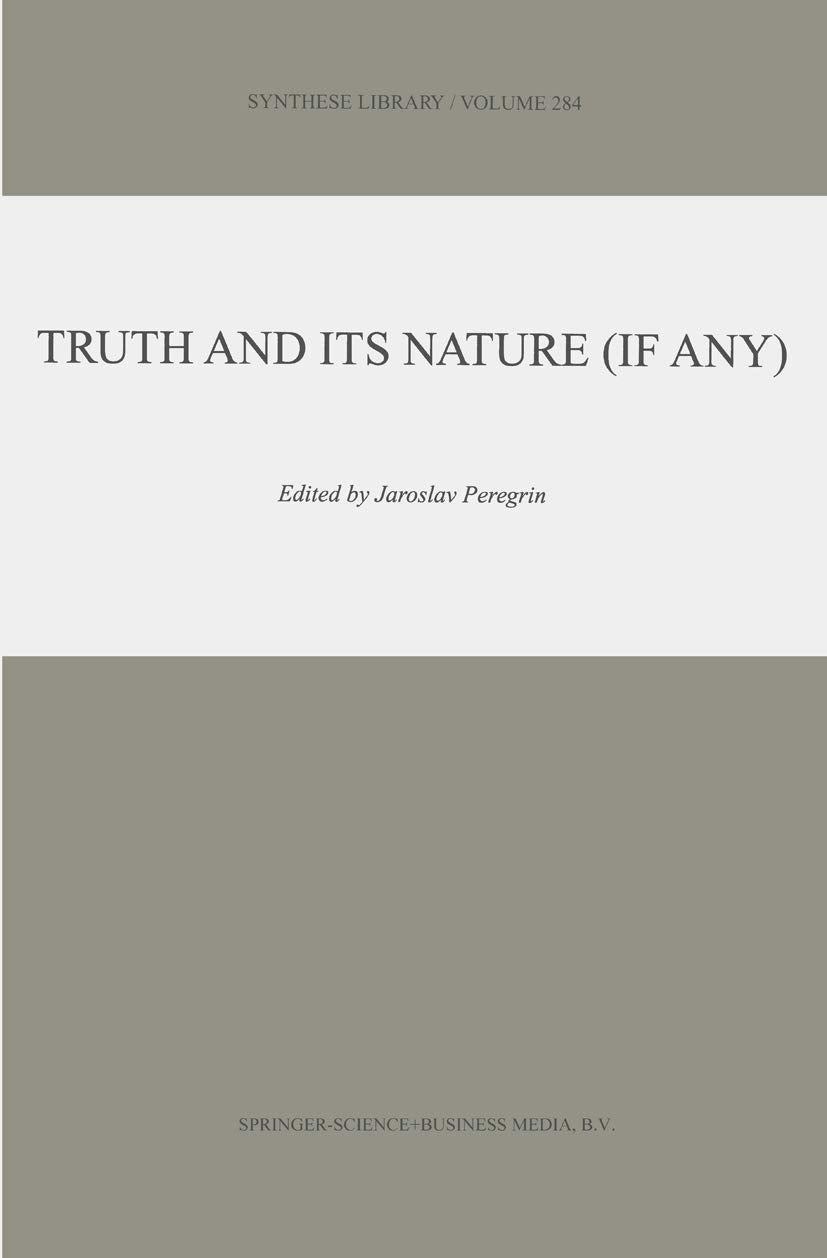
Truth and Its Nature (if Any) - concise philosophical
Truth and Its Nature (if Any) - concise philosophical
Price subject to change. Tap below for current.
Couldn't load pickup availability
In this review of Truth and Its Nature (if Any) the reviewer finds a focused, scholarly treatment aimed at readers who want a rigorous examination of the semantic problem of truth. The book is best for advanced students and researchers in philosophy of language and logic because it tackles Tarski's solution of satisfaction and the surprising claim that truth is in a precise sense ineffable. The single biggest reason to read it is its close engagement with the challenge of explicating truth and the limits of formal languages, presented in a concise, analytic style.
Key Features
- Focused inquiry: Concentrates on the core problem of turning implicit principles of truth into an explicit explication, making the central question clear and tractable.
- Engagement with Tarski: Explains Tarski's introduction of satisfaction in a way that connects the recursive definition to an explication of truth.
- Philosophical rigor: Presents arguments about ineffability and the limits of truth predicates with technical care, suitable for readers familiar with semantic theory.
- Concise presentation: The treatment avoids broad generalities and stays closely focused on the conceptual problem, saving reader time while preserving depth.
- Scholarly context: Situates the discussion within modern Western philosophy and the analytic tradition of semantics and logic.
Who It's For
This book is primarily for graduate students, professional philosophers, and logicians who already have some grounding in semantic theory and want a concentrated discussion of how satisfaction serves as a technical route to explicating truth. It rewards readers who appreciate careful argumentation over expansive historical narrative.
Those looking for an introductory, textbook-style overview of truth for general audiences or for a broad history of the concept should look elsewhere; this volume presumes familiarity with basic logical and semantic vocabulary and focuses on a specific analytic problem.
Pros & Cons
Pros
- Clear, focused analysis of the problem of explicating truth provides genuine conceptual clarity.
- Careful exposition of Tarski's satisfaction concept links formal recursion to philosophical explication.
- Concise treatment that respects the reader's time while maintaining technical precision.
Cons
- The book's narrow scope and technical tone make it less accessible to newcomers to philosophy of language.
Specifications
| Title | Truth and Its Nature (if Any) |
| Series | Synthese Library |
| Author | J. Peregrin |
| Subject | Philosophy of language and semantics |
| Focus | Explication of truth and Tarski's satisfaction |
| Geographic tradition | Western, Modern philosophy |
Our Verdict
Truth and Its Nature (if Any) is a valuable, tightly argued volume for readers who need a precise treatment of how satisfaction helps explicate truth and why truth shows a form of ineffability. It is good value for advanced students and scholars seeking a compact, conceptually rich discussion rather than a general survey.
Frequently Asked Questions
Does the book explain Tarski's approach?
Yes. It discusses Tarski's introduction of satisfaction and how that concept yields an explication of truth.
Is this suitable for beginners?
No. The book assumes background in logic and semantics and is aimed at advanced students and researchers.
Does it cover the history of truth theories?
It focuses on the analytic problem and Tarski's solution rather than a broad historical overview.
Editor's Take
A concise, tightly argued book that explains how Tarski's satisfaction yields an explication of truth and why truth can be seen as ineffable; excellent for advanced students and researchers in semantics.

Recently viewed
Recently viewed products will appear here as customers browse the store.