

Uncertainty Quantification: An Accelerated Course - Practical UQ
Uncertainty Quantification: An Accelerated Course - Practical UQ
Price subject to change. Tap below for current.
Couldn't load pickup availability
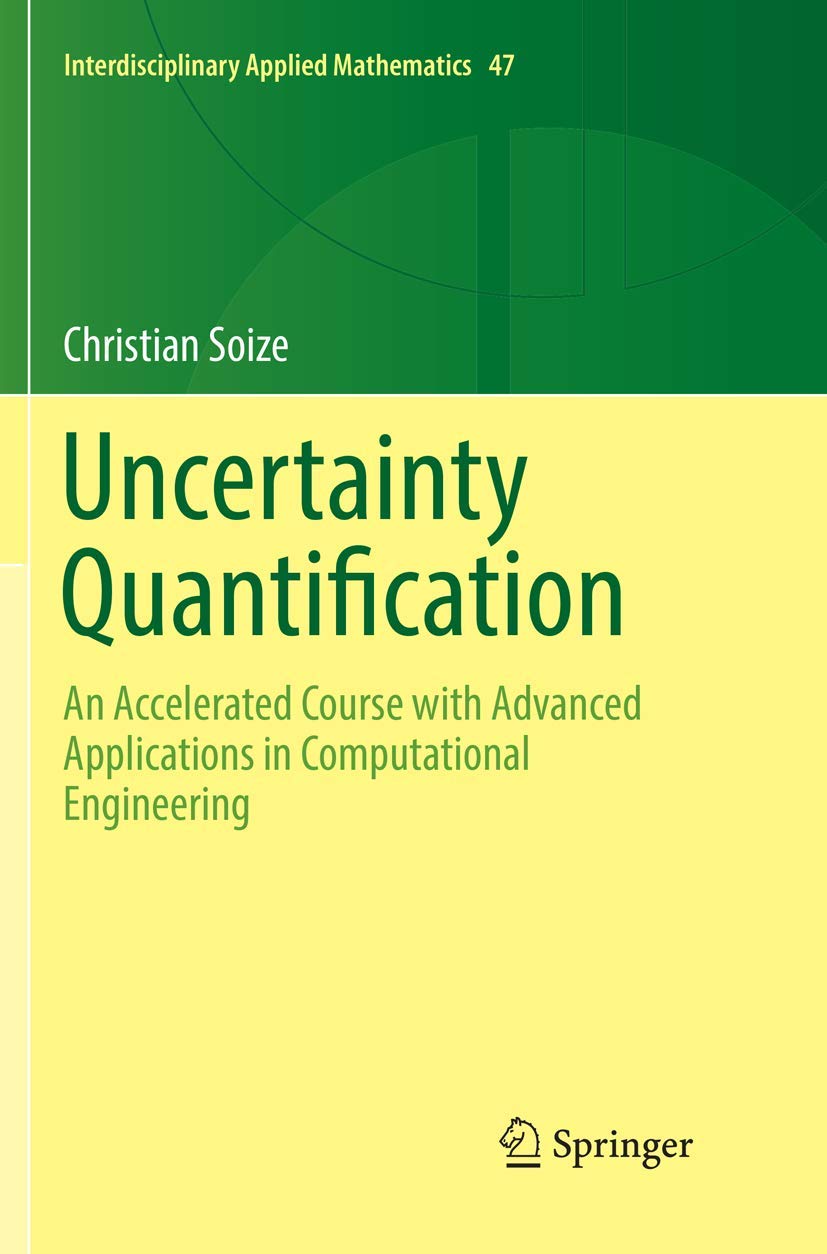
In this review of Uncertainty Quantification: An Accelerated Course the author delivers a focused, mathematically rigorous guide aimed at researchers and advanced practitioners who need practical tools for stochastic modeling. The book's single biggest reason to buy is its clear bridging of fundamental probability with advanced techniques for large-scale computational models; readers will find a course-derived structure that walks from basic statistical concepts to sophisticated methods for parametric and non-parametric uncertainties. This review examines how well the material supports applications in structural dynamics, vibroacoustics and multiscale mechanics.
Key Features
- Course-derived structure: Chapters progress logically from core probability and statistics to advanced uncertainty modeling, making learning sequential and coherent for self-study.
- Focus on parametric uncertainties: Practical descriptions show how to represent and propagate input parameter variability in large computational models used in engineering.
- Non-parametric approaches: The book explains methods for building stochastic models when data do not fit simple parametric families, useful for complex material behavior and heterogeneous systems.
- Applications in mechanics: Worked examples and discussion connect theory to structural dynamics, vibroacoustics and micromechanics, helping translate methods to real problems.
- Advanced mathematical tools: Detailed exposition of mathematical techniques supports readers who need rigorous foundations for implementation in computational engineering.
Who It's For
The book is best for graduate students, applied mathematicians and engineering researchers working on simulation-driven studies who already have a solid background in probability and numerical methods. It suits readers who want a compact, course-style treatment that links theory directly to applications in structural dynamics and heterogeneous materials.
Those looking for a beginner text with minimal mathematics or a purely software-focused how-to should look elsewhere; this volume assumes comfort with mathematical notation and is oriented to theoretical understanding as much as practical application.
Pros & Cons
Pros
- Well-structured course format that builds from fundamentals to advanced methods, aiding self-paced learning.
- Strong emphasis on both parametric and non-parametric uncertainty modeling, increasing its applicability across problem types.
- Concrete connections to structural dynamics, vibroacoustics and multiscale mechanics that help transfer methods to engineering practice.
Cons
- Not a beginner's primer; readers without a solid mathematical background may struggle with some derivations.
Specifications
| Title | Uncertainty Quantification: An Accelerated Course |
| Series | Interdisciplinary Applied Mathematics, 47 |
| Author | Christian Soize |
| Scope | Parametric and non-parametric stochastic modeling |
| Applications | Structural dynamics, vibroacoustics, micromechanics |
| Approach | Course-derived with theoretical foundations and applied examples |
Our Verdict
For advanced students and engineering researchers, this book is a concise, high-value reference that blends probability fundamentals with practical stochastic modeling techniques for large-scale computational problems. Its course-like progression and focus on mechanical applications make it particularly useful for those tackling uncertainty in structural dynamics and multiscale materials.
Frequently Asked Questions
Does this book require strong math background?
Yes. It assumes familiarity with probability, statistics and mathematical notation typical of graduate-level applied mathematics.
Are practical examples included?
Yes. The text links methods to applications in structural dynamics, vibroacoustics and micromechanics to illustrate real-world use.
Is software or code provided?
The book focuses on mathematical tools and modeling approaches rather than packaged software or step-by-step code examples.
Editor's Take
A concise, course-style reference for advanced students and researchers that ties probability fundamentals to practical stochastic modeling for structural dynamics and multiscale materials, offering strong value for those with a solid mathematical background.

Recently viewed
Recently viewed products will appear here as customers browse the store.