

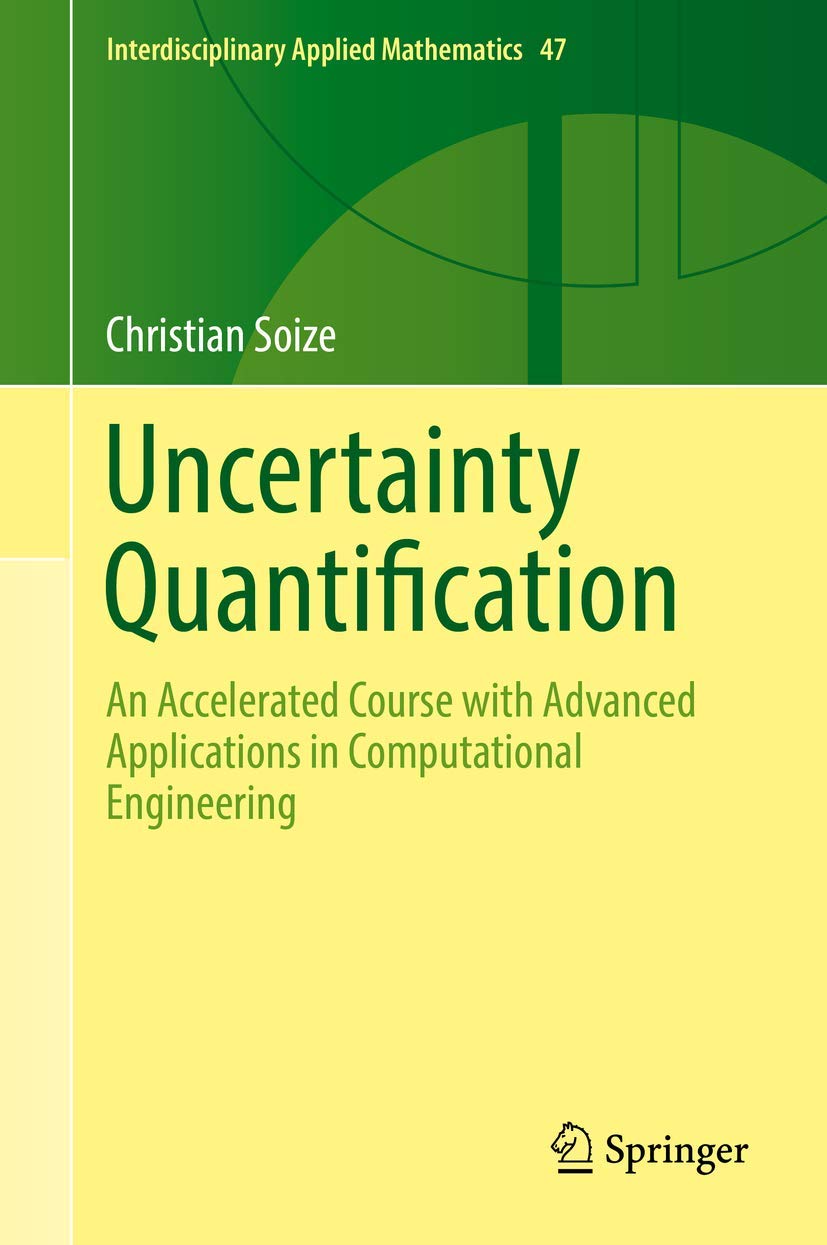
Uncertainty Quantification (Interdisciplinary Applied Mathematics, 47)
Uncertainty Quantification (Interdisciplinary Applied Mathematics, 47)
Price subject to change. Tap below for current.
Couldn't load pickup availability
In this review of Uncertainty Quantification (Interdisciplinary Applied Mathematics, 47) the author presents a focused, mathematically rigorous treatment of stochastic modeling for large-scale computational models. The bottom line: this book is best for graduate students, researchers and practicing engineers who need a thorough foundation in probabilistic tools and practical methods for both parametric and non-parametric uncertainties. It stands out for combining probability basics with advanced construction of stochastic models tied to applications in structural dynamics, vibroacoustics and multiscale mechanics.
Key Features
- Comprehensive foundations: The book begins with probability and statistics fundamentals that are directly useful for applied uncertainty quantification, giving readers a clear starting point before moving to advanced topics.
- Parametric uncertainty focus: It explains methods for representing and propagating parametric uncertainties through large-scale computational models, useful for simulation-driven engineering decisions.
- Non-parametric approaches: The text covers non-parametric uncertainties and practical modeling strategies that do not rely on fixed distributional assumptions, which helps when data are limited or heterogeneous.
- Application-driven examples: Examples draw from structural dynamics, vibroacoustics and micromechanics, showing how theoretical tools apply to complex mechanical systems and heterogeneous materials.
- Course-derived structure: Resulting from a course developed by the author, the book is organized to support progressive learning from basic tools to advanced stochastic model construction.
Who It's For
Graduate students and researchers in applied mathematics, mechanical engineering, or computational science who need a rigorous treatment of uncertainty quantification will find the material directly relevant to coursework and thesis-level work. Practitioners developing or validating large-scale simulation models in structural dynamics or vibroacoustics will value the applied examples.
Who should look elsewhere: Readers seeking a light introduction, intuitive-only explanations, or hands-on coding tutorials for specific software packages may find this book too theoretical; those needs are better met by shorter primers or application-specific manuals focused on implementation details.
Pros & Cons
Pros
- Clear linkage between probability/statistics foundations and applied uncertainty quantification techniques that aid understanding of model behavior.
- Balanced treatment of both parametric and non-parametric uncertainty modeling useful across several engineering domains.
- Relevant applications in structural dynamics, vibroacoustics and multiscale mechanics that demonstrate practical use of theoretical methods.
Cons
- The presentation is mathematically advanced and may be challenging for readers without prior graduate-level exposure to probability and applied mathematics.
- There is limited emphasis on software implementation or step-by-step computational recipes for practitioners seeking immediate code examples.
Specifications
| Title | Uncertainty Quantification (Interdisciplinary Applied Mathematics, 47) |
| Author / Editor | Soize |
| Subject Area | Stochastic modeling, probability and statistics for engineering |
| Primary Applications | Structural dynamics, vibroacoustics, micromechanics, multiscale mechanics |
| Approach | Parametric and non-parametric uncertainty modeling for large-scale computational models |
| Origin | Based on a course developed by the author |
Our Verdict
For readers who need a rigorous, application-aware reference on uncertainty quantification, this volume is a strong value: it ties foundational probability to advanced stochastic modeling with examples from mechanics and engineering. Those wanting implementation-first resources should supplement it with code-oriented texts, but for theoretical depth and applied perspective this book is a recommended pick.
Frequently Asked Questions
Is this book suitable for practicing engineers without a math background?
It is written at a graduate level and assumes comfort with probability and applied mathematics; practicing engineers with solid mathematical training will benefit most.
Does the book include applied examples?
Yes, it includes applications in structural dynamics, vibroacoustics and micromechanics to illustrate how stochastic models are used with large-scale computational models.
Will I find software tutorials or code in the text?
The focus is on mathematical tools and model construction rather than step-by-step software tutorials, so readers should seek complementary implementation guides if they need code examples.
Editor's Take
A rigorous, application-aware reference that links probability foundations to advanced stochastic modeling for large-scale computational models; best for graduate students, researchers and mathematically prepared practitioners.

Recently viewed
Recently viewed products will appear here as customers browse the store.