

Unsteady Transonic Flow - Analytical Monograph for Aeroelastic Study
Unsteady Transonic Flow - Analytical Monograph for Aeroelastic Study
Price subject to change. Tap below for current.
Couldn't load pickup availability
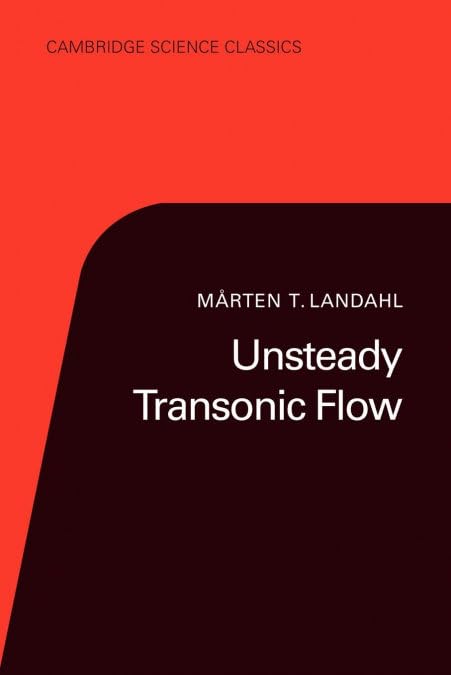
In this review of Unsteady Transonic Flow readers will find a focused, academically oriented treatment of how thin oscillating wings behave near the speed of sound; the book's single biggest reason to buy is its rigorous, analytical approach to predicting flutter and unsteady lift when shocks are present. Intended as a specialist monograph first published in 1961, this work emphasizes linearised theory and boundary-condition discussion rather than modern computational practice, making it most useful to students and engineers who need clear derivations and historical context for transonic aeroelastic problems.
Key Features
- Analytical focus: Presents step-by-step derivations for linearised unsteady lift distributions so readers can follow the theoretical development used for simple planforms.
- Transonic emphasis: Concentrates on the speed regime near Mach 1 where flutter and shocks become critical, offering targeted analysis for that regime.
- Planform examples: Treats rectangular and delta wings explicitly, which helps readers apply the methods to common simple geometries.
- Validity discussion: Gives a thorough account of the limitations of linearised theory so practitioners understand when the assumptions break down.
- Boundary conditions for shocks: Explains appropriate boundary conditions for flows with shocks, a detail often glossed over in shorter treatments.
Who It's For
The book is best for graduate students, researchers and practicing aerodynamicists who need a mathematically clear reference on unsteady lift at transonic speeds and an understanding of flutter prediction from a theoretical perspective. It is particularly useful for courses or projects that contrast analytical methods with modern numerical simulation.
Those looking for contemporary computational workflows, extensive numerical results, or a practitioner's manual with code and simulation recipes should look elsewhere; this monograph focuses on classical linear methods and conceptual rigor rather than turnkey computational tools.
Pros & Cons
Pros
- Clear analytical derivations that expose the assumptions behind linearised transonic theory.
- Focused treatment of rectangular and delta wing planforms makes the material directly applicable to simple model problems.
- Careful discussion of boundary conditions for shock-containing flows helps bridge theory and difficult physical cases.
Cons
- Published in 1961, the book does not cover modern direct numerical simulation approaches common in current engineering practice.
Specifications
| Title | Unsteady Transonic Flow (Cambridge Science Classics) |
| Author | Marten Landahl |
| First published | 1961 |
| Primary focus | Unsteady lift distributions and flutter prediction at transonic speeds |
| Theoretical approach | Linearised analytical methods |
| Example planforms | Rectangular and delta wings |
| Key topic | Boundary conditions for flows with shocks |
Our Verdict
Unsteady Transonic Flow remains a valuable, compact reference for anyone studying the foundations of aeroelasticity at speeds near sound because of its rigorous analytical treatment and explicit planform examples; it is good value for readers who need theoretical clarity, though engineers requiring modern simulation techniques should pair it with contemporary computational texts.
Frequently Asked Questions
Does this book cover numerical simulations for transonic flow?
No. The monograph emphasizes analytical, linearised theory and discusses limitations rather than presenting modern numerical simulation methods.
Which wing shapes are analyzed in the book?
The text treats simple planforms explicitly, including rectangular and delta wings, to illustrate the analytical approach.
Is the material still relevant for today's aeroelastic problems?
Yes for theoretical understanding and for problems where linearised assumptions apply; it should be supplemented by modern computational resources for practical design work.
Editor's Take
Unsteady Transonic Flow is a rigorous, analytically focused monograph valuable to students and researchers studying flutter and unsteady lift near Mach 1; it provides clear derivations and planform examples but lacks modern numerical simulation coverage.

Recently viewed
Recently viewed products will appear here as customers browse the store.