

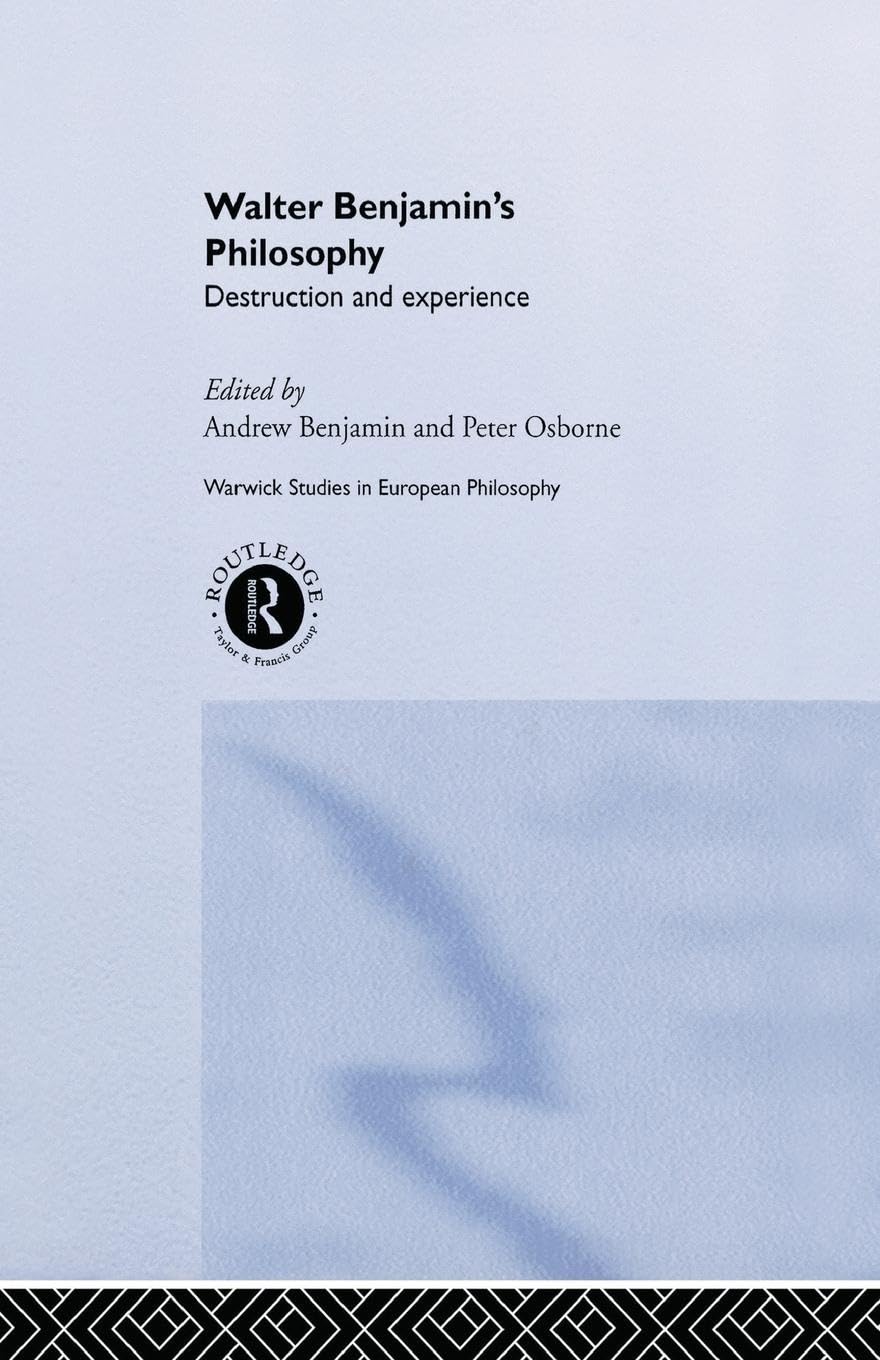
Walter Benjamin's Philosophy - Warwick Studies in European Philosophy
Walter Benjamin's Philosophy - Warwick Studies in European Philosophy
Price subject to change. Tap below for current.
Couldn't load pickup availability
In this review of Walter Benjamin's Philosophy (Warwick Studies in European Philosophy) the bottom line is clear: this is an incisive, scholarly collection best suited to readers seeking a rigorous, critical examination of Benjamin's work. The essays collected here map Benjamin's trajectory from early aesthetics and philosophy of language to his late thinking on history and time, offering a sustained interpretation that frames his work as, in Adorno's words, philosophy directed against philosophy. Anyone requiring close readings and conceptual context will find this volume rewarding.
Key Features
- Comprehensive coverage: The essays survey Benjamin's writings from his early art and language studies through his mature concept of history, providing a wide-angle view of his intellectual development.
- Focus on time and history: Contributors emphasize the experience of time and the destruction of false continuity, clarifying Benjamin's central historical themes for readers.
- Scholarly tone: The collection maintains an academic voice suitable for graduate study or advanced undergraduate courses in modern philosophy.
- Editorial framing: Editors place Benjamin in the context of European philosophy, helping readers see continuities and contrasts with contemporaries such as Adorno.
- Use for research: The essays provide close textual interpretation and conceptual argumentation valuable for further research or seminar preparation.
Who It's For
This volume is primarily for students, researchers, and readers already familiar with continental philosophy who want a concentrated set of essays on Benjamin's major themes, especially his account of history and the temporal experience. In particular, those studying critical theory, philosophy of history, or modern German thought will gain useful perspectives from the contributors' analyses.
Readers seeking an introductory or popular biography of Walter Benjamin should look elsewhere; the collection assumes some prior familiarity and emphasizes analytic and critical engagement rather than a chronological life narrative. It is also less suited to casual readers wanting light, generalist overviews.
Pros & Cons
Pros
- Provides a thorough scholarly overview of Benjamin's themes, especially time and history.
- Useful editorial framing situates Benjamin within European philosophical debates.
- Offers close readings that support advanced study and research tasks.
Cons
- The academic tone and depth make it less accessible to casual readers or newcomers to Benjamin.
Specifications
| Title | Walter Benjamin's Philosophy (Warwick Studies in European Philosophy) |
| Editors/Authors | Andrew Benjamin, Peter Osborne |
| Scope | Essays covering early work on art and language to concept of history |
| Key themes | Experience of time; destruction of false continuity; concept of history |
| Intended audience | Students and researchers in philosophy and critical theory |
| Academic approach | Scholarly essays with editorial framing in European philosophy |
Our Verdict
Walter Benjamin's Philosophy is a well-curated academic collection that rewards readers who want rigorous interpretive essays on Benjamin's art, language, and historical thought. It is good value for graduate students and scholars seeking depth and contextual analysis, though less appropriate as a beginner's introduction.
Frequently Asked Questions
Does this book cover Benjamin's concept of history?
Yes; the collection explicitly treats the concept of history and emphasizes the role of time and the critique of false continuity.
Is this volume suitable for beginners?
It is oriented toward readers with some prior background in continental philosophy and may be challenging as a first introduction.
Who edited the collection?
The volume is edited by Andrew Benjamin and Peter Osborne, who provide the editorial framing linking essays to European philosophy.
Editor's Take
A carefully edited collection that provides rigorous, scholarly essays on Benjamin's themes of time, history and aesthetics, making it valuable for graduate students and researchers though not for beginners.

Recently viewed
Recently viewed products will appear here as customers browse the store.