

Weak Chaos and Quasi-Regular Patterns - Rigorous Intro to Transitional
Weak Chaos and Quasi-Regular Patterns - Rigorous Intro to Transitional
Price subject to change. Tap below for current.
Couldn't load pickup availability
In this review of Weak Chaos and Quasi-Regular Patterns the reviewer finds a rigorous, methodical exposition aimed at readers who need a clear bridge between Hamiltonian dynamics and observable pattern formation. The book is best for advanced undergraduates, graduate students, and researchers seeking a focused treatment of transitional states that lie between deterministic motion and full chaos; the single biggest reason to buy is its systematic development of the theory of stochastic layers and webs alongside practical computational approaches that can be applied to related problems.
Key Features
- Foundations of Hamiltonian dynamics: Presents the core concepts of conservative systems so readers can follow how stability gives way to complex motion.
- Theory of stochastic layers and webs: Offers a stepwise, theoretical treatment of transitional structures that govern weak chaos, useful for modeling near-integrable systems.
- Computational methods explained: Details the numerical approaches and algorithms that allow readers to reproduce results and apply techniques to new problems.
- Applications to pattern symmetry: Connects theoretical results to pattern formation and symmetry questions, making the abstract ideas more tangible.
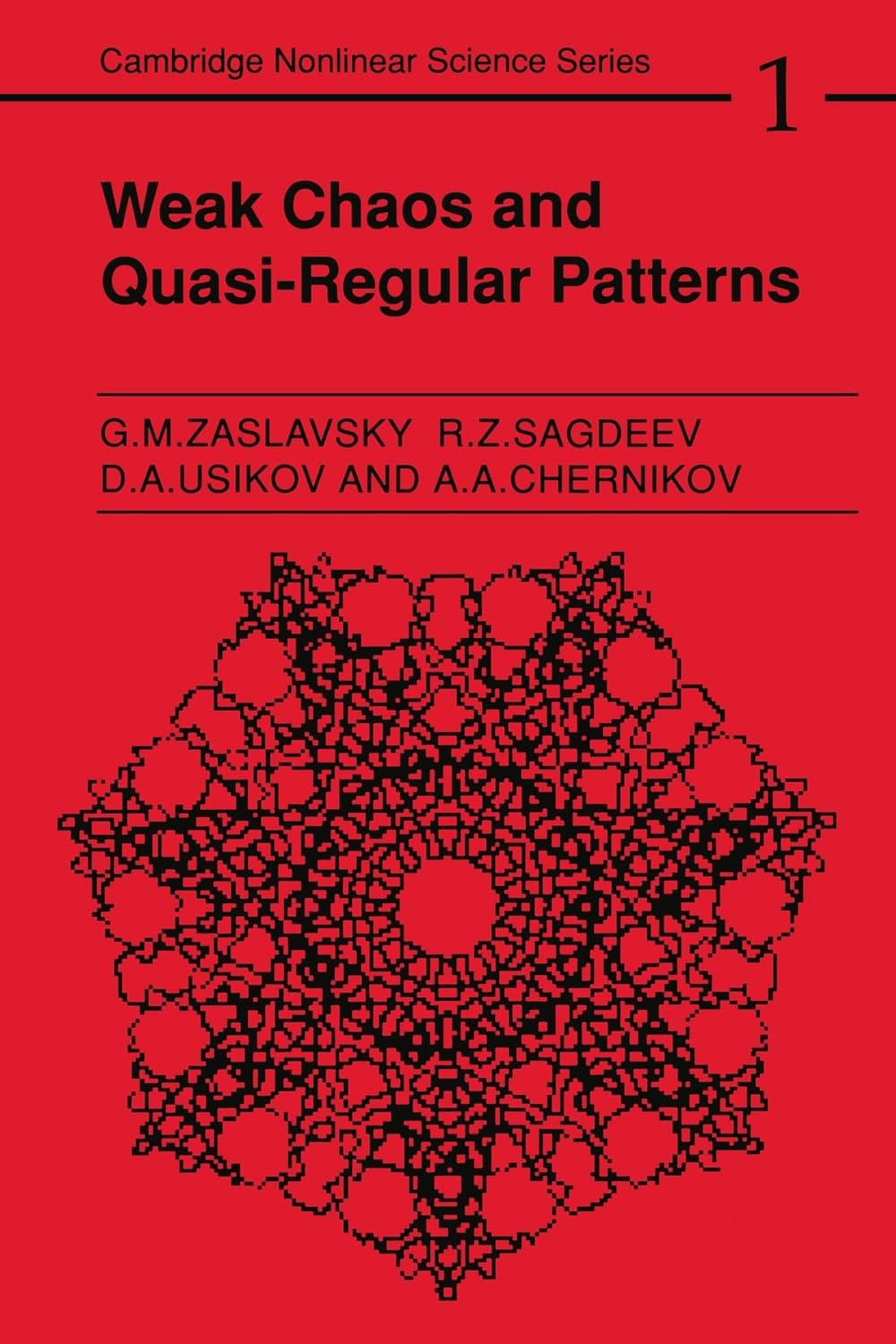
- Illustrative computer graphics: Includes visualizations that aid understanding of subtle dynamical behavior and the emergence of quasi-regular patterns.
- Collection of patterns: Ends with a curated set of patterns from art and nature that demonstrate the theory's reach into real-world motifs.
Who It's For
This book suits readers with a solid background in classical mechanics or dynamical systems who want a concentrated study of conservative chaos and transitional dynamics. It is particularly useful for graduate students, researchers in theoretical physics or applied mathematics, and practitioners who need computational methods tied to theory.
Readers looking for an elementary introduction to chaos, a casual popular-science survey, or a textbook packed with worked homework problems may want to look elsewhere; the book assumes mathematical maturity and focuses on exposition and methods rather than classroom-ready exercises.
Pros & Cons
Pros
- Careful, systematic presentation of transitional states helps build a coherent theoretical picture.
- Practical computational guidance lets motivated readers reproduce and extend results.
- Visual material and the final pattern collection connect abstract theory to concrete examples.
Cons
- The material assumes significant prior knowledge of Hamiltonian mechanics and is not intended as a gentle introduction.
Specifications
| Title | Weak Chaos and Quasi-Regular Patterns |
| Series | Cambridge Nonlinear Science Series, Series Number 1 |
| Authors / Editors | Georgin Moiseevich Zaslavskii, R. Z. Sagdeev, D. A. Usikov, A. A. Chernikov, A. R. Sagdeeva |
| Subject | Chaos in conservative systems; stochastic layers and pattern symmetry |
| Includes | Computational methods and computer graphics |
| Focus | Theory of transitional states between deterministic and chaotic behavior |
Our Verdict
Weak Chaos and Quasi-Regular Patterns is a strong, focused resource for mathematically inclined readers who need a rigorous account of transitional dynamics in conservative systems; its blend of theory, computational methods, and visual examples makes it excellent value for graduate students and researchers seeking tools to analyze near-integrable chaos and pattern symmetry.
Frequently Asked Questions
Does this book require prior coursework?
Yes. It assumes familiarity with Hamiltonian dynamics and advanced undergraduate or graduate-level mechanics.
Are there practical examples and visuals?
Yes. The text includes computer graphics and a final section with patterns drawn from art and nature to illustrate the concepts.
Is this suitable for a first course in chaos?
No. It is more appropriate as a deeper, specialized study rather than an introductory textbook.
Editor's Take
A rigorous, focused resource for graduate students and researchers interested in transitional dynamics of conservative systems; strong on theory, computational methods, and visual examples.

Recently viewed
Recently viewed products will appear here as customers browse the store.