

What Is Philosophy? - Concise Essays on Language and Thought
What Is Philosophy? - Concise Essays on Language and Thought
Price subject to change. Tap below for current.
Couldn't load pickup availability
Our review of What Is Philosophy? finds it most valuable for readers who want a compact, rigorous exploration of language in philosophical practice; Giorgio Agamben reframes the question of philosophy by dissecting the smallest elements of speech rather than arguing about philosophy as a whole. The book presents five tightly focused essays that function as a summa of Agamben's concerns, making it a rewarding read for those interested in the relation between voice, the sayable, and the conditions that make thought audible. This review explains why the book is strongest as an analytical, linguistic probe rather than a broad history.
Key Features
- Five focused essays: Each essay concentrates on a single emblematic topic so the reader can follow Agamben's methodic reconstructions without extraneous digressions.
- Attention to language: The book treats phonemes, letters, syllables, and words as primary philosophical objects, which illuminates how thought is bound to the conditions of speech.
- Methodological blend: Agamben combines archaeological and theoretical investigations to trace how concepts of language were invented and reworked.
- Concise summa: As a compact overview of recurring themes, the book gathers Agamben's concerns into a readable, essayistic form rather than a sprawling treatise.
- Emphasis on voice: By restoring thought to its place within the voice, the essays foreground embodiment and the act of saying over abstract propositions.
Who It's For
This book suits graduate students, scholars of continental philosophy, and attentive readers who appreciate dense, idea-driven essays that interrogate language at a granular level. Those working in phenomenology, philosophy of language, or literary theory will find the treatment of the Voice, the Sayable, and the Muse especially thought-provoking.
Readers seeking an introductory textbook, a systematic history of philosophy, or clear, pedagogical explanations should look elsewhere; the book assumes familiarity with continental methods and rewards careful, repeated reading rather than seeking to instruct novices in basic concepts.
Pros & Cons
Pros
- The focused essays allow deep engagement with the concept of language without unnecessary breadth.
- Agamben's archaeological approach offers original readings that reconnect voice and thought.
- The concentration on phonemes and syllables highlights often-overlooked foundations of philosophical discourse.
Cons
- The dense, essayistic style may feel elliptical to readers who prefer systematic exposition or introductory clarity.
Specifications
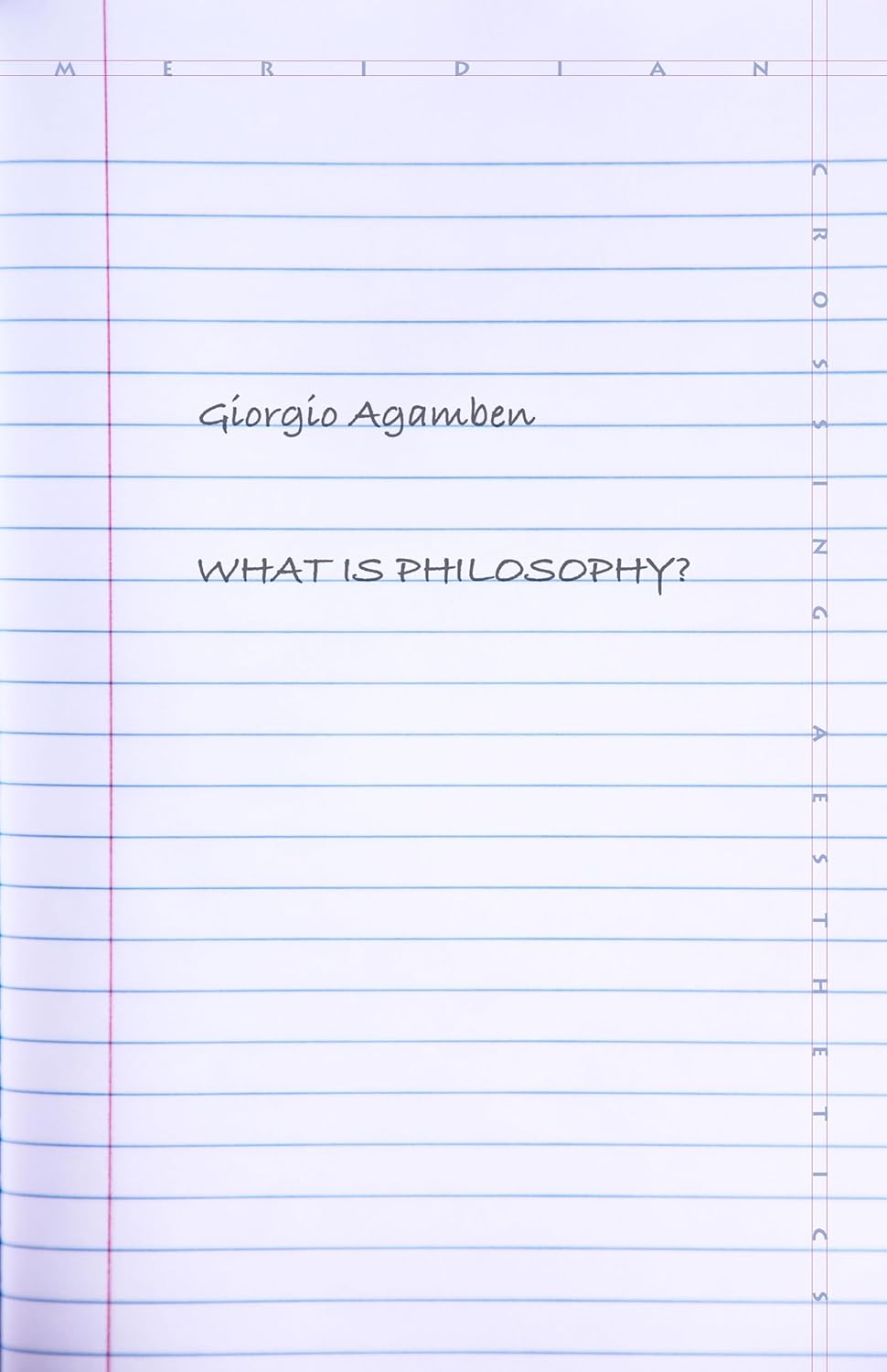
| Title | What Is Philosophy? (Meridian: Crossing Aesthetics) |
| Author | Giorgio Agamben |
| Content | Five essays on Voice, the Sayable, the Demand, the Proem, and the Muse |
| Approach | Archaeological and theoretical investigations of language |
| Focus | Phonemes, letters, syllables, words and the voice |
| Series | Meridian: Crossing Aesthetics |
Our Verdict
What Is Philosophy? is a compact, intellectually demanding collection that rewards readers who want a concentrated inquiry into how language shapes thought. It is good value for scholars and committed readers of continental philosophy because it gathers Agamben's recurrent concerns into five incisive essays that reconnect voice and meaning in a way few short books do.
Frequently Asked Questions
Does this book cover the history of philosophy?
Answer. No; it focuses on language and small units of speech rather than providing a broad historical survey.
How technical is the writing?
Answer. The style is dense and theory-driven, suitable for readers familiar with continental methods rather than beginners.
What are the main topics covered?
Answer. The book centers on the Voice, the Sayable, the Demand, the Proem, and the Muse through archaeological and theoretical readings.
Editor's Take
What Is Philosophy? is a compact, intellectually demanding set of five essays that reward readers who want a concentrated inquiry into how language shapes thought; it is especially valuable for scholars and committed readers of continental philosophy.

Recently viewed
Recently viewed products will appear here as customers browse the store.